Showing posts with label Black Fiction. Show all posts

Monday, January 31, 2022

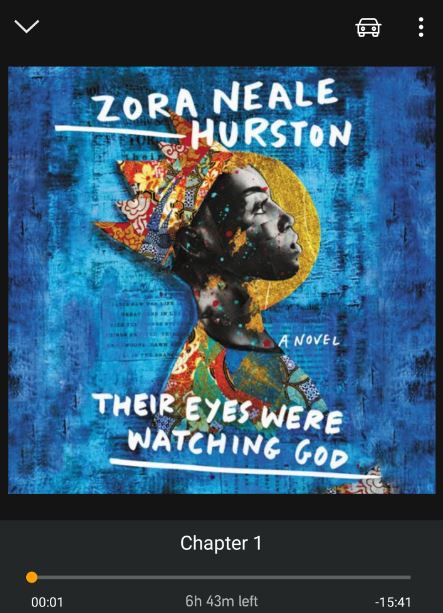
Micro Mention "Their Eyes Were Watching God"

Zora Neale Hurston


Zora Neale Hurston's "Their Eyes Were Watching God" is one of those novels written in such a keenly beautiful way that everything you want to express about how good it is—feels trite. What I can say is it was eye-opening for me.

In my full review of this novel, I finish by talking about its prominent religious themes, but apart from that, I think its humanity is what made it so touching to me. That is the true magic of stories to me. If you're open to it, you can experience a whole new world, a way of thinking and being, completely separate from your own. Hurston's writing makes it so easy to see the world through Janie's eyes.


This preview is an Amazon Affiliate link; 
as an Amazon Associate, I earn from qualifying purchases.


Friday, May 21, 2021

"Their Eyes Were Watching God" by Zora Neale Hurston--Fiction Review

Hello, my obscurists. In today’s review, we’re going to head into the deep south in the post-reconstruction era, with Zora Neale Hurston’s “Their Eyes Were Watching God.” It’s a story of loss and love, but most of all, it’s a book about what a life well-lived looks like despite all opposition.


Zora Neale Hurston


***The Non-Spoiler part of this review***


What I love about this book:

Usually, I’m a “narrative is king” sort of person, but to read “Their Eyes Were Watching God” and not note how absolutely gorgeous Hurston’s prose is—would be a disservice. There is a pastoral, naturalistic quality to it that her metaphors are all grounded in. Her use of regional dialect might be off-putting to some people, but I found that it enhanced the story for me. Her words described the world her characters lived in, and their words, and the language they used, told who they were and what it was like to live in that world.

The three men in Janie’s life that were her husbands at various points in her life are interesting contrasts of each other. They each represent a different mode of life for black men of their era. And while their “works,” or the lack of them in Tea Cake’s case, in some sense, defined them, they were also capable of surprising acts outside of their usual character, which means they never fall into becoming flat stereotypes.

Janie herself is a heroic character—a black woman, born into a world only a few scant generations after the American Civil War—finding her voice and achieving agency for herself in of itself was a radical idea for her era. That’s how oppressive her world was—that the very idea that she could have wants and dreams, hopes and goals, of her own, wasn’t even considered. The fact that it takes her the better part of the story to finally stand up for her belief that she, Janie, was a person with thoughts and feelings just as valid as anyone else doesn’t diminish her heroism. It’s still an achievement when she stands up for herself, her gender, and her race—even when sometimes those three elements weren’t necessarily aligned.


What I don’t love about this book:

There are many side characters in this book that can be described as people who should just mind their own business. They’re constantly insinuating themselves into Janie’s life, typically just picking at her and expressing disapproval for some such or other. As someone who grew up in a small-town setting, I can confirm wholeheartedly this is definitely authentic small-town behavior. My dislike for this kind of behavior, in reality, translates right into fiction, and I was often annoyed by some petty character or another whose whole role in life seems to be to give Janie a hard time. I get their function within the story and why they’re there, but I did find myself thinking several times, did there really need to be so many of them?

I’ve mentioned that I’m a big dog lover before on this blog—so it was horribly troubling for me that the ultimate antagonist of this story, other than the hurricane, was a rabid dog. The thing is, I saw it coming too, and when the dog bit someone, I knew exactly what the problem was going to be after that. All of that was very sad for the humans involved, don’t get me wrong, it works, but me being me, I was still going on about how sad I was about the dog in my head. So I was distracted by that.


This preview is an Amazon Affiliate link; 
as an Amazon Associate, I earn from qualifying purchases

***The Spoiler part of this review***
***Ye be warned to turn back now***


The quick and dirty synopsis:

The story starts with a frame story of Janie returning home after a long day and not engaging with her gossiping neighbors, who proceed to talk about her—unkindly. Janie’s friend, however, excuses herself and walks over to Janie’s house to give her some food, and ultimately the conversation turns to the story of Janie’s life.

Friday, November 13, 2020

"Invisible Man," by Ralph Ellison--Fiction Review

Today’s review is on “Invisible Man” by Ralph Ellison—ah-ha! You all read this review’s title and thought ole Kevin was losing his marbles, reviewing the same book twice. But no—this is another book about invisibility, metaphorical invisibility, where Ellison tries to capture the black experience through fiction. 


Ralph Ellison


***The Non-Spoiler part of this review***


What I love about this book:

This book is really a series of stories, loosely strung together by our unnamed protagonist, a young black man. Because of circumstances mostly out of his control, he leads several lives that make him an excellent everyman character—who is black. I say he’s an everyman character, but part of the novel’s point is he’s also no one because of his persistent anonymity. The whole device of never properly naming the protagonist of the story is clever in supporting this theme.

Sometimes funny, “Invisible Man,” for the most part, is rather poignant. I believe its most salient point is that—despite how society acts—black people aren’t all a homogenous group. They are people, some good, some bad, some apathetic, and others deeply caring and loving. They don’t all think the same, they don’t all value the same things, but they all have the shared experience of being black, which in America, historically and today, is a mixed bag—often negative. All that, plus the marginalization and being robbed of agency in one’s own life, is what I believe Ellison was trying to capture with this novel.

Ellison had to have known he would ruffle some feathers with this novel because he takes an unsparing examination of all society. Not just with what you might expect—topics such as racism and how violence tends to only accomplish more violence, but his critiques also wither things that are nearly universally considered virtues. His point, I believe, is that under the right circumstances, even good things can be corrupted—and that’s a brave and subtle point to make.   


What I don’t love about this book:

The whole medical experiment scene, while creepy, and I like creepy, just ends awkwardly. I get the spirit of what Ellison was driving at—a sort of Tuskegee Experiment vibe—but plotwise, it’s an episode somewhere in the middle of the story that feels out of place. After the protagonist is injured “accidentally” at the paint factory he is working at, he’s taken to the company doctor to be treated. And sure, that was a popular thing back in the day and relevant to the black experience. If you’ve ever read “The Immortal Life of Henrietta Lacks,” you’ll know that the medical profession has had some troubling track records with black people. But why it doesn’t work for me is it doesn’t add or take away anything in the novel. It happens, the protagonist has an odd conversation with the doctor, and then he leaves. But other than suffering from feeling faint for a bit, he has no further complications, and it’s as if nothing happened.  

Narratively speaking, occasionally, the transition from one scene to the next got a little foggy for me. I’ve considered that might be an intentional move by Ellison to further the novel’s surreal atmosphere, but, for me, any time I miss a mental gear change as I did several times in this book, it just annoys me.


This preview is an Amazon Affiliate link; 
as an Amazon Associate, I earn from qualifying purchases.


***The Spoiler part of this review***
***Ye be warned to turn back now***

Friday, June 12, 2020

"Down the River unto the Sea," by Walter Mosley--Fiction Review

It’s Friday gumshoes, and today’s review is of a noir-style detective mystery, “Down the River unto the Sea” by Walter Mosley.  

Walter Mosley


***The Non-Spoiler part of this review***


What I love about this book:

First, the gritty uncompromising detail of this novel, it’s a noir-style mystery, so that’s appropriate. Also, the main character, Joe King Oliver, who was formerly NYPD and was framed and disgraced by dirty cops in the department and sent to Rikers Island, has the added dimension of being an ex-cop in prison and being black. So it doesn’t go well—would be a massive understatement. Mosley captures the horrors of being a black man on the wrong side of the law and the unique terror of being simultaneously a fallen paragon of said law.

It’s no secret here if you’re a return reader of this blog, but I’m a big audiobook fan. So a big reason I like this book is that the narrator, Dion Graham, perfectly captures the voice of the world-weary PI. Something about his performance makes Walter Mosley’s already polished but blunt—straightforward but educated—prose sparkle. There is a quality to the writing that without coming right out and saying it, that this is what the real lived-in world is like, and it sweeps you up in its narrative and doesn’t stop until it’s over.     

There are references to jazz, and Thelonious Monk in the narrative, which are appropriate because if a book could capture the spirit of a jazzy improvisational style without being a book specifically about jazz music—it’s this one. Mosley’s writing above all else to me is musical, lyrical even. 


What I don’t love about this book:

A lot of criminal mystery novel clichés are packed into this plot. The twists and turns in the plot are all rote and barely caused me anything resembling shock. I don’t want to give you the wrong impression, and this doesn’t make it a bad novel, it’s just a little predictable. 

You know how I just said this novel two paragraphs ago, captures the spirit of jazzy improvisation? Yeah, I meant that purely in how Mosley writes, the actual writing stylistically ebbs and flows, changes, and experiments. The plotting doesn’t do that. Nearly every chapter of the book has a sandwich quality. What I mean by this is: the critical information comes at the beginnings and ends of each chapter. The in-between bits are where the character work happens, which is enjoyable, since Mosley’s characters are all flawed, and interesting, multifaceted people.

There is one thing though about the main character that I don’t like: he has a troublesome relationship with women, in general. He doesn’t hate them or hit them, nothing like that, but you could say he loves them a little too much, which includes his daughter. Some of his comments and observations are creepy.    

Every time I read a detective mystery, or a police procedural, where there is someone seemingly in the inner circle of the detective who is probably a traitor, I play a game. And the game is called: is the traitor the detective's best friend/long time partner/trusted mentor?  
 

This preview is an Amazon Affiliate link; 
as an Amazon Associate, I earn from qualifying purchases.

Author's Website: http://www.waltermosley.com/

***The Spoiler part of this review***
***Ye be warned to turn back now***