
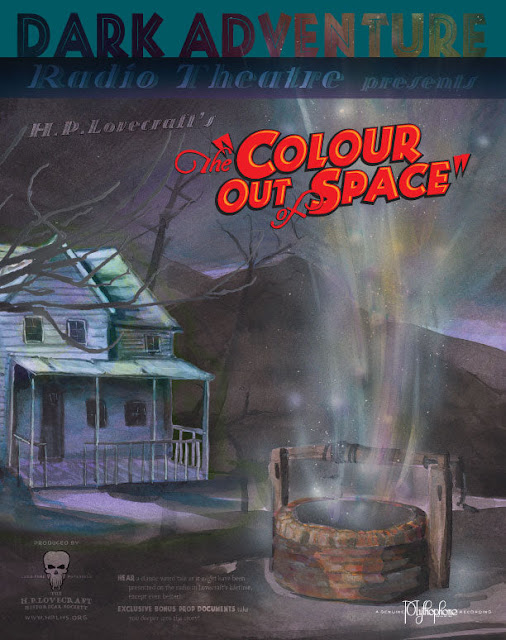
In this review, Obscurists, I am talking about H.P. Lovecraft’s “The Colour Out of Space.” Still, this one is a little different because I’m actually talking about three different versions of this story in one place. But I’m primarily talking about the original short story and the H.P. Lovecraft Historical Society’s Dark Adventure Radio Theatre version.
***The Non-Spoiler part of this review***
What I love about this book:
I go back and forth on whether or not “The Colour Out of Space” is my second favorite H.P. Lovecraft story, or maybe it’s “The Dunwich Horror,” anyway, today, let’s say it’s the former. On a totally unplanned and spontaneously random self-promotional note, if you read my own novel “Jade Fall,” you’ll pick up on how this story and “The Shadow over Innsmouth” influenced me.
My biggest love for this story is how it derives its horror without actually invoking the supernatural, unlike many of Lovecraft’s earlier stories. It isn’t ruled out that the meteorite comes from a supernatural source, but it isn’t confirmed or even suggested either. What it is, is simply unknowable. It’s so different and so odd that it can’t be classified when studied. I love that atmosphere of merely saying it came from outside. He doesn’t even specify outside of what, the earth, the solar system, the galaxy, the universe!?
Specific to the Dark Adventure Radio Theatre version of this story, the H.P. Lovecraft Historical Society has created an updated—yet still feeling part of an older era—radio drama edition that is sublime. I’m not nearly old enough to be properly nostalgic for or even remember the golden age of the radio drama, but I love the format.
What I don’t love about this book:
Lovecraft pulls his old standby of: “It was just too horrible to describe.” And sure, there is something to be said about less is more and don’t show the monster, but he overuses that trick, and it happens in this story in more than one place.
Every version of this story that I’ve experienced at least makes use of a framing story of a surveyor making his way into the hill country around Lovecraft’s fictional city of Arkham, working on the planning stage of a new reservoir. Anyway, like I said, it’s just a framing story, and it’s an excuse to tell this outsider, and by extension, us the audience, the weird and horrible goings-on at the Gardner farm. Usually, I don’t mind a framing story, “At the Mountains of Madness,” my favorite Lovecraft story sort of employs one. I’m not too keen on this one because “The Colour out of Space” is already a short story, so it feels like words are being wasted.
Also, present in this story, there is that Lovecraft element of a casual disdain for foreigners that I always find off-putting.

Author’s Website: https://www.hplhs.org/
***The Spoiler part of this review***
***Ye be warned to turn back now***
The quick and dirty synopsis:
Like I said above, the narrative begins with a surveyor telling the tragic story of the Gardner family as it was told to him by their neighbor, a man named Ammi. The story tells of how a meteorite crashed into one of the Gardners’ fields. At first, the family’s patriarch is pleased by all the attention his farm is getting from the local scientific community—and really just the community in general.
