Showing posts with label self-help. Show all posts

Friday, July 15, 2022

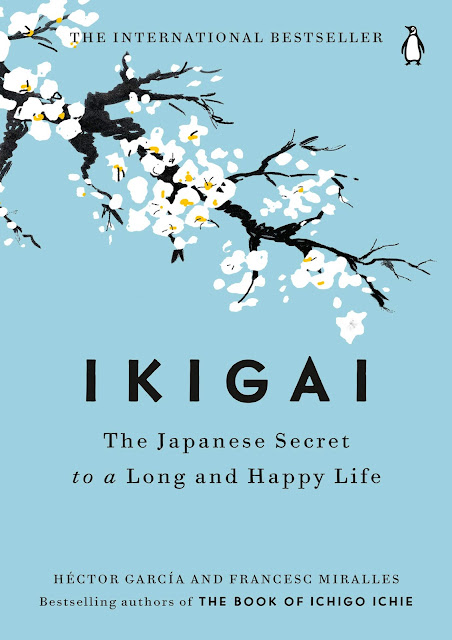
"Ikigai" by Hector Garcia and Francesc Miralles--Nonfiction Review

Today Obscurists, we’re finding our purpose with “Ikigai” by Hector Garcia and Francesc Miralles. It’s a book about the Japanese way of living a long and happy life by discovering your purpose in life and how to recognize it.

Hector Garcia and Francesc Miralles


What I love about this book:

“Ikigai” is a relatively short book that doesn’t outstay its welcome. I appreciated the brevity and straightforwardness of the book’s message—that the secret to happiness is ultimately to have a purpose. 

Like many Americans, I harbor a particular fascination for Japanese culture. While that isn’t specifically this book’s goal, “Ikigai” also gives an enjoyable look into this specific eastern mindset. I found it interesting to learn how aging is viewed in Japanese culture.

Finally, the practicality of this book’s advice appealed to my sensibilities. I like tangible, achievable advice that eschews mystical concepts. Never have I been impressed by the “positive vibes” people or those seeking to communicate with the “universe.”


What I don’t love about this book:

This is a bit of a petty start here, but I don’t like the long chapter titles. Mainly, I don’t like them because each chapter seems like just a continuation of the primary thesis behind this book. It’s good that the main point is reiterated, despite the attempt to break it down by subtopic though it still feels like there isn’t much rhyme or reason for why one point is presented here and why one thought is presented there. It all feels kind of the same.  

Also, while Japanese culture is far—far more collectivist than western cultures in nature, the Japanese aren’t nearly as monolithic as this book presents. Japanese people, like any subgroup of humans, have various traits, predispositions, and opinions that differ from others within that culture. They’ve not all found their “Ikigai” and are some wise super society. This book feels like it views them with more than a little rose-tinted glasses.

I’m prepared to accept that, on average, especially compared to the West, the Japanese tend to live longer, happier lives, as this book asserts. That ultimately just comes down to statistics. And those who live longer probably have better than average coping strategies, like defining themselves by the goals they profess.


This preview is an Amazon Affiliate link; 
as an Amazon Associate, I earn from qualifying purchases.

Author’s Website: https://hectorgarcia.org/


Parting thoughts:

To carry on my point from the prior section, I think this is one of those situations in which statistics can—well, not lie so much—as omit specific qualifying details. Like I said before, I accept, on average, that the Japanese probably live longer, healthier, and happier lives than in, say—my culture. But that’s only for the ones it works out for because while the national suicide rate in the United States isn’t great, it isn’t in the same ballpark as it is in Japan.

It’s a major societal issue for them with many complex factors. One of those factors is that Japanese society is incredibly demanding, with stratospheric standards to live up to and a preoccupation to avoid shame wherever possible.

So my point is that it seems to me that cultural values in Japan, when they work out, really work out overall for people. But when they don’t, they really don’t.

Also finally, a significant stressor in Japan right now is that its population is aging, and there are more and more older people with fewer younger people to support them. So there is that double-edged sword. Great success in one area typically means neglect in another.

Monday, November 15, 2021

Micro Mention "The Minimalist Way"

Erica Layne


Interested in minimalism? "The Minimalist Way" by Erica Layne. Minimal post.

...okay, so, a bit more. I've personally been interested in the concept of minimalism since about 2015. My interest in the topic stems from multiple reasons, my personal economics not the least of them. This may come as a shock to you, but an extremely bookish blogger isn't typically the wealthiest of individuals, and I have never been rich in life. So learning to appreciate less helps to soothe both mind and soul.

The biggest reason is that minimalism is another way to streamline one's life. I am constantly looking for ways to focus more on what is important to me and simply let go of what isn't. It isn't easy since modern life insists that everyone should want more stuff, more things, more, more, more. But it is gratifying when you can just get off that hamster wheel and go spend your time with what you want to spend it with instead of what you're told you should wish to have. 

Hard work is fine and can be rewarding, but what are you working toward? Buying an even bigger house to store your stuff, neither of which you spend much of your time with because you're always working, or maybe it's so you can eventually pursue your passion? That's what I mean by streamlining.


This preview is an Amazon Affiliate link; 
as an Amazon Associate, I earn from qualifying purchases


Monday, October 25, 2021

Micro Mention "I Will Teach You to be Rich"

Ramit Sethi


We could all use a little help with our finances, and Ramit Sethi can give you some great advice in "I Will Teach you to be Rich," or at the very least, help you to start tackling some of your biggest financial problems.

So this might come as a complete shock to all of you, Obscurists, but I actually don't survive alone on blogging—I know—revelatory. I went to school for journalism and loved the traditional news so much that I quickly graduated from college and got a job as a banker. And that's just what I've been doing since college to pay the bills.

I wouldn't say banking is my passion in life, but I've learned a lot from it, and I feel that I am good at being a banker. Primarily, I've learned that most people have a woefully poor understanding of how to manage their finances. Sethi didn't actually teach me anything I didn't already know. Still, I can tell you that if you're in over your head with just avoiding overdrafts on your checking account, this book is a great place to start piecing your financial future together.

I'd say you could contact me for banking advice, but did I say I was a banker? I meant to say that I'm a baker, also I'm a terrible baker, so don't ask me for advice on that front either. Everything I bake comes out charcoal briquette black. If that's, for some reason, your goal, the recipe is simple. Step one, set food on fire. Step two, there is no step two.


This preview is an Amazon Affiliate link; 
as an Amazon Associate, I earn from qualifying purchases.


Friday, September 18, 2020

"The Pumpkin Plan," by Mike Michalowicz--Nonfiction Review

Now I know what you’re thinking—it’s Kevin, you’re reviewing a self-help book? Isn’t that outside of your bailiwick? Listen, for a man who lives in an imaginary dome, in an imaginary desert, constantly under siege by imaginary sandworms; I need all the help I can get. No, no, it isn’t. So let’s talk about “The Pumpkin Plan” by Mike Michalowicz and feel the entrepreneurial spirit together. But before we do, I should be upfront that I bought my copy of this book in 2016, and Michalowicz has since updated it—so you might not be reading the exact same copy of this book as I am, but I’m sure the gist is the same.


Mike Michalowicz


What I love about this book:

The book immediately jumps off with Michalowicz explaining the metaphor of his book’s title “The Pumpkin Plan.” He describes how the same techniques used to grow the massive gourds can be used to drive a business to greatness. I appreciate this bit because, well, it’s pristinely clear what the rest of the book is about.

Throughout the book, I love the practical advice Michalowicz gives you, drawn from personal experience. Early on, Michalowicz describes his struggles to grow his own business and the advice he got from his mentor about where he was going wrong. Like with most wisdom, when initially heard, he didn’t appreciate it—at first.

Overall Michalowicz, keeps a positive tone throughout the book and can be humorous at times. It’s easy to follow him as he breaks down step-by-step how his method works. Then at the end of each chapter, he sets up a hypothetical business, each in a different sector and industry within the economy, and describes how he might apply his method. At the very least, they’re interesting thought experiments.   


What I don’t love about this book:

Some of his descriptors he uses to get across his point can be a little distracting. His fear of becoming “one nut guy”—precisely what it sounds like—springs to mind. Also, at times, his writing can become a bit manic—it’s especially evident in the audiobook version, which he narrates. 

I get that this is a book about what hard work, creative flexibility, and insight can do for your business, and all those positive things, but I also feel it doesn’t do enough to address the things entirely out of the blue that can torch a business. Advising on how your business can cope with a catastrophe isn’t really discussed in this book about advice for business, which should be evident in today’s climate is incredibly necessary. Now I’m not trying to go too hard on Michalowicz for not being prophetic and anticipating the pandemic of 2020—but massive economic downturn should always be somewhere in business owner’s lists of contingencies to prepare for if they happen.


This preview is an Amazon Affiliate link; 
as an Amazon Associate, I earn from qualifying purchases.

Author's Website: https://mikemichalowicz.com/

Parting thoughts:

Even if you’re not an entrepreneur, books like this can be worth reading anyway. My reason is that authors such as Michalowicz can offer real insight into problem-solving and creative thinking that can be used in other dimensions of one’s life. These skills are valuable to enrich any life, even one not directly pursuing profit. He talks about the importance of focus, playing to one’s strengths, communal cooperation with others—but I’m not going to lie to you, this isn’t really how the book is intended to be used and is an exercise in the abstract. My point is, information is inherently valuable, and how it is applied is primarily up to the recipient. 

More-and-more I find myself more likely to be aligned with the left politically, a position I feel I’ve been pushed toward by the GOP from my typically centrist tendencies. Why I bring this up is for the same reason I talked about ideological purity in an earlier review. There are those on the left, politically, that wouldn’t see the value of this book, and would be pretty annoyed by me for choosing to review it because it is a book extolling the virtues of capitalism. The people always going on about late-stage capitalism spring to mind.

Now don’t get me wrong, I’m not proselytizing the greatness of pure and unfettered capitalism stripped of all government regulation. The days of Andrew Carnegie and John D. Rockefeller weren’t great times for anyone other than the few that had made their way to the top. The problem with that time in American history where capitalism reigned supreme is: that once at the top, with all that wealth and power, great capitalists stopped being positive forces for society. They became preoccupied with entrenching their “legacy” and destroying any and all competition from rivaling them—all at the expense of, and while exploiting the poor. When anyone tells me about how pure capitalism is the greatest boon to society, they always sound naïve to me and like they just don’t know their history.

The same goes for anyone describing to me their belief in a socialist utopia. Again, it’s a failure to appreciate history. Smart people, educated and well-meaning people—like Christopher Hitchens for one—believed in worker’s paradises before now and were disillusioned because it’s never worked out. In the positive pursuit of enriching the masses, equitably, pure socialism and communism fail to take into account the potential for corruption. The strong man—the autocrat—always seems to rise from such environments. Don’t believe me? Take a good hard look at China, Russia, and Eastern Europe. 

Which brings me back to my theme—purity—is inherently a bad thing. It’s terrible in genetics, and it’s just as bad in economics. I don’t have any grand solutions here, other than to say I have heard good capitalistic ideas and good socialistic ideas. I believe it’s the balancing of the two extremes, that endless competition between ideals is what keeps society healthy.