Showing posts with label American Philosophy. Show all posts

Friday, January 14, 2022

"The Federalist Papers" by Alexander Hamilton, James Madison, John Jay--Nonfiction Review

Set phasers to maximum pretentious, Obscurists, as today I’m going to talk about a keystone document or rather documents supporting the constitution of the United States of America. Yep, I’m talking about “The Federalist Papers” by Alexander Hamilton, James Madison, and John Jay—and all because I read them that one time after watching the musical “Hamilton” more times than I’ve gone outside in the last two years.

You’re probably asking yourself, “wait, isn’t this Kevin guy a recluse? Does that mean like, five?” No, it does not. I’ve been outside tens of tens of times.
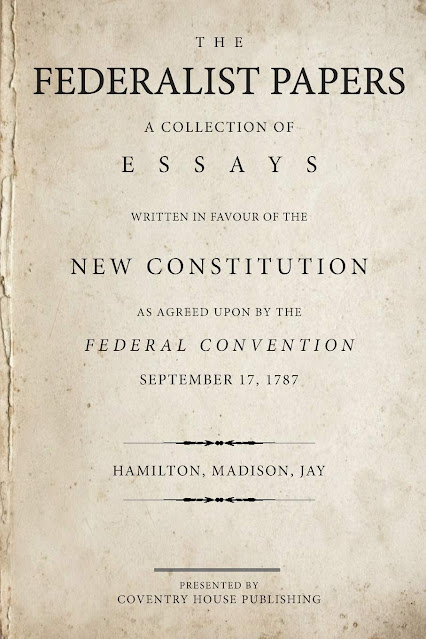

Alexander Hamilton, James Madison, John Jay


What I love about this book:

I talked about this recently on Twitter—it’s also why I’m writing this review—but Federalist number 6 is one of my favorites. It goes into ancient history and Medieval-ish European history, but mainly what it talks about is human nature, avarice, war, and insurrection. It’s a strange but illuminating experience to read something written in the distant past and see today’s problems. 

This brings me to my next point of what I love about “The Federalist Papers,” the authors were idealistic men but also intensely practical—and I value both of those traits. They didn’t seek to fix the human condition or change the person as more religious or purely philosophical schools of thought tend to fixate on as their chief concern.

What the Federalists believed in, in my opinion, is that a strong and carefully tuned government can channel the collective will and wisdom for the aggregate betterment of all. But the mechanisms that make that possible also include an ever-present sword of Damocles. It comes in the form that a small syndicate—or an individual—of an unscrupulous bent might hijack the components of our government to wield outsized influence over their fellow citizens.

And that’s why so much of our governmental system in the United States is dedicated to frustrating itself via checks and balances. It wasn’t a bug. It was always baked in as a feature all the way back in the day.


What I don’t love about this book:

As the song goes—John Jay got sick after writing five, which was a shame because I thought he had made some interesting points. I would have liked to get more of his thoughts in this collection.

There is a bit of historical controversy over exactly who wrote which essays. Also, it’s disputed how many were written by Hamilton and how many were written by Madison. It really underscores the point that we were always fractious and argumentative, even all the way back to the beginning.

It’s wearying because there is a theme that runs through human history that if we all were just a bit better—not even a lot better as individuals—the collective improvement would be immense. I believe you can pick up on that frustration, reading these essays. But like I eluded to above, you work with the clay you have, not the clay you wish you had.

“The Federalist Papers,” and this is really Hamilton’s doing, which is disappointing, comes out hard against the idea of a Bill of Rights. That turned out to be dead wrong, and I hate agreeing with Madison over Hamilton on something—but I’m on Madison’s side of this argument.


This preview is an Amazon Affiliate link; 
as an Amazon Associate, I earn from qualifying purchases.


Parting thoughts:

Returning to a theme from the previous section—let’s imagine for a moment that better clay. Think about what might have been if Hamilton was a slightly better version of himself.

He was a towering intellect of his day, and after reading his work, even by today’s standards. He fought incredibly hard for the birth of my home country and worked his mind and pen to superhuman levels. In terms of sheer ability, there is no reason he couldn’t have one day risen to be President of the United States. And what would that have looked like?

Instead, he ended up dead from a bullet shot by, at the time, the third sitting vice-president of the United States. What a way to go out, I guess—stupid—but memorable. Pretty ironic for a guy who tried to define himself as the smartest man in any room.

But it’s really the little character flaws that wore him down and put him in front of that gun. It was his arrogance, his propensity to make enemies when he didn’t need to, and his pride is no small part of his downfall too.

I think his most tragic character flaw is how he cheated on his wife—and through some childlike delusion—concluded if he just wrote enough about his infidelity, he could somehow make it all better. Because that’s what he did, to achieve everything he did in his life. 

It’s sad to watch someone’s favorite tool fail them at their greatest moment of crisis—but there are just some things you don’t get to come back from, and that’s one of them. 

Or, well, it used to be—kinda different now.


Friday, April 16, 2021

"American Philosophy: A Love Story," by John Kaag--Nonfiction Review

Ok, obscurists today, we’re getting introspective, philosophical, and a little romantic with John Kaag’s book “American Philosophy.” 


John Kaag


What I love about this book:

This book gave me a fantastic framework of the most prominent American philosophers and beyond via the frame story—well, really—Kaag’s memoir of discovering the Hocking library at West Wind and then restoring the rare books he found there. He describes numerous American luminaries and their personal philosophies on life and a variety of other topics. It all works as a survey of great American thinkers.

It was because of this book that I was first introduced to Henry David Thoreau’s work. Thoreau is a writer I can’t imagine I would have stumbled upon naturally by myself and someone I now greatly admire, despite him being a bit of a misanthrope. So this book did something that is one of my absolute favorite things about reading; it gave me a direction for further reading and the opportunity to discover new vistas outside of my view of the world. 

Kaag isn’t limited to just American philosophers. He mentions great thinkers of other countries and cultures and creates a web of ideas and counter ideas, painting a mental landscape for you of the different approaches and schools of philosophy. He’s even good for the occasional reference to classic up to modern-ish literature, making him a sort of one-man walking library. 

I found it interesting how Kaag developed and grew as a person—thankfully into a better person—as the book went on, and he and Carol restored and cataloged more and more of the books in the library. As it grew, too, their relationship was cute as well, and I rather enjoyed the romance between the two rival philosophy scholars. In fact, my favorite parts of the book were the bits with Carol, and while it’s a bit of a treacly cliché—I do feel she helped the author to be a better person.


What I don’t love about this book:

So Kaag is the protagonist of this narrative—it is his memoir after all—and while I appreciate him not sugar coating how insufferable he was as a young man, it doesn’t make him any less unbearable. This is especially true of him describing how his first marriage fell apart, which might not have been entirely his fault, but who sells their wedding band before they have the divorce conversation? Like—what was the plan there? This is really a thing I don’t like about the man, but a large part of this book is about him personally, so I feel it’s valid to bring up.

There is a certain amount of pretentiousness and angst in this book, especially in the early chapters—that Kaag mostly moves beyond as the Hocking library project progresses. Still, a spade is a spade, and I definitely rolled my eyes at the beginning of the book several times. 


This preview is an Amazon Affiliate link; 
as an Amazon Associate, I earn from qualifying purchases.

Author's Website: https://johnkaag.com/

Parting thoughts:

I find it to be a bit of an irony that Kaag’s love story with Carol is what honestly seems to turn him around as a person, and sure, I get that the title of this works with a double meaning. The title implies that it’s also a story of his love for philosophy, but he was well-read before his relationship with Carol, and it’s not like that made him a better person. It may have helped, but it doesn’t seem to have done the trick alone. It’s ironic because a lot of American philosophy revolves around independence, self-actualization, self-reliance, and so on and so forth to a possible over macho extreme. We Americans—past and present—have never been known for our gifts of subtlety.

That being said, I believe, despite some claims that we have no “real” culture of our own, I do feel that American culture has had a lot to offer the world. I credit this book with sparking my interest in the men and women who lived, thought, and wrote in America, especially in the 19th to early 20th century, which is a time often overshadowed by such concerns as war—both civil and world flavors—and economic depression. It’s easy to overlook that great American writers concerned themselves with more than just war and money, but with the entirety of the human experience. Typically, when one hears philosophy or ethics, it’s predictable to think of the Greeks or Europeans before America, but that doesn’t mean there weren’t erudite scholars here too.


Monday, April 12, 2021

Micro Mention "Walden"

Henry David Thoreau


Sometimes it’s nice to just get away, get out in nature, take a walk, and maybe take a holiday in the mountains. No one quite did it like Thoreau, but luckily he wrote the experience down for us in “Walden.”

Like with Edward Abbey, who I very much thought was a spiritual successor to Henry David Thoreau, I admire Thoreau's fierce streak of independence. Of the transcendentalists, he's certainly the writer of that group that I've learned the most about, and he is, to me at least, a quintessentially American writer of the 19th century who was forward-thinking.

He was undoubtedly also a bit of a curmudgeon, a quality Abbey also shared with him. If you'd like to know more about Edward Abbey, I wrote a review of his book here.


This preview is an Amazon Affiliate link; 
as an Amazon Associate, I earn from qualifying purchases.


Wednesday, March 10, 2021

Micro Mention "American Philosophy"

John Kaag


"American Philosophy" by John Kaag is a love story in two ways—with a woman and great American thinkers—mostly, it works as an excellent framework and introduction to the American, transcendentalists, idealists, pragmatists, and various other philosophical traditions.

What I loved most about this book is how it started me out on a path to then read Henry David Thoreau's "Walden," which then allowed me to better appreciate "Desert Solitaire" by Edward Abbey even more. This is quintessentially what I love about non-fiction; you never know what roads it will lead you down next. 


This preview is an Amazon Affiliate link; 
as an Amazon Associate, I earn from qualifying purchases.