
Set phasers to maximum pretentious, Obscurists, as today I’m going to talk about a keystone document or rather documents supporting the constitution of the United States of America. Yep, I’m talking about “The Federalist Papers” by Alexander Hamilton, James Madison, and John Jay—and all because I read them that one time after watching the musical “Hamilton” more times than I’ve gone outside in the last two years.
You’re probably asking yourself, “wait, isn’t this Kevin guy a recluse? Does that mean like, five?” No, it does not. I’ve been outside tens of tens of times.
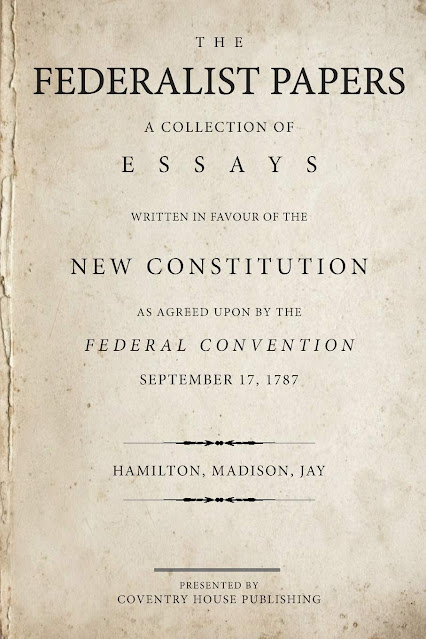
What I love about this book:
I talked about this recently on Twitter—it’s also why I’m writing this review—but Federalist number 6 is one of my favorites. It goes into ancient history and Medieval-ish European history, but mainly what it talks about is human nature, avarice, war, and insurrection. It’s a strange but illuminating experience to read something written in the distant past and see today’s problems.
This brings me to my next point of what I love about “The Federalist Papers,” the authors were idealistic men but also intensely practical—and I value both of those traits. They didn’t seek to fix the human condition or change the person as more religious or purely philosophical schools of thought tend to fixate on as their chief concern.
What the Federalists believed in, in my opinion, is that a strong and carefully tuned government can channel the collective will and wisdom for the aggregate betterment of all. But the mechanisms that make that possible also include an ever-present sword of Damocles. It comes in the form that a small syndicate—or an individual—of an unscrupulous bent might hijack the components of our government to wield outsized influence over their fellow citizens.
And that’s why so much of our governmental system in the United States is dedicated to frustrating itself via checks and balances. It wasn’t a bug. It was always baked in as a feature all the way back in the day.
What I don’t love about this book:
As the song goes—John Jay got sick after writing five, which was a shame because I thought he had made some interesting points. I would have liked to get more of his thoughts in this collection.
There is a bit of historical controversy over exactly who wrote which essays. Also, it’s disputed how many were written by Hamilton and how many were written by Madison. It really underscores the point that we were always fractious and argumentative, even all the way back to the beginning.
It’s wearying because there is a theme that runs through human history that if we all were just a bit better—not even a lot better as individuals—the collective improvement would be immense. I believe you can pick up on that frustration, reading these essays. But like I eluded to above, you work with the clay you have, not the clay you wish you had.
“The Federalist Papers,” and this is really Hamilton’s doing, which is disappointing, comes out hard against the idea of a Bill of Rights. That turned out to be dead wrong, and I hate agreeing with Madison over Hamilton on something—but I’m on Madison’s side of this argument.
This preview is an Amazon Affiliate link;
as an Amazon Associate, I earn from qualifying purchases.
Parting thoughts:
Returning to a theme from the previous section—let’s imagine for a moment that better clay. Think about what might have been if Hamilton was a slightly better version of himself.
He was a towering intellect of his day, and after reading his work, even by today’s standards. He fought incredibly hard for the birth of my home country and worked his mind and pen to superhuman levels. In terms of sheer ability, there is no reason he couldn’t have one day risen to be President of the United States. And what would that have looked like?
Instead, he ended up dead from a bullet shot by, at the time, the third sitting vice-president of the United States. What a way to go out, I guess—stupid—but memorable. Pretty ironic for a guy who tried to define himself as the smartest man in any room.
But it’s really the little character flaws that wore him down and put him in front of that gun. It was his arrogance, his propensity to make enemies when he didn’t need to, and his pride is no small part of his downfall too.
I think his most tragic character flaw is how he cheated on his wife—and through some childlike delusion—concluded if he just wrote enough about his infidelity, he could somehow make it all better. Because that’s what he did, to achieve everything he did in his life.
It’s sad to watch someone’s favorite tool fail them at their greatest moment of crisis—but there are just some things you don’t get to come back from, and that’s one of them.
Or, well, it used to be—kinda different now.

