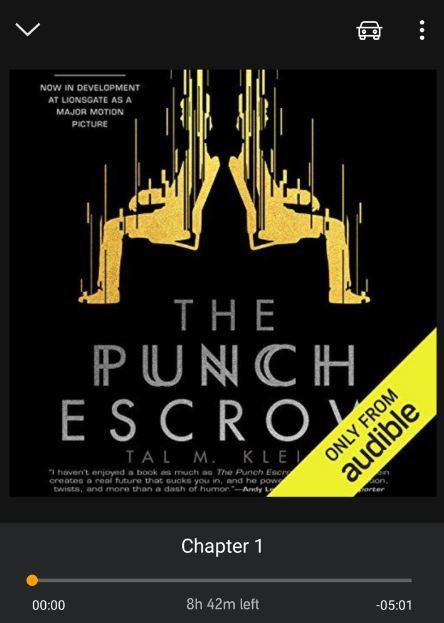
In today’s review, we’re going teleporting—just like in “Star Trek.” But unlike that show most of the time, we’re really going to dive into the ramifications of that kind of technology with Tal M. Klein’s “The Punch Escrow.”
***The Non-Spoiler part of this review***
What I love about this book:
I’ve heard of “The Ship of Theseus” thought experiment before, but this book managed to cement it in my mind better than anything else because it directly ties into the plot’s central conflict. In sum—the paradox is—Theseus’s ship was kept in port as a monument for generations. Over the years, planks, ropes, et cetera would rot and need to be replaced, and they’d be replaced with carefully crafted replicas to match the original components. Eventually, every piece of the ship is replaced in this manner. The ship in the harbor is the same in every regard, but is it still Theseus’s ship? If not, when did it stop being Theseus’s ship?
As any good sci-fi should, “The Punch Escrow” tackles big questions and invites the audience to examine them from every angle. The ever revelatory question of; what does it mean to be human? Is a question that recurs throughout literature—not just sci-fi. The question might be the same, but the answers change based on the context in my experience. Since this is a story about teleportation, the human question and what makes you—you question are intertwined. Are you just the matter that makes up your body? Or are you a pattern of thoughts, a continuity of experience? There is a lot to consider in this book, and I love that.
The pacing in “The Punch Escrow” is quick—in my opinion. Klein never meanders too long in any one spot, and his characters are constantly in motion to the next thing. It’s not that I’m against slower-paced stories, but I always feel initial stories in a series or standalone novels are better served by not resting too much and being a more kinetic experience. For me, you have to earn those slow moments. They can be great for character development, but if I don’t know enough about why I should be interested in a character, I’m wary of the idea of sitting around waiting for them to tell me who they are.
What I don’t love about this book:
I don’t know why exactly, but I thought there would be more to this story—more locations, more conflicts, and more characters. With its quick pacing, which I like, it nevertheless felt like a third or maybe half of a longer story. The big cliffhanger ending felt less like a tease into another story and more like part of the rising action to me.
Okay, so there is a trope in sci-fi—cliché really—where the protagonist is oddly obsessed with something in our contemporary time. “Star Trek” did it, that terrible “I, Robot” movie with Will Smith did it, and all of “Ready Player One (and Two)” are stories built around it. And I get the function—create a character who can seem contemporary, in knowledge at least, to short circuit the audience into identifying with them. “The Punch Escrow” does it with Joel’s love of 1980’s new wave music—it comes up more than once. As for if this element works in this story, I’d say it works fine, but personally, I’m skeptical of nostalgia, which is a big part of why as time has gone on, stories that feature an homage to the ‘80s or— heaven forbid—the ‘90s, creep me out.
This preview is an Amazon Affiliate link;
as an Amazon Associate, I earn from qualifying purchases
***The Spoiler part of this review***
***Ye be warned to turn back now***
The quick and dirty synopsis:
“The Punch Escrow” starts with Joel Byram, our protagonist, jumping around in his story—and creating an excuse, narratively speaking, to dump some info about the world he lives in. After a bit with a framing story, where Joel is telling some mysterious Turkish strangers why he thinks the company responsible for teleportation is trying to kill him, we jump back to before Joel had serious problems.