Showing posts with label biology. Show all posts

Friday, May 13, 2022

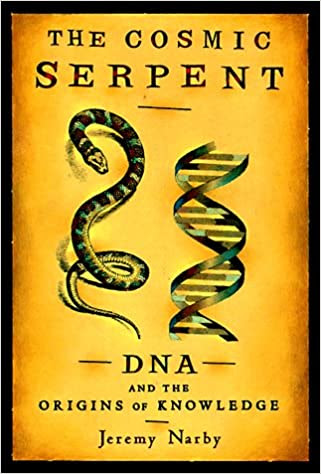
"The Cosmic Serpent" by Jeremy Narby--Nonfiction Review

Today we’re talking about a weird one, Obscurists. This nonfiction book is called “The Cosmic Serpent,” and it’s written by Jeremy Narby.


What I love about this book:

I appreciate the sentiment in this book about keeping an open mind about things and not prejudging, which I realize will probably sound awfully hypocritical a little further on in this review. But, for now, I agree with Narby’s stance that when speaking to native people about their lives and traditions, you should listen to them, reserving judgment for as long as possible. It is certainly interesting how shamans developed several techniques to manipulate the hallucinogenics they ingest and control their biochemical effects. Though I think the author discounts how much could be achieved through simple experimentation, however imperfectly. 

Alternatives on how to think about biology, other than western medicine, are, again, something I find interesting. The concept that ecology from a perspective different than what I’m used to might hold valuable insights is a tantalizing idea. A lot of research for new medicines finds their genesis after all in the world’s rainforests, and a lot of the time, it is native peoples to those regions that develop the precursors to the drugs that get synthesized in labs. True, typically, those indigenous people then get cut out of any real profit-making side of this business, but that’s a different subject that deserves its own essay.

This book does do an excellent job of pointing out that we hold a lot of local shamans and native people’s traditions on the one hand with a sort of bemused disdain. We make a show of not taking anything they have to say seriously while also fleecing them for their best ideas with the other hand. All with absolutely no sense of irony.


What I don’t love about this book:

Right at about the middle of the book—it lost me. Narby takes off onto some truly magical flights of fancy that are just nonsense. By the end, he’s accusing the scientific method of being non-objective because it dismisses what it doesn’t understand, which is precisely the opposite of the scientific method. Finding proof of a new phenomenon that can’t be explained by current models is every scientist’s wet dream because it means there is new science to be done. 

He also has a pretty piss poor understanding of natural selection or only conveniently describes it poorly to support his own unsupportable positions. Toward the end of the text, he says something to the effect of “the theory of natural selection states that evolution only happens through the random collection of errors accumulated in DNA as it’s passed down through the generations, and only keeps the changes which are improvements.” The first part is more or less accurate. Still, the second part is a common misconception used by people who have an ax to grind against the concept of evolution. Natural selection doesn’t “design” anything to be objectively better at anything, it’s merely a statement that what has survived tends to pass down its traits. 

Certainly beneficial traits like evolving wings or eyes can aid in survival and thus make sense as to why those traits are passed down. But if you’ve read my review of “Human Errors,” you’ll know we have some charming problems like retinas that are wired backward. Or the inherited need to desperately seek out vitamin c in our diet that most other animals don’t share with us. So no, the changes brought on by evolution don’t have to be helpful. They tend to be, but sometimes they’re just problems that don’t outright kill us before we can reproduce. 

His other major point he drums that made me grind my teeth is his assertion that it’s a central tenant of western, rational thought to hold absolutely true that DNA, or sometimes he just calls it “nature,” isn’t and can’t be conscious or have intent. And then he uses that to set up a whole host of logical fallacies like Straw man arguments and appeals to ignorance, so on, and so forth. The proper “scientific” way of stating skepticism toward the idea that DNA in of itself is probably not conscious is to say that “you have not proven it is conscious,” not that it “isn’t conscious.” In science, you can prove that something does exist by demonstrating it and then repeating it in testable and measurable ways. You can’t prove the non-existence of things by demonstrating, repeating, or measuring—non-existence.

He also says that the knowledge that he can gain through the use of hallucinogenics can be tested. Great! Here’s a test, use all the hallucinogenics you want and tell me a random digit of pi out past the trillionth place that a computer could verify for us. Then do that a few more times. And if the supposed ancient alien biological technology—that DNA supposedly is—doesn’t want to answer that question, then let’s ask it what it does want to answer. If the question is too hard, then maybe we can start with what color shirt is Bill wearing in Hoboken? Surely, a globally connected decentralized super consciousness should be able to muster that.


This preview is an Amazon Affiliate link; 
as an Amazon Associate, I earn from qualifying purchases.


Parting thoughts:

As you might imagine from above, I didn’t enjoy this book. I think it’s crucial to read things you disagree with because it’s important to know what the other side of an intellectual dispute looks like and to check your own beliefs. 

While not harboring any desire to experiment with hallucinogenics, I can get behind Narby on the idea that our research into precisely how they function in the human brain is woefully thin. It’s only thin because of the conscious choice to bend, at least in the United States, to those of us of a more puritanical bent and deeming all these psychotropic drugs as icky and therefore banned. 

And maybe there is a legitimate public health concern here. But it seems awfully hypocritical to me that here in the land of the free, within ten minutes walk of my front door, I can first indulge in a three thousand calorie fast food meal. Second, get a carton of cigarettes to smoke afterward, and then three chase it all down with a bottle of Jack Daniels. That there is my right as an American, no matter how ungodly destructive it is to my body, which I wouldn’t recommend. However, if I want to do acid or ingest certain mushrooms within the closed walls of my own home, that’s too far.

My point, though, isn’t to glorify drug culture or anything of the sort—none of it seems appealing to me. What I’m pointing out is that we say we have these laws because of high moral standards and character, but once new drug laws go on the books, there are always caveats and exceptions. 

The real reason certain things are prohibited has nothing to do with morality, public health, or safety. It’s money. Specifically, those in power don’t stand to make any or actively might lose some if new competitors enter the marketplace to compete with their “legitimate” psychoactive drugs that they’re invested in.

Thursday, March 31, 2022

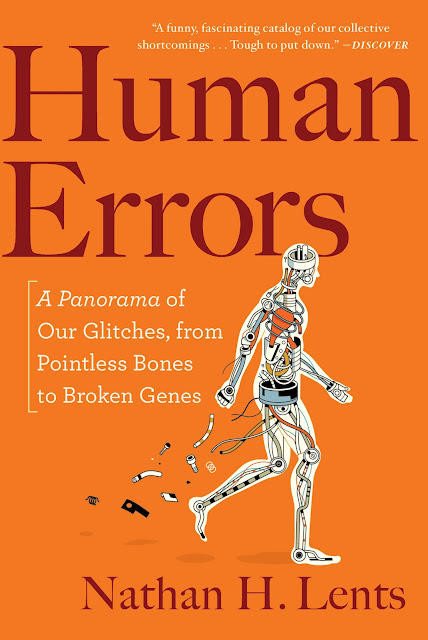
Talking In Obscurity, "Human Errors," by Nathan H. Lents

 
Nathan H. Lents


Today Obscurists, I've tricked Steven into reading one of my favorite books on biology and how, well, it could be better. Nathan H. Lents has managed to write a hilarious book on human biology. 


This preview is an Amazon Affiliate link; 
as an Amazon Associate, I earn from qualifying purchases.

Friday, March 18, 2022

"Human Errors" by Nathan H. Lents--Nonfiction Review

Today my dear obscurists, we’re talking about biology! Don’t worry, it’ll be more fun than it seems because “Human Errors” by Nathan H. Lents is an awesome book.


Nathan H. Lents


What I love about this book:

I re-read a lot of fiction, and not so much when it comes to nonfiction titles, but I’ve probably read “Human Errors” three or four times now—it’s that good. This book is so good, in my opinion, because it transcends just being informative about a topic I find interesting, the biology of the human body, and is genuinely funny. There is not a chapter in it that you won’t be entertained if you randomly flip to it. Lents’s writing is smoothly consistent from start to finish in that regard.

Once you start viewing the world from this book’s lens of the human body is just one big pile of “eh, close enough” biological engineering, you start seeing our bodies’ limitations that are frankly arbitrary. For instance, open your hand and have it palm up. Now have it face down, easy, right? Bet you can even make it go a little further than just straight up or just straight down. Look how flexible you are. But why can’t you make it go all the way around? Wouldn’t a ball joint where our hands could just rotate on—be way more flexible? Oh, and this up-down thing with the hand? Try it with your foot, and you’ll break your ankle. In fact, a lot of our bones in our wrists don’t actually do anything other than float there and get shittier with age.

It isn’t just our suboptimal form, but how our guts function too is often bizarrely inefficient. For instance, humans are terrible at making their own vitamins—unlike most other animals, it turns out. As every desperately poor person has found out since the dawn of civilization—people need a wide and rich variety of food in their diet to stand any chance of having decent health. We’re prone to a panoply of illnesses brought on by poor nutrition without that variety. And yet—consider human’s best friend—the dog. Dogs can eat the same dog food day-in, day-out without complaint their entire lives and never get rickets or scurvy.


What I don’t love about this book:

It’s hard to come up with things I don’t love about this book—there is my ever continuing petty complaint that the chapters are all long, but there is no bite there because they all feel like twenty minutes to me.

The only thing I picked up on—is that Lents seems to be a bit hard on vegans and vegetarians when nutrition comes up. And sure, some nutrients are harder to come by in an entirely plant-based diet, but it isn’t like the solutions in the modern era aren’t plentiful. Either because people have far more access to fruits and vegetables in a greater variety than what can be grown locally, or there are supplements that make up the shortfalls. Also, it isn’t like meat is the be-all-end-all health food for us—which makes sense when you consider that our ancestors rarely ate meat, but only because we’re naturally not great hunters. We lack the physical traits to be great at the activity, and the skills to be a successful hunter are hard-learned, whereas most animals have an instinct for the activity. 


This preview is an Amazon Affiliate link; 
as an Amazon Associate, I earn from qualifying purchases.


Parting thoughts:

Evolution is thought of—wrongly—as a process of adaptation for improvements’ sake. Often there is a villain in a sci-fi monologuing about how they and their people are the next steps in human evolution. But what evolution is, is over the great gulf of time, an aggregate of the genetic traits which have survived. Sometimes those traits are useful, but that isn’t actually a given.

Returning to a prior topic, the phrase “Ye scurvy dog” is especially ironic because dogs don’t get scurvy—well, at least in normal circumstances. So long as they eat and all of their organs function correctly, their bodies make all the vitamin C they will ever need. Our body has all the same machinery to do the same trick, but we lack one key enzyme, which renders the process useless. Why? Because in the distant past, a common ancestor, who was apparently prolific in spreading their genes, had a busted gene that controls this process.

So why didn’t natural selection naturally select this out of us before we all inherited the bum trait of only being close to capable of creating our own vitamin C? Well, again, and this is a difficult concept for people, but evolution doesn’t actually design anything. Not on purpose, at least. Purpose implies a conscious designer who makes choices. Whereas in this case, how adaptation and evolution work is through the mistake. When any animal reproduces sexually, its offspring typically will inherit all of its genetic traits from its parents. The DNA is all dutifully copied, and voila, that’s how traits are passed down from parent to child. But, every so often, there is a mistake in that copy, which manifests as a new genetic trait—and that trait is often cancer—and that organism dies. But sometimes, that trait is just benign or helpful. And after millions of years of this, the differences are profound.

Not being able to manufacture your own vitamin C versus being able to seems like a significant disadvantage. Why wouldn’t the ones that could produce this vitamin be more successful? Well, you must consider the birthplace of humanity—along the equator—in about the north of Africa. What do you also find there in the world? A lot of fruit which has high concentrations of Vitamin C. So, we all have this problem, because back in the day, it just didn’t matter all that much. Assuming you continued to live near a source of the vitamin.


Monday, August 16, 2021

Micro Mention "The Invention of Nature"

Andrea Wulf


Everyone has heard of and read about Charles Darwin. But do you know who he read about before his adventures on the Beagle? Alexander Von Humbolt—and Andrea Wulf tells his story in "The Invention of Nature." He’s the original; let’s get out there and see nature, guy.

What I find amazing about this book is after reading it how many times I started noticing things and places named after Humboldt. It's an amazement that is dual-sided, though, because, on the one hand, it's nice to learn about an adventuring scientist I had previously not known about and is honored all over the world, but on the other side, he's been largely forgotten. Not a lot of people know why various squares, parks, and reserves are named Humbolt anymore.

Alexander Von Humboldt was a pioneer of the school of thought that nature should be studied and appreciated. I think we could all use a little more of that wisdom today, given the amount of environmental destruction prevalent in today's world.


This preview is an Amazon Affiliate link; 
as an Amazon Associate, I earn from qualifying purchases.

Author's Website: https://www.andreawulf.com/


Monday, June 28, 2021

Micro Mention "Nine Pints"

Rose George


So let’s talk about something red! Blood! I’ve got some, you’ve got some, I’d like some more… anyway, moving on “Nine Pints,” by Rose George is a fascinating deep-dive look into the liquid of life, and you should read it.

What I like about this book is it's a high-level and all-around look at the subject. So you get some history on technology involving blood, from leeches to transfusions, and explanations of its bodily function, especially when something is wrong, like during a blood-specific illness.

This book also corrected a misconception I had, and I'd bet a lot of people have as well. I was so used to referring to leeches as such an anachronistic medical practice that it made for a great metaphor for why I thought someone's opinions were backward. However, it turns out that there is still such a thing as medical-grade leeches because there are just some things they can do involving blood that is just better than any other medical treatment. So take that past smug Kevin! You'll just have to find another way to be insufferable.


This preview is an Amazon Affiliate link; 
as an Amazon Associate, I earn from qualifying purchases.

Author's Website: https://www.rosegeorge.com/