Showing posts with label science. Show all posts

Friday, May 13, 2022

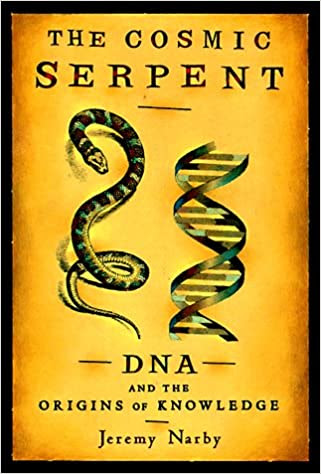
"The Cosmic Serpent" by Jeremy Narby--Nonfiction Review

Today we’re talking about a weird one, Obscurists. This nonfiction book is called “The Cosmic Serpent,” and it’s written by Jeremy Narby.


What I love about this book:

I appreciate the sentiment in this book about keeping an open mind about things and not prejudging, which I realize will probably sound awfully hypocritical a little further on in this review. But, for now, I agree with Narby’s stance that when speaking to native people about their lives and traditions, you should listen to them, reserving judgment for as long as possible. It is certainly interesting how shamans developed several techniques to manipulate the hallucinogenics they ingest and control their biochemical effects. Though I think the author discounts how much could be achieved through simple experimentation, however imperfectly. 

Alternatives on how to think about biology, other than western medicine, are, again, something I find interesting. The concept that ecology from a perspective different than what I’m used to might hold valuable insights is a tantalizing idea. A lot of research for new medicines finds their genesis after all in the world’s rainforests, and a lot of the time, it is native peoples to those regions that develop the precursors to the drugs that get synthesized in labs. True, typically, those indigenous people then get cut out of any real profit-making side of this business, but that’s a different subject that deserves its own essay.

This book does do an excellent job of pointing out that we hold a lot of local shamans and native people’s traditions on the one hand with a sort of bemused disdain. We make a show of not taking anything they have to say seriously while also fleecing them for their best ideas with the other hand. All with absolutely no sense of irony.


What I don’t love about this book:

Right at about the middle of the book—it lost me. Narby takes off onto some truly magical flights of fancy that are just nonsense. By the end, he’s accusing the scientific method of being non-objective because it dismisses what it doesn’t understand, which is precisely the opposite of the scientific method. Finding proof of a new phenomenon that can’t be explained by current models is every scientist’s wet dream because it means there is new science to be done. 

He also has a pretty piss poor understanding of natural selection or only conveniently describes it poorly to support his own unsupportable positions. Toward the end of the text, he says something to the effect of “the theory of natural selection states that evolution only happens through the random collection of errors accumulated in DNA as it’s passed down through the generations, and only keeps the changes which are improvements.” The first part is more or less accurate. Still, the second part is a common misconception used by people who have an ax to grind against the concept of evolution. Natural selection doesn’t “design” anything to be objectively better at anything, it’s merely a statement that what has survived tends to pass down its traits. 

Certainly beneficial traits like evolving wings or eyes can aid in survival and thus make sense as to why those traits are passed down. But if you’ve read my review of “Human Errors,” you’ll know we have some charming problems like retinas that are wired backward. Or the inherited need to desperately seek out vitamin c in our diet that most other animals don’t share with us. So no, the changes brought on by evolution don’t have to be helpful. They tend to be, but sometimes they’re just problems that don’t outright kill us before we can reproduce. 

His other major point he drums that made me grind my teeth is his assertion that it’s a central tenant of western, rational thought to hold absolutely true that DNA, or sometimes he just calls it “nature,” isn’t and can’t be conscious or have intent. And then he uses that to set up a whole host of logical fallacies like Straw man arguments and appeals to ignorance, so on, and so forth. The proper “scientific” way of stating skepticism toward the idea that DNA in of itself is probably not conscious is to say that “you have not proven it is conscious,” not that it “isn’t conscious.” In science, you can prove that something does exist by demonstrating it and then repeating it in testable and measurable ways. You can’t prove the non-existence of things by demonstrating, repeating, or measuring—non-existence.

He also says that the knowledge that he can gain through the use of hallucinogenics can be tested. Great! Here’s a test, use all the hallucinogenics you want and tell me a random digit of pi out past the trillionth place that a computer could verify for us. Then do that a few more times. And if the supposed ancient alien biological technology—that DNA supposedly is—doesn’t want to answer that question, then let’s ask it what it does want to answer. If the question is too hard, then maybe we can start with what color shirt is Bill wearing in Hoboken? Surely, a globally connected decentralized super consciousness should be able to muster that.


This preview is an Amazon Affiliate link; 
as an Amazon Associate, I earn from qualifying purchases.


Parting thoughts:

As you might imagine from above, I didn’t enjoy this book. I think it’s crucial to read things you disagree with because it’s important to know what the other side of an intellectual dispute looks like and to check your own beliefs. 

While not harboring any desire to experiment with hallucinogenics, I can get behind Narby on the idea that our research into precisely how they function in the human brain is woefully thin. It’s only thin because of the conscious choice to bend, at least in the United States, to those of us of a more puritanical bent and deeming all these psychotropic drugs as icky and therefore banned. 

And maybe there is a legitimate public health concern here. But it seems awfully hypocritical to me that here in the land of the free, within ten minutes walk of my front door, I can first indulge in a three thousand calorie fast food meal. Second, get a carton of cigarettes to smoke afterward, and then three chase it all down with a bottle of Jack Daniels. That there is my right as an American, no matter how ungodly destructive it is to my body, which I wouldn’t recommend. However, if I want to do acid or ingest certain mushrooms within the closed walls of my own home, that’s too far.

My point, though, isn’t to glorify drug culture or anything of the sort—none of it seems appealing to me. What I’m pointing out is that we say we have these laws because of high moral standards and character, but once new drug laws go on the books, there are always caveats and exceptions. 

The real reason certain things are prohibited has nothing to do with morality, public health, or safety. It’s money. Specifically, those in power don’t stand to make any or actively might lose some if new competitors enter the marketplace to compete with their “legitimate” psychoactive drugs that they’re invested in.
Wednesday, April 20, 2022

Micro Mention "The Clockwork Universe"

Edward Dolnick


“The Clockwork Universe,” by Edward Dolnick, is about many things—but most of all, it’s about the beginning of true scientific thought. The transitions from alchemy's magic potions to verifiable and reproducible results were painful and anything but clear cut.

It's a fascinating book that describes the early days of the scientific method and the people who made this school of thought that gave us the modern world. That turning point for us as a species is immeasurable in its impact on our collective destiny. It's not at all clear yet if scientific progress will eventually lift us to the point of transcendence or merely give us greater tools to destroy ourselves.


This preview is an Amazon Affiliate link; 
as an Amazon Associate, I earn from qualifying purchases.


Wednesday, April 6, 2022

Micro Mention "Astrophysics for People in a Hurry"

 
Neil deGrasse Tyson


"Astrophysics for People in a Hurry" by Neil deGrasse Tyson is precisely what it claims to be, and it's genuinely impressive how much content is packed into this slim volume. If you want to better understand the universe quickly, here's the book.

I have been a fan of Neil deGrasse Tyson for a while. Like I said in my full review of this book, what I really appreciate about this book is how he talked about a lot of the same material as Carl Sagan's "Cosmos" and even evoked the same spirit as that book but made it his own. Frankly, it's nice to get such a focused product.


This preview is an Amazon Affiliate link; 
as an Amazon Associate, I earn from qualifying purchases.


Thursday, March 31, 2022

Talking In Obscurity, "Human Errors," by Nathan H. Lents

 
Nathan H. Lents


Today Obscurists, I've tricked Steven into reading one of my favorite books on biology and how, well, it could be better. Nathan H. Lents has managed to write a hilarious book on human biology. 


This preview is an Amazon Affiliate link; 
as an Amazon Associate, I earn from qualifying purchases.

Friday, March 18, 2022

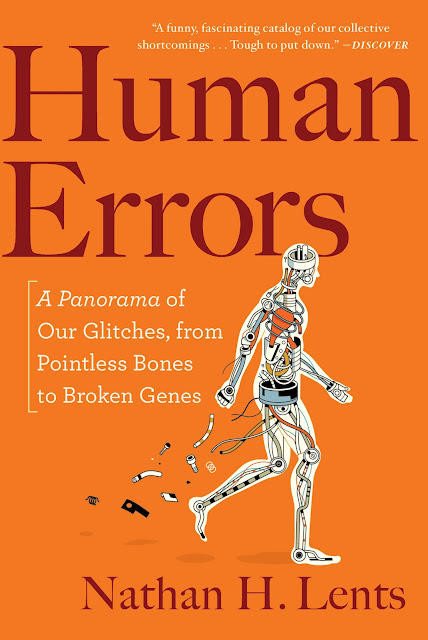
"Human Errors" by Nathan H. Lents--Nonfiction Review

Today my dear obscurists, we’re talking about biology! Don’t worry, it’ll be more fun than it seems because “Human Errors” by Nathan H. Lents is an awesome book.


Nathan H. Lents


What I love about this book:

I re-read a lot of fiction, and not so much when it comes to nonfiction titles, but I’ve probably read “Human Errors” three or four times now—it’s that good. This book is so good, in my opinion, because it transcends just being informative about a topic I find interesting, the biology of the human body, and is genuinely funny. There is not a chapter in it that you won’t be entertained if you randomly flip to it. Lents’s writing is smoothly consistent from start to finish in that regard.

Once you start viewing the world from this book’s lens of the human body is just one big pile of “eh, close enough” biological engineering, you start seeing our bodies’ limitations that are frankly arbitrary. For instance, open your hand and have it palm up. Now have it face down, easy, right? Bet you can even make it go a little further than just straight up or just straight down. Look how flexible you are. But why can’t you make it go all the way around? Wouldn’t a ball joint where our hands could just rotate on—be way more flexible? Oh, and this up-down thing with the hand? Try it with your foot, and you’ll break your ankle. In fact, a lot of our bones in our wrists don’t actually do anything other than float there and get shittier with age.

It isn’t just our suboptimal form, but how our guts function too is often bizarrely inefficient. For instance, humans are terrible at making their own vitamins—unlike most other animals, it turns out. As every desperately poor person has found out since the dawn of civilization—people need a wide and rich variety of food in their diet to stand any chance of having decent health. We’re prone to a panoply of illnesses brought on by poor nutrition without that variety. And yet—consider human’s best friend—the dog. Dogs can eat the same dog food day-in, day-out without complaint their entire lives and never get rickets or scurvy.


What I don’t love about this book:

It’s hard to come up with things I don’t love about this book—there is my ever continuing petty complaint that the chapters are all long, but there is no bite there because they all feel like twenty minutes to me.

The only thing I picked up on—is that Lents seems to be a bit hard on vegans and vegetarians when nutrition comes up. And sure, some nutrients are harder to come by in an entirely plant-based diet, but it isn’t like the solutions in the modern era aren’t plentiful. Either because people have far more access to fruits and vegetables in a greater variety than what can be grown locally, or there are supplements that make up the shortfalls. Also, it isn’t like meat is the be-all-end-all health food for us—which makes sense when you consider that our ancestors rarely ate meat, but only because we’re naturally not great hunters. We lack the physical traits to be great at the activity, and the skills to be a successful hunter are hard-learned, whereas most animals have an instinct for the activity. 


This preview is an Amazon Affiliate link; 
as an Amazon Associate, I earn from qualifying purchases.


Parting thoughts:

Evolution is thought of—wrongly—as a process of adaptation for improvements’ sake. Often there is a villain in a sci-fi monologuing about how they and their people are the next steps in human evolution. But what evolution is, is over the great gulf of time, an aggregate of the genetic traits which have survived. Sometimes those traits are useful, but that isn’t actually a given.

Returning to a prior topic, the phrase “Ye scurvy dog” is especially ironic because dogs don’t get scurvy—well, at least in normal circumstances. So long as they eat and all of their organs function correctly, their bodies make all the vitamin C they will ever need. Our body has all the same machinery to do the same trick, but we lack one key enzyme, which renders the process useless. Why? Because in the distant past, a common ancestor, who was apparently prolific in spreading their genes, had a busted gene that controls this process.

So why didn’t natural selection naturally select this out of us before we all inherited the bum trait of only being close to capable of creating our own vitamin C? Well, again, and this is a difficult concept for people, but evolution doesn’t actually design anything. Not on purpose, at least. Purpose implies a conscious designer who makes choices. Whereas in this case, how adaptation and evolution work is through the mistake. When any animal reproduces sexually, its offspring typically will inherit all of its genetic traits from its parents. The DNA is all dutifully copied, and voila, that’s how traits are passed down from parent to child. But, every so often, there is a mistake in that copy, which manifests as a new genetic trait—and that trait is often cancer—and that organism dies. But sometimes, that trait is just benign or helpful. And after millions of years of this, the differences are profound.

Not being able to manufacture your own vitamin C versus being able to seems like a significant disadvantage. Why wouldn’t the ones that could produce this vitamin be more successful? Well, you must consider the birthplace of humanity—along the equator—in about the north of Africa. What do you also find there in the world? A lot of fruit which has high concentrations of Vitamin C. So, we all have this problem, because back in the day, it just didn’t matter all that much. Assuming you continued to live near a source of the vitamin.


Monday, March 14, 2022

Micro Mention "Stress and Your Body"

Robert Sapolsky


Feel stressed sometimes? Stressed right now, maybe? Want to learn what it does to your body? Then this course, "Stress and Your Body," lectured by Robert Sapolsky, is just the thing.

This is the second lecture series I've listened to by professor Sapolsky, and I've also read his memoir "A Primate's Memoir." He's obviously brilliant, but what I think I value most about him as an educator is his objectivity mixed with a wry sense of humor. It's dry humor, sure, but I'm always surprised how quickly his lectures seem to go by because of how engaging I find him.


Wednesday, February 9, 2022

Micro Mention "Abundance"

Peter H. Diamandis & Steven Kotler


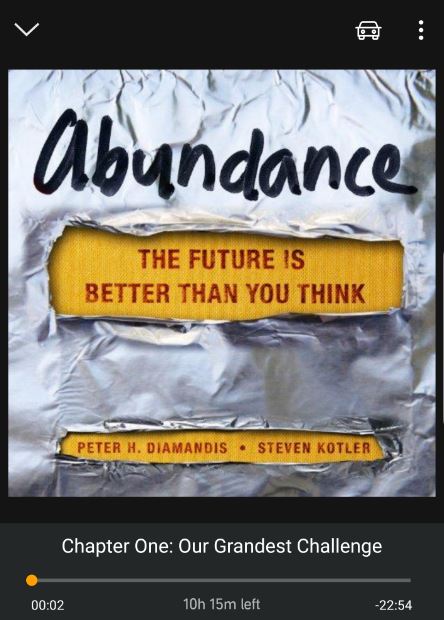
"Abundance," by Peter H. Diamandis and Steven Kotler, reminded me of Ray Kurzweil's "The Singularity is Near." Like that book, essentially, it's an argument that the future will be better than we can imagine because of exponentially improving technologies, and boy, I hope they're right.

I really enjoy the optimism of books like this, and I even tell myself I believe it, which is true most of the time. Without descending into another "climate change is bad" soliloquy—which don't you worry, I'm sure I'll be at again soon—their argument is rather compelling about why things will be better in the future. The pace of technological development really is unprecedented. It only seems normal to us, who have lived during the golden age of technology, because our lives are still relatively short.

Take, for instance, that the United States is still just shy of 250 years old at the time of this writing. However, 250 years ago would be unrecognizable to a modern-day person. Indoor plumbing wasn't something that the vast majority of people had even heard of, let alone experienced. Most of the founding fathers, however, would have been aware that in certain circumstances the ancient Romans and various other cultures of antiquity had access to knowledge and engineering skills that were lost to time, and had to be re-learned.

Sorry to be a bummer, but golden ages can and do end. If we're not careful, who is to say our descendants won't be telling stories about our glorious empires and their works. Maybe in another 200 hundred-odd years, the internet will seem like a fanciful magic tale.


This preview is an Amazon Affiliate link; 
as an Amazon Associate, I earn from qualifying purchases


Friday, February 4, 2022

"Everything All At Once" by Bill Nye--Nonfiction Review

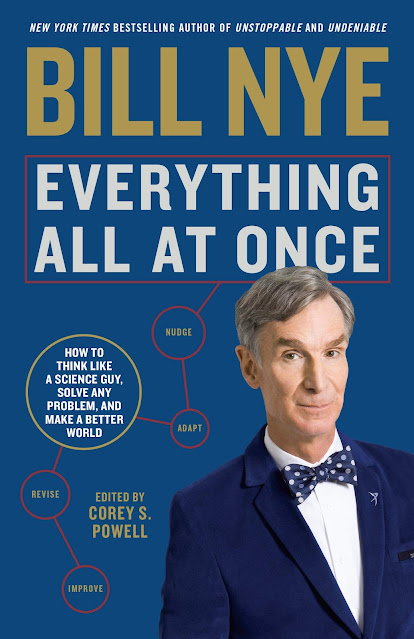
As the man says—we’re changing the world today, Obscurists! Well, at least a little, you will have at least read this review, and that’s a change, a little one, sure, remember though an ocean is but a large collection of drops and all that. Anyway, we’re discussing Bill Nye’s “Everything All At Once.”


Bill Nye


What I love about this book:

I’ve said this in other quarters of the internet and at least obliquely referenced this in my review of “Cosmos”—Bill Nye is a hero of mine. Starting with “Bill Nye The Science Guy,” over the course of nearly thirty years, I’ve probably watched most of the shows he’s been featured in. Also, this is the second book of his I’ve read. So, I’m a fan of Bill Nye, and listening to his audiobook read by him was a real treat.

I admire most about Nye—and really all good scientifically minded people—his capacity to take in new information and admit when he was wrong, which he does in this book. 

The stories about Nye’s life, as a kid and as a young engineer at Boeing, were enjoyable excursions down his memory lane. However, what I appreciated most about these stories is they all had a point for why he was bringing them up, and they fit in with whatever theme he was talking about at that moment in the book. I think Nye is one of the most gifted science communicators I’d ever come across—which you might want to take with a grain of salt because I’m sure nostalgia has more than a little influence on my opinion.

On the topic of petty loves, each chapter of this book was just about at my sweet spot of favorite chapter-length—somewhere between 15 minutes to 30 minutes to read.


What I don’t love about this book:

Like I said above, I love Bill Nye, and I’m very familiar with his work—if not quite an expert. This isn’t precisely a familiarity breeds contempt situation, but Nye regularly strays into a level of absurd corniness. He might be every dad joke that ever was or will be uttered, fused into one being that personifies them all in one avatar.

I rolled my eyes a few times, is what I’m saying.

On the front, of not an actual problem with this book or its author, and just things I don’t like about the world that this book brings up—It often feels like we’re just dead set on being on the wrong track as a species. Despite the excellent work this book and others like it do, and even though from a macroscopic perspective, we as a global society know climate change is killing us—the will to do better is still low and disappointing.

It’s like knowing the house is on fire, and too many members of the human family just shrug and suggest, “well, there is a lot of house to burn before there is no house.”


This preview is an Amazon Affiliate link; 
as an Amazon Associate, I earn from qualifying purchases.

Author’s Website: https://billnye.com/

Parting thoughts:

It is my observation that in all our various human cultures and societies, we suffer from an endemic of thought—a resistance to the idea of ever being wrong. This is the counter impulse to the scientific method, a mental cancer, which insists on magical explanations. It refuses to accept others’ expertise over our own unexamined opinions and feelings.

But most of all, this plague of our minds and discourse demands one thing above all else—that it is a weakness to admit it when you are wrong. It is far better to deny, deny, and deny even when the point has become ridiculous. Instead of admitting fault, it is again better to lie, lie, and lie in the public square until you’re blue in the face. How far should you take it? Just ask the anti-vaxxers lying in early graves or the dead capitol police officers.

The problem has only gotten worse.

Here is the thing, though, all of us have been and will be wrong. In fact, the only thing that moves us forward as a species is taking in new information, admitting our previous theories aren’t robust enough, and refining them, over and over, without end. Absolute knowledge is so far, and likely always will be, impossible.

I, too, don’t like being wrong. It makes me uncomfortable and embarrassed to admit it when it is true. But no matter how I might feel about the subject, it doesn’t make it any less so—ever. I have said many things that turned out not to be accurate even on this blog, I’m sure.

The last thought I want to leave you with today is: being wrong isn’t necessarily bad if you can admit it when it happens. When you can put aside your ego, own your mistakes, and move on—new vistas and new knowledge await. That process of refining old ways of thinking is how we cultivated crops, domesticated animals, learned to fly, split the atom—and yes—even created vaccines.

That is what we all need to do a little more going forward.


Monday, September 20, 2021

Micro Mention "Hidden Figures"

Margot Lee Shetterly


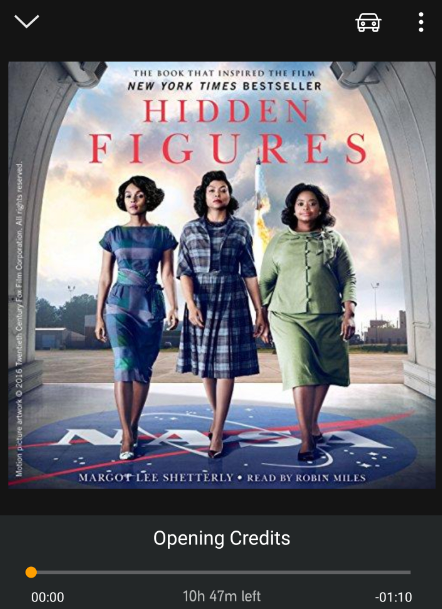
I recall many an idiotic conversation where it was positioned to me that black men and women just don’t contribute as much. An immediate refutation to that is Margot Lee Shetterly’s “Hidden Figures,” the book that inspired the excellent movie.

These women did their jobs as part of our fledgling space program, not just as good as white men and women but often better. The pressure to be accepted at the table was incredibly immense because not only were they women when women were treated as inferiors but also black when a lot of whites didn't consider them even people.

The truth of the matter is we wouldn't have just been poorer as a nation without the contributions and insight of people like Katherine Johnson, Dorothy Vaughan, and Mary Jackson—but poorer as a species. A fine mind can rest in the skull of any person, of any race, gender, or sexual preference. To pretend otherwise is as childish as it is willfully stupid.


This preview is an Amazon Affiliate link; 
as an Amazon Associate, I earn from qualifying purchases.


Wednesday, June 30, 2021

Talking In Obscurity, "The Panic Virus," by Seth Mnookin

Seth Mnookin


Or Download This Episode Here: 


We're back, folks! After a long hiatus, Steven and I are here to talk about books again. And after such a long break due to a pandemic, what should we talk about? Something with "virus" right in the name. That's the Talking in Obscurity guarantee; never read the room.

But seriously, it's a nonfiction book about the "do vaccines cause autism" debate. Short answer: no. 


This preview is an Amazon Affiliate link; 
as an Amazon Associate, I earn from qualifying purchases.

Author's Website: http://sethmnookin.com/

Monday, June 28, 2021

Micro Mention "Nine Pints"

Rose George


So let’s talk about something red! Blood! I’ve got some, you’ve got some, I’d like some more… anyway, moving on “Nine Pints,” by Rose George is a fascinating deep-dive look into the liquid of life, and you should read it.

What I like about this book is it's a high-level and all-around look at the subject. So you get some history on technology involving blood, from leeches to transfusions, and explanations of its bodily function, especially when something is wrong, like during a blood-specific illness.

This book also corrected a misconception I had, and I'd bet a lot of people have as well. I was so used to referring to leeches as such an anachronistic medical practice that it made for a great metaphor for why I thought someone's opinions were backward. However, it turns out that there is still such a thing as medical-grade leeches because there are just some things they can do involving blood that is just better than any other medical treatment. So take that past smug Kevin! You'll just have to find another way to be insufferable.


This preview is an Amazon Affiliate link; 
as an Amazon Associate, I earn from qualifying purchases.

Author's Website: https://www.rosegeorge.com/


Friday, June 18, 2021

"Astrophysics for People in a Hurry," by Neil deGrasse Tyson--Nonfiction Review

It’s review day, obscurists! And today, we’re going to touch on big topics like the stars and the universe, in all their glory, quickly, with Neil deGrasse Tyson’s “Astrophysics for People in a Hurry.” 


Neil deGrasse Tyson


What I love about this book:

This book is very much in the same tradition as Carl Sagan’s “Cosmos,” which is a book I very much enjoy, and I’ve reviewed on this blog as well. Like Sagan, Tyson takes some of the biggest, mind-bending concepts—right on the verge of human understanding—and breaks them down for an audience who aren’t astrophysicists. Similar to what I said in the “Cosmos” review, Tyson achieves this similar effect by explaining the results of well-documented experiments and famous scientific theories with a liberal amount of metaphors.

Unlike “Cosmos,” this book is a far—far more focused product. Ever faithful to his title, in “Astrophysics for People in a Hurry,” Tyson doesn’t meander. You can read every chapter in the book, in about twenty minutes on average, or thereabouts, which is right at that sweet spot for my favorite chapter length.

The material covered in this book is about the fundamental workings of the universe as we understand them—it’s literally the biggest topic there is—and I can’t imagine not being at least curious about the subject. Personally, I’m more than just curious but deeply fascinated, and I can gobble up these sorts of books endlessly. Even when I’ve revisited material I already knew, rereading it never fails to cement it again in my mind in a new and often unexpected way.


What I don’t love about this book:

That focus I lauded above doesn’t come without a cost, and it’s this: “Astrophysics for People in a Hurry” will never be remembered being as profound as “Cosmos.” I find it laudable that Neil deGrasse Tyson didn’t set out to rewrite Carl Sagan’s book. He wrote his own book, largely about the same subjects, but with its own goals. It’s a brief primer, which casts the widest net possible through its focus and brevity to bring in the largest crowd, and hopefully, teach them something.

One thing that “Cosmos” does better and gets short shrift in “Astrophysics for People in a Hurry” is its political commentary—or rather, it’s near-total lacking it until the end. Sagan was never one to shy away from commenting on the virtues and foibles of our little human world—and I’m not precisely accusing Tyson of the opposite—he’s very, very outspoken in the public sphere and a fierce proponent of rational thought. But, unfortunately, this book lacks his typical flair for commentary on the human condition because it’s sacrificed to the abbreviated form rather than any timidity.

So the final chapter, “Reflections on the Cosmic Perspective,” while I like it—a lot—in of itself, feels like an appendix. It’s an indulgent essay in an otherwise just the facts and science text. Mind you, this hurts me to point out because I agree with everything he says in the chapter. It might be my favorite chapter—paradoxical since I’m talking about it here. I guess what I don’t love about this chapter, that I love, is that it’s a bumpy spot in an otherwise smooth experience.


This preview is an Amazon Affiliate link; 
as an Amazon Associate, I earn from qualifying purchases.


Parting thoughts:

The stars—and books about them—never fail to leave me awestruck. Contemplating the infinite, deep time, and cosmic scale objects is an exercise in the abstract, to be sure, but it’s such a sublime experience. These topics create perspective in a way nothing else can. 

It always leaves me wanting to know more and what happens next. It’s probably why I love sci-fi and space opera so much in the realms of fiction. I want to know what is out there beyond our tiny world. But, honestly, it makes me a bit jealous of those generations that will come after us because they might get to find out some of those things. So here’s hoping that they get the chance to get there.