Showing posts with label technology. Show all posts

Monday, March 7, 2022

Micro Mention "Kingpin"

Kevin Poulsen


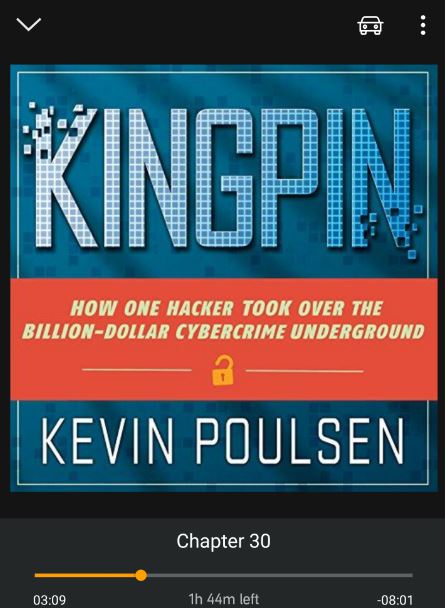
Not going to lie—my favorite thing about Kevin Poulsen’s “Kingpin” was the bit about the FBI agent Keith Mularski aka Master Splyntr from Pittsburgh. Why? Because multiple times during the book, I could say, “I know where that is!” …all small city people are like this.

This book is an interesting and modern true crime story because it combines digital and real-world elements. The people Poulsen talks about are just as colorfully multifaceted as characters in a novel. Plus, I felt how he laid out the events of this true story worked just like any techno-thriller crime drama.


This preview is an Amazon Affiliate link; 
as an Amazon Associate, I earn from qualifying purchases.

Author's Website: https://www.kingpin.cc/


Wednesday, February 9, 2022

Micro Mention "Abundance"

Peter H. Diamandis & Steven Kotler


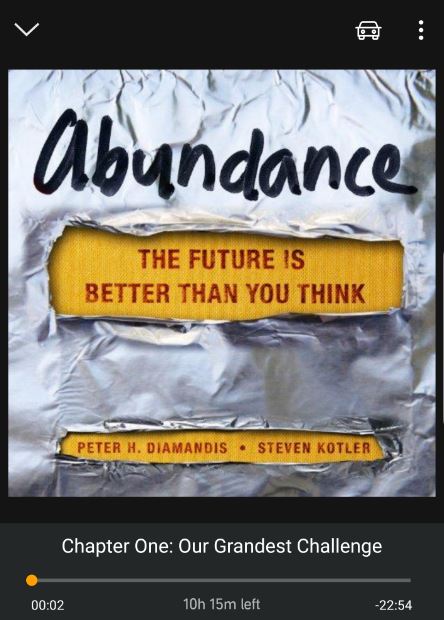
"Abundance," by Peter H. Diamandis and Steven Kotler, reminded me of Ray Kurzweil's "The Singularity is Near." Like that book, essentially, it's an argument that the future will be better than we can imagine because of exponentially improving technologies, and boy, I hope they're right.

I really enjoy the optimism of books like this, and I even tell myself I believe it, which is true most of the time. Without descending into another "climate change is bad" soliloquy—which don't you worry, I'm sure I'll be at again soon—their argument is rather compelling about why things will be better in the future. The pace of technological development really is unprecedented. It only seems normal to us, who have lived during the golden age of technology, because our lives are still relatively short.

Take, for instance, that the United States is still just shy of 250 years old at the time of this writing. However, 250 years ago would be unrecognizable to a modern-day person. Indoor plumbing wasn't something that the vast majority of people had even heard of, let alone experienced. Most of the founding fathers, however, would have been aware that in certain circumstances the ancient Romans and various other cultures of antiquity had access to knowledge and engineering skills that were lost to time, and had to be re-learned.

Sorry to be a bummer, but golden ages can and do end. If we're not careful, who is to say our descendants won't be telling stories about our glorious empires and their works. Maybe in another 200 hundred-odd years, the internet will seem like a fanciful magic tale.


This preview is an Amazon Affiliate link; 
as an Amazon Associate, I earn from qualifying purchases


Friday, February 4, 2022

"Everything All At Once" by Bill Nye--Nonfiction Review

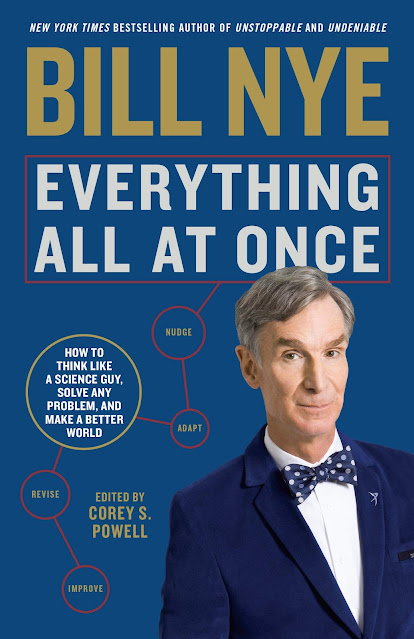
As the man says—we’re changing the world today, Obscurists! Well, at least a little, you will have at least read this review, and that’s a change, a little one, sure, remember though an ocean is but a large collection of drops and all that. Anyway, we’re discussing Bill Nye’s “Everything All At Once.”


Bill Nye


What I love about this book:

I’ve said this in other quarters of the internet and at least obliquely referenced this in my review of “Cosmos”—Bill Nye is a hero of mine. Starting with “Bill Nye The Science Guy,” over the course of nearly thirty years, I’ve probably watched most of the shows he’s been featured in. Also, this is the second book of his I’ve read. So, I’m a fan of Bill Nye, and listening to his audiobook read by him was a real treat.

I admire most about Nye—and really all good scientifically minded people—his capacity to take in new information and admit when he was wrong, which he does in this book. 

The stories about Nye’s life, as a kid and as a young engineer at Boeing, were enjoyable excursions down his memory lane. However, what I appreciated most about these stories is they all had a point for why he was bringing them up, and they fit in with whatever theme he was talking about at that moment in the book. I think Nye is one of the most gifted science communicators I’d ever come across—which you might want to take with a grain of salt because I’m sure nostalgia has more than a little influence on my opinion.

On the topic of petty loves, each chapter of this book was just about at my sweet spot of favorite chapter-length—somewhere between 15 minutes to 30 minutes to read.


What I don’t love about this book:

Like I said above, I love Bill Nye, and I’m very familiar with his work—if not quite an expert. This isn’t precisely a familiarity breeds contempt situation, but Nye regularly strays into a level of absurd corniness. He might be every dad joke that ever was or will be uttered, fused into one being that personifies them all in one avatar.

I rolled my eyes a few times, is what I’m saying.

On the front, of not an actual problem with this book or its author, and just things I don’t like about the world that this book brings up—It often feels like we’re just dead set on being on the wrong track as a species. Despite the excellent work this book and others like it do, and even though from a macroscopic perspective, we as a global society know climate change is killing us—the will to do better is still low and disappointing.

It’s like knowing the house is on fire, and too many members of the human family just shrug and suggest, “well, there is a lot of house to burn before there is no house.”


This preview is an Amazon Affiliate link; 
as an Amazon Associate, I earn from qualifying purchases.

Author’s Website: https://billnye.com/

Parting thoughts:

It is my observation that in all our various human cultures and societies, we suffer from an endemic of thought—a resistance to the idea of ever being wrong. This is the counter impulse to the scientific method, a mental cancer, which insists on magical explanations. It refuses to accept others’ expertise over our own unexamined opinions and feelings.

But most of all, this plague of our minds and discourse demands one thing above all else—that it is a weakness to admit it when you are wrong. It is far better to deny, deny, and deny even when the point has become ridiculous. Instead of admitting fault, it is again better to lie, lie, and lie in the public square until you’re blue in the face. How far should you take it? Just ask the anti-vaxxers lying in early graves or the dead capitol police officers.

The problem has only gotten worse.

Here is the thing, though, all of us have been and will be wrong. In fact, the only thing that moves us forward as a species is taking in new information, admitting our previous theories aren’t robust enough, and refining them, over and over, without end. Absolute knowledge is so far, and likely always will be, impossible.

I, too, don’t like being wrong. It makes me uncomfortable and embarrassed to admit it when it is true. But no matter how I might feel about the subject, it doesn’t make it any less so—ever. I have said many things that turned out not to be accurate even on this blog, I’m sure.

The last thought I want to leave you with today is: being wrong isn’t necessarily bad if you can admit it when it happens. When you can put aside your ego, own your mistakes, and move on—new vistas and new knowledge await. That process of refining old ways of thinking is how we cultivated crops, domesticated animals, learned to fly, split the atom—and yes—even created vaccines.

That is what we all need to do a little more going forward.


Friday, November 12, 2021

"Hidden Figures" by Margot Lee Shetterly--Nonfiction Review

We're doing another space book, Obscurists. Well, sort of, it is more a history of NASA and some of the most talented women to ever work there whose contributions were sadly mostly forgotten until recently. Today's book is "Hidden Figures" by Margot Lee Shetterly.


Margot Lee Shetterly


What I love about this book:

So I'm a big lover of all things space—I'm not so crazy that it's become the playground of billionaires—but still, I love the history of the space race and the ambition and talent that drove NASA forward. I love this book because it shines a light on the contributions of black women who participated, immensely, it turns out, to our success in space.

"Hidden Figures" isn't just a history of NASA's earliest days during the Mercury missions but primarily a biography of Katherine Johnson, Mary Jackson, and Dorothy Vaughan. It shows how all three black women—and more like them—contributed mathematical prowess in the computing departments and engineering expertise in Jackson's case. All of this was at a time when women, in general, were typically discriminated against in the workplace.

Racial prejudice is focused on in far greater intensity in the movie based on this book than the book itself. I'm in no way trying to suggest that it didn't exist back then or that it didn't exist at NASA, and I'm sure these women were faced with that ugly truth. After all, black people don't get to stop being black ever, not for one moment. We should live in a world where color doesn't matter, but that goal has yet to be achieved. 

What I mean is this book reaffirms NASA's core value of excellent research above all else. Any skilled person can describe a good idea or the truth about nature, regardless of uterus status or skin color. That is and always was, most important at NASA. While admitting there were still segregation laws in force at NASA, Katherine Johnson even said that she personally didn't feel it during her time there because the mission was most important at work. I'm paraphrasing from this quote: "... didn't feel the segregation at NASA, because everybody there was doing research. You had a mission and you worked on it, and it was important to you to do your job ... and play bridge at lunch." She added: "I didn't feel any segregation. I knew it was there, but I didn't feel it."

  1.  "Katherine Johnson Interview: NASA's Human ComputerHistoryvsHollywood.com. CTF Media. 2016. Archived from the original on March 3, 2017. Retrieved March 2, 2017.


What I don't love about this book:

The movie focuses on the racial element of the story pretty hard because it's a reliable story beat to gain audience support—at least a certain non-racist audience—but in doing so, it miss characterizes this book, in my opinion. Sure, generally, the past in the late '50s and the early '60s overall had a more in-your-face sort of race problem. However, telling the story of these women as a way of saying they succeeded despite the old racists at NASA is kind of disingenuous and lazy. NASA was a pretty progressive place back then, maybe not to our standards today, but still, the Mercury missions took place on the tail end of the Jim Crow era. The idea that black people and women, too to boot, were trusted with genuine, hard, and necessary—life or death work was radical for the day. 

So the actual shameful thing—the real no-joke insidious racism—that this book points out is how we just forgot these women, who they were, and what they did. It's insidious because of its banality. Women like Johnson, Jackson, and Vaughan were always there up to the modern era. They just weren't given any sort of visibility to the public, in either the media or in popular movies—movies I like which saddens me to no end.

The Hollywood movie is the way that it is, in my opinion, because we like to see the past being somehow less enlightened on this front—across the board—and that we, the wise non-racists, have grown and transcended this problem. Except that's bullshit, and we haven't. We're just much more sensitive to being called out for when we're doing some racist shit. Ignoring the contributions of some, belittling them, denying them representation or just plain apathy toward an ethnic group is, in fact, racist.

Where I am going with this point is that this book's quality that makes it feel like a revelation isn't a good thing as the movie version supposes. It isn't a breath of fresh air, some grand rediscovery—it's a goddamn American tragedy. The idea that we as a society tacitly allowed the perception that NASA employed nothing but exclusively white dudes with pocket protectors from the flight director all the way down to the janitor and no one else—is as tragic as it is wrong.


This preview is an Amazon Affiliate link; 
as an Amazon Associate, I earn from qualifying purchases.


Parting thoughts:

So for my parting thoughts, I'd like to shift gears here. Recently, it has become fashionable, we'll say, for some groups of Americans to vocally and stupidly claim that we never landed on the moon—and also that the Earth is flat. I don't know, probably.

This is one of those things like Mr. McConaughey's character in "Interstellar" that instantly gets under my skin and annoys me. On the face of it, not only is it wrong, with nearly every country verifying that our radio signals from the Apollo missions came from the moon. Countries including Russia, who was famously competing with us at the time to do just that. Not only is it a denial of the single greatest technological feat we as Americans have ever accomplished, including the atomic bomb, and that there are literal mirrors on the moon that we still use in experiments today left by the Apollo astronauts. It is a slap in the face of every brilliant American astronaut, scientist, engineer, mathematician, and physicist who sacrificed so much, sometimes their very lives, to accomplish that dream.

This insult typically comes from the same group of people who can't even spell algebra, let alone pass it in high school. So why do they insist on their factually wrong position and that we take their non-expertise as valid? I've meditated on this point for a long time, and I believe the answer is actually quite simple.

They are Americans who hate America.

That is a loaded and admittedly inflammatory statement that requires qualification—which I will provide. More precisely, they hate America as it is, and as it always has been, which is a broad land of immigrants from all corners of the Earth, with different skins, beliefs, religions, and languages cohering together as one society. They do, however, love their imaginary America that they've constructed in their mind. An America that was somehow uniformly white, Christian (whichever brand they subscribed to), and the reason that there are literally any problems whatsoever is that we've gotten away from that.

There is this sick love for conspiracy where there is no conspiracy. Instead of admitting that maybe their lives are mediocre because they are, in fact, mediocre. They've never taken the time or effort to change that about themselves. Instead, they invent cabals of satan worshiping pedophiles that somehow hold back their natural all-white awesome American-ness.

The denial of the moon landing stems from the same poisoned fruit that we couldn't possibly have succeeded at such a challenge because the people who did it weren't pure as defined by some wackjob. The people who did the work, the math, the planning, and took the risks to make it possible were diverse in ethnicity, gender, and religion.

And that has no place in their imaginary America. So it didn't happen.


Wednesday, September 15, 2021

Micro Mention "The Master Algorithm"

Pedro Domingos


“The Master Algorithm” by Pedro Domingos is way fascinating—I imagine especially so for all you computer scientists out there—and I loved lying to myself for a while that it wasn’t way over my head.

I like to challenge myself with books like this sometimes, books about topics that fascinate me but are just on the edge of my ability to comprehend. So to break down what this book is about, you first need to know what an algorithm is and how it applies to computer science. Very broadly, an algorithm is a set of rules and procedures used in problem-solving. Computers love rules like if X then do Y or if 2X do Z, et cetera—et cetera in ever greater complexity. So "The Master Algorithm" is a learning model so complex and elegant that eventually, it would, in theory, be able to mimic human-level complexity of thought and then one day go beyond.

How we get there—much like the road to El Dorado—is unclear, and maybe impossible, or maybe it's just impossible today but is really inevitable. It's hard to say. As a materialist at heart, I don't believe, other than its complexity, that there is anything special about our brains, materially speaking. All they are are mostly fatty fleshy bags that hold a lot of water, consume many calories, and have measurable electrical activity. There isn't a single rare component to them from an elemental perspective. So it would seem that given enough time, we should be able to build a software model that might not exactly emulate the human brain but at least be comparable in terms of complexity. The interesting questions then are, would that software be conscious? Would it be alive? And most interesting, could you believe it if it said it was?


This preview is an Amazon Affiliate link; 
as an Amazon Associate, I earn from qualifying purchases.


Friday, February 12, 2021

"Homo Deus," by Yuval Noah Harari--Nonfiction Review

Hello, my dear obscurists! Last week, we talked about a science fiction speculating on the possible darker side of humanity’s future. So today, I thought we’d discuss a nonfiction written by Yuval Noah Harari called “Homo Deus,” which is about humanity’s possible future. Lookout, we’re doing a theme here.


Yuval Noah Harari


What I love about this book:

Futurism and futurists have a special place in my heart—like Ray Kurzweil, for example—but despite the title and content of this book, to claim Yuval Noah Harari as a futurist might be a bit of a stretch. In this book, Harari looks at the intersection between our species’ history and where our technology is progressing and charts out what our course might be in the future. That aspect of it reminded me of Kurzweil’s “The Singularity is Near,” a book I rather quite liked, and I enjoyed that speculation on the future in “Homo Deus” nearly as much. 

Harari has such a conversational tone and sharp insight that it makes reading—or in my case, listening to—this book a real joy. How he flows from topic-to-topic while weaving in evidence to support his points is almost hypnotic in a way. He makes it look easy, is all I’m saying, which is impressive for a book about deep history and time.  

In “Homo Deus,” Harari tackles prejudices of thought that aren’t exclusively the racist sort of prejudices, but things like the proposition that the agriculture revolution was an unqualified good thing. It had good effects for us—humans—some bad too, but that’s a different topic, but mostly it’s an example of how one kind of creature could fundamentally change the environment around them. Great for us, but catastrophic to all the other life in our way. This is our superpower as a species, in action, and we’re only getting better at it in terms of power and not necessarily wisdom. Since there is no going backward—barring world-ending nuclear holocaust—I believe Harari’s point in this book is that we need to proceed with a clear understanding of the past and with restraint, characteristics of wise decision making.

The primary prejudice “Homo Deus” points out is the assumed primacy of humans, specifically Homo Sapiens—our brand of humans. Quick aside, there are no other groups within the Homo genus because we killed them. Sure there is the argument they might have died out because of climate change. But what seems more likely to you? The Homo Neanderthalensis, and assorted Homo cousins, all died out because the weather fundamentally changed. Or that “climate change” was represented as one group of the genus, say Sapiens, for example, invented language, close communities born of cooperation, and the throwing spear. Let me remind you we don’t even like other Sapiens who happen to have different skin colors. The tragedy here is our best qualities are often used for terrible purposes.

All of this certainly made us powerful. But does power or rather—and you may have heard this before—might make right? That’s the primacy of humans, and “Homo Deus” questions the objectivity of that premise.


What I don’t love about this book:

Harari spends a great deal of time covering territory, or rather re-covering territory in this book that seems more appropriate for his preceding book, “Sapiens.” Don’t get me wrong, it’s not that he’s whole cloth restating himself from that book in this one. What I mean is far more subtle than that. If “Sapiens” and “Homo Deus” work as a series and the former is a look at humanity’s past, the latter should be a look at the future—and it is—sort of, but a lot of it also looks at the past. You could make the argument that you can’t understand the future without understanding the past, and I agree. He wrote a whole book covering that before this one. The next argument is that maybe not every reader of “Homo Deus” has read “Sapiens” first, and he needs to do it this way to include them. Fair, but I still don’t understand why people do this—read books out of order, which drives me nuts when I do it accidentally. 

My old nemesis of hyper long chapters raises its irksome head in this book, which I know I mention a lot in this blog. But when it stops annoying me, I’ll stop mentioning it, so settle in that heat death of the universe thing can’t be too much longer off from now.

A thing that made me uncomfortable about my own failings; is all the allusions in this book to the horrors of industrial-scale ranching and meat production. Harari is an ardent vegan—and I admire him for that. I wish I could say that I could maintain the lifestyle of just a vegetarian, but so far, that isn’t the case. I really, really like the taste of buffalo chicken wings, and a steak made rare. I wish that I didn’t. Books like this have made it so I will never eat veal knowingly ever again. But even I realize that’s like saying, “look, I only cut down ninety acres of the hundred-acre wood. Pooh and his friends have like ten whole acres of woods left to gallivant around in whenever they want.” So this is a necessary societal—and clearly personal for me—evil that we needed to be confronted with, so I’m glad Harari put it in this book from an intellectual perspective. Emotionally, it sucks because I don’t like feeling like the bad guy, especially when I am the bad guy.


This preview is an Amazon Affiliate link; 
as an Amazon Associate, I earn from qualifying purchases.

Author's Website: https://www.ynharari.com/

Parting thoughts:

The will to change—and change for the better—is hard. It takes immense willpower, and willpower is a finite resource. From my understanding of modern-day psychology, this is true of not just individuals but also societies of people. To indulge in a cliché, the future isn’t written yet—but it is coming, and coming faster and faster every day. If the last thirteen odd months have taught me anything, it’s that if we want a bright future like the one Gene Roddenberry imagined, then we collectively need to change for the better. Otherwise, we’ll end up living in one a lot more like Orwell and Huxley imagined.

As I’ve grown older, I’ve noticed that some things get set in motion. Then their inertia is such that as an individual, the momentum is too much to overcome alone. There is a limit to what one person can achieve or grow beyond—and that sucks. I’ve even touched on one of my own limitations when it comes to diet. I consider myself an animal lover. But no matter how you gussy it up, though, no argument has ever convinced me that quality about my character isn’t incompatible with the fact that I find chickens delicious—and am therefore unwilling to stop eating chickens. As an individual, the willpower to change—on this specific topic—just isn’t there for me. I just accept the flaw and live with the discontinuity.

I would argue, though, that the point of a society is to overcome individuals’ flaws and deficiencies to create a better world for everyone. In America—this American too—we’re deeply skeptical of that concept, and historically, we have always been so too. We believe in the strength and character of the individual, the maverick, the pioneer, and there is precedent for this belief. When individual Americans such as Abraham Lincoln and Ulysses S. Grant led us through the civil war, they had their supporters, numerous even—but the collective in power was mostly against them. That’s another example of how the collective isn’t always morally correct. But on the other hand, taking another American president whose face is on money as an example, Andrew Jackson was undoubtedly a dynamic individual, and he was a lunatic. So you win some, you lose some. 

The great question is; how do we balance these conflicting notions of the flexibility and innovation of the individual and our species superpower of collective cooperation to change the world—and do it for the benefit of all life, not just human life?