Showing posts with label Astronomy. Show all posts

Saturday, June 11, 2022

"Spaceman" by Mike Massimino--Nonfiction Review

So I’ve been pretty clear on this blog before about how much I love space, which is why today we’re talking about Mike Massimino’s “Spaceman.”
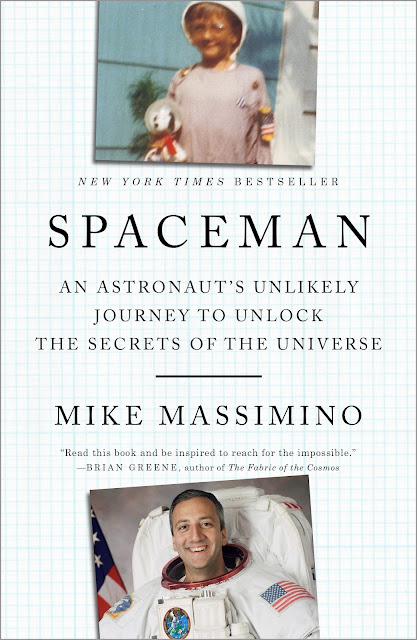

Mike Massiminio


What I love about this book:

Clearly, the space stuff is my top love for this book. Massimino was part of the tail end of the generation of astronauts who flew in the space shuttle, which I’m not too proud to admit I don’t know as much about as the earlier programs. So it was nice to get to know the names and missions that happened during his time at NASA.

Most of this book is about his journey to become an astronaut. I hadn’t realized this before he pointed it out, but, unlike most career paths, there are no well-known tracts to take to become an astronaut. So it’s nice that he put it down how he did it, for all the advice he provides.

Massimino is a charmingly warm and often funny guy. I went in for the audiobook version—per usual—and it’s read by him. I know I belabor this point a lot, but especially in this, hearing the tone of his voice as he relates some of his personal disappointments and some of the tragedies to befall NASA immeasurably adds to the experience.

Getting his first-hand account of what it was like to work on the Hubble telescope was endlessly fascinating to me. It cannot be adequately expressed how much that orbiting telescope has given us, so it’s incredibly important. Working on it in space sounded equally amazing as it was terrifying.


What I don’t love about this book:

There isn’t much I didn’t love about this memoir. It’s firmly in my wheelhouse, after all. If I had to say something, maybe an argument could be made that it dithers a little bit too much before getting into the meat of the NASA stuff. That isn’t too serious of a criticism, though, because I enjoyed Massimino’s journey becoming an astronaut almost as much as I enjoyed him as an astronaut.

The Space Shuttle Columbia disaster was hard to read about and thus relive. When the Challenger exploded during the launch, that disaster happened before I was born, but I was in middle/high school when Columbia happened. So the tragedy of that event when it happened still sticks in my mind, and the old feelings of disappointment that NASA, an organization I idolized, didn’t do enough to keep that crew safe resurfaced. That they dropped the ball on the dangers of free-falling foam debris from launch and how it could damage the orbiting vehicle.


This preview is an Amazon Affiliate link; 
as an Amazon Associate, I earn from qualifying purchases.

Author’s Website: https://www.mikemassimino.com/


Parting thoughts:

Space exploration is inherently dangerous and expensive. There are many solid arguments for why we shouldn’t bother with this exercise. How to justify the cost monetarily and, more importantly, in lives lost is tricky. Why spend billions of dollars on space exploration to send a handful of people to space while millions of people are starving right here on Earth.

What Space exploration is ultimately about is investing in the next step for our species, for the next generation’s future. It’s about the billions and billions of people yet to be born who could one day lead a better existence beyond the confines of the Earth. 

The Earth, as wonderful and beautiful as it is, is a closed system. We keep adding more and more humans to that closed system without increasing the fixed amounts of resources and livable area. The idea that we’re somehow going to collectively agree to stop creating too many people globally and then create rigidly sustainable utopias out of our various bickering and competing cultures in the near future demonstrates a lack of awareness of human history in my mind.

At this point in our societal and social evolution, we should do what we have always done collectively when faced with shortages of livable space, opportunity, and resources. We should move on and spread out.

Crossing the oceans at one point seemed like an impossible technical feat to our ancestors, yet, they eventually managed it. It wasn’t safe, and it wasn’t cheap. Many people died for the dream of seeing over that next horizon. But in the end, it was necessary.

Let’s be clear about this point: our shameful legacy of appalling poverty, sickness, famine, and war wasn’t caused by NASA’s budget. Our poorest citizens, again globally, are so poor because we’re still collectively beholden to a wealthy and privileged ruling caste. We might not call our billionaires princes, princesses, dukes, or duchesses anymore in the United States, but that doesn’t mean they don’t exist. 

Most of the world’s wealth belongs to a few individuals—a lot of it is inherited wealth that wasn’t earned in any meaningful way by the so-called elites of our various human societies but is merely passed down. That is the real insidious reason most of us toil from the cradle to the grave.

I wish that we were collectively wise enough to conserve the Earth and do so in a way that we could all live reasonably equitably on it and happily. But wishing reality was different doesn’t make it so, and realistically what I believe our next step is—is to chase that next frontier, the last and final one above us all. 
Wednesday, April 6, 2022

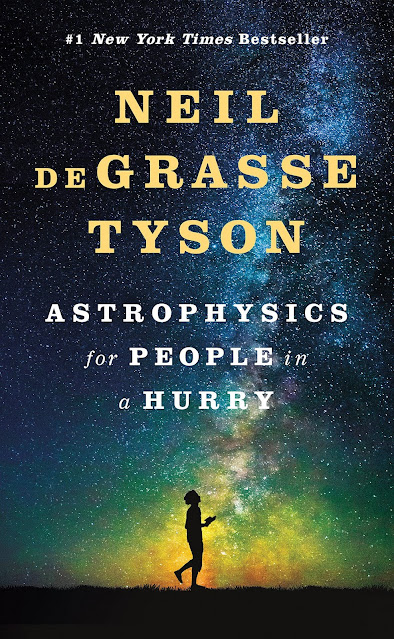
Micro Mention "Astrophysics for People in a Hurry"

 
Neil deGrasse Tyson


"Astrophysics for People in a Hurry" by Neil deGrasse Tyson is precisely what it claims to be, and it's genuinely impressive how much content is packed into this slim volume. If you want to better understand the universe quickly, here's the book.

I have been a fan of Neil deGrasse Tyson for a while. Like I said in my full review of this book, what I really appreciate about this book is how he talked about a lot of the same material as Carl Sagan's "Cosmos" and even evoked the same spirit as that book but made it his own. Frankly, it's nice to get such a focused product.


This preview is an Amazon Affiliate link; 
as an Amazon Associate, I earn from qualifying purchases.


Friday, June 18, 2021

"Astrophysics for People in a Hurry," by Neil deGrasse Tyson--Nonfiction Review

It’s review day, obscurists! And today, we’re going to touch on big topics like the stars and the universe, in all their glory, quickly, with Neil deGrasse Tyson’s “Astrophysics for People in a Hurry.” 


Neil deGrasse Tyson


What I love about this book:

This book is very much in the same tradition as Carl Sagan’s “Cosmos,” which is a book I very much enjoy, and I’ve reviewed on this blog as well. Like Sagan, Tyson takes some of the biggest, mind-bending concepts—right on the verge of human understanding—and breaks them down for an audience who aren’t astrophysicists. Similar to what I said in the “Cosmos” review, Tyson achieves this similar effect by explaining the results of well-documented experiments and famous scientific theories with a liberal amount of metaphors.

Unlike “Cosmos,” this book is a far—far more focused product. Ever faithful to his title, in “Astrophysics for People in a Hurry,” Tyson doesn’t meander. You can read every chapter in the book, in about twenty minutes on average, or thereabouts, which is right at that sweet spot for my favorite chapter length.

The material covered in this book is about the fundamental workings of the universe as we understand them—it’s literally the biggest topic there is—and I can’t imagine not being at least curious about the subject. Personally, I’m more than just curious but deeply fascinated, and I can gobble up these sorts of books endlessly. Even when I’ve revisited material I already knew, rereading it never fails to cement it again in my mind in a new and often unexpected way.


What I don’t love about this book:

That focus I lauded above doesn’t come without a cost, and it’s this: “Astrophysics for People in a Hurry” will never be remembered being as profound as “Cosmos.” I find it laudable that Neil deGrasse Tyson didn’t set out to rewrite Carl Sagan’s book. He wrote his own book, largely about the same subjects, but with its own goals. It’s a brief primer, which casts the widest net possible through its focus and brevity to bring in the largest crowd, and hopefully, teach them something.

One thing that “Cosmos” does better and gets short shrift in “Astrophysics for People in a Hurry” is its political commentary—or rather, it’s near-total lacking it until the end. Sagan was never one to shy away from commenting on the virtues and foibles of our little human world—and I’m not precisely accusing Tyson of the opposite—he’s very, very outspoken in the public sphere and a fierce proponent of rational thought. But, unfortunately, this book lacks his typical flair for commentary on the human condition because it’s sacrificed to the abbreviated form rather than any timidity.

So the final chapter, “Reflections on the Cosmic Perspective,” while I like it—a lot—in of itself, feels like an appendix. It’s an indulgent essay in an otherwise just the facts and science text. Mind you, this hurts me to point out because I agree with everything he says in the chapter. It might be my favorite chapter—paradoxical since I’m talking about it here. I guess what I don’t love about this chapter, that I love, is that it’s a bumpy spot in an otherwise smooth experience.


This preview is an Amazon Affiliate link; 
as an Amazon Associate, I earn from qualifying purchases.


Parting thoughts:

The stars—and books about them—never fail to leave me awestruck. Contemplating the infinite, deep time, and cosmic scale objects is an exercise in the abstract, to be sure, but it’s such a sublime experience. These topics create perspective in a way nothing else can. 

It always leaves me wanting to know more and what happens next. It’s probably why I love sci-fi and space opera so much in the realms of fiction. I want to know what is out there beyond our tiny world. But, honestly, it makes me a bit jealous of those generations that will come after us because they might get to find out some of those things. So here’s hoping that they get the chance to get there.


Friday, April 10, 2020

"Cosmos," by Carl Sagan--Nonfiction Review

We’ve made it to another Friday, my dear internet strangers. You all still socially distancing? Still, reading this blog? Good, you’ll survive… that isn’t to imply reading this blog will impact your chances of survival one way or another, or is it?

Anyway, in today’s nonfiction review, we’re talking space stuff, shocking, I know, with Carl Sagan’s “Cosmos.” It’s one of those books that I believe everyone should read at least once in their life because the gifts Carl Sagan left us with are genuinely precious—chief of which is the gift of perspective.

Carl Sagan


What I love about this book:

It isn’t just a book about astronomy. Don’t get me wrong, I love me some astronomy and could talk about it for many an hour—but Sagan doesn’t limit the topics covered in “Cosmos” to things that happen in outer space. After all, like that stoner you met in freshman year, once said, “like everything man, is like the universe, so like we’re all the universe, man.” He wasn’t wrong—inelegant maybe—but not wrong. Sagan describes it a bit more elegantly by saying that we are all made of star-stuff. He leads you on the journey of why that is true, explaining that all elements making up matter are ultimately forged through the process of fusion in the furnaces of every star. The rarer and very dense elements, further down the periodic table, can only be made via this process, not in normal stars but only after a star dies in a fiery explosion called a supernova.

Without getting too much further into the weeds—understanding that and how matter and energy can’t ever truly be destroyed but only transformed creates an opportunity. The opportunity to realize that not only are we all fundamentally the same, but the greater truth that we are connected to everything, everywhere, for as long as time passes. No one and nothing is ever truly lost, only changed in form and pattern.

Overall, the text of “Cosmos” is accessible for everyone, regardless of personal scientific education level. Carl Sagan wouldn’t have been the arch science communicator we remember him as if he could only express himself in a meaningful way to other astrophysicists. His book is the perfect starting place for anyone interested in the stars, physics, or the universe as a whole. He doesn’t dumb down the concepts presented in the book, more he just slowly and robustly explains them without presupposing the audience all have PhDs. How does he do this? With a lot of metaphors. 

Sagan sometimes even flexes his fiction muscles at various points in the book, for which I’m appreciative. He’s a powerful writer, and his talents with fiction are sometimes forgotten in the face of his nonfiction accomplishments as an astronomer, astrophysicist, and a science communicator—especially in the shadow of the television programs that share a namesake with this book.         


What I don’t love about this book:

Sagan can wax poetic like the best of them, and most of the time, it’s lovely—flowery and so forth, but it can be a bit long-winded. The problem is he takes a while,  getting to his point of whatever he’s describing. When he does get there, it’s usually graceful, sort of like how the Sistine Chapel is elegant—but if all you wanted was a picture, there are no pictures in Cosmos, only Sistine Chapel(s), metaphorically speaking. Literally, there are several pictures in “Cosmos,” and what I’m getting at is the word choice is always elevated, and with elevated language, your audience needs to be in the right mindset to appreciate the product fully. I understand why the author chose to write this book in such a revering way. This is his life’s work, and it’s about the most significant topic possible because it’s about the whole universe—which by definition, is the biggest thing that can be conceived of that we know for certain exists.

Also, “Cosmos” is guilty of one of my primary nemeses when reading—hyper long chapters—right up there with super short chapters in terms of how much it annoys me. I get it—the thirteen chapters of “Cosmos” accompany the thirteen episodes of the original “Cosmos” show, but it still aggravates me for petty reasons.

It’s hard to say what any chapter in the book is precisely about in a concise way. Certainly, they’ve all got individual themes, and they’re about a lot of things, but without breaking them down further, they all become vast self-contained literary adventures in their own right. So my experience reading “Cosmos” wasn’t that I was reading one book but several small books tied together. 


This preview is an Amazon Affiliate link; 
as an Amazon Associate, I earn from qualifying purchases.


Parting thoughts:

Carl Sagan lived and died a little before my time—so sadly, I don’t know the experience of him and his work as a science communicator during my formative years. Those figures for me are Bill Nye and Neil deGrasse Tyson. Yes, I was alive in 1996 when Carl Sagan died, but I was in elementary school, and my love for the stars hadn’t been fostered much beyond reruns of “Star Trek: The Next Generation.”

Even still, it has been an emotional journey for me to discover his work and watch his old shows now that I’m older. My introduction to him, was in fact, “Cosmos” but hosted by Neil deGrasse Tyson. I guess technically the first thing I’d experienced by him was “Contact” the 1997 film based on his novel of the same name—but I don’t count it because I hadn’t realized that movie was based on a novel, haven’t seen it since the ’90s, and it went way over my head back then. I’ll have to revisit it at some point.

Why this stuff resonates with me so much is because outer space, the further reaches of our solar system and beyond, is our only logical future as a species. There are no more oceans to cross on Earth, no more lands to discover—this is it, and there are more of us every day. I know it’s a strange thing to say during a pandemic, but even after world wars one and two, and the Spanish flu, which by all accounts was far more lethal than COVID-19, the Earth’s population still grew and grew at ever-increasing rates. It will continue to do so—even after this.

Carl Sagan was ultimately an optimist. He believed in humanity, and that we can be better. Through the rigorous use of the scientific method, one day, we will reach the stars, and it is a beautiful dream. Before that can happen though, we as a species need to do better, to cooperate and learn to let live, better. For me, that is ultimately the perspective Carl Sagan wanted us to adopt—and I hope we don’t let him down.