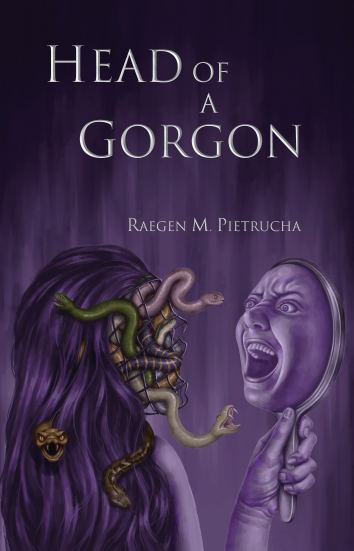
Today Obscurists, we’re diving into another book on poetry.
Full disclosure—these poems and the overall narrative of this book touch on
violence, sexual and otherwise. It also involves mental health, including
straying into the realm of suicide ideation, so it’s worth keeping that in mind
before picking it up. Besides that, “Head of a Gorgon” by Raegen M. Pietrucha
is thought-provoking and visceral.
What I love about this book:
Succinctly put, “Head of a Gorgon” is an incredible read—it’s short, so I flew through it in one sitting, but I also felt compelled to re-read portions of it again, more than once.
I’m a sucker for anything touching on Greek myth ever since I read Madeline Miller’s “Circe,” which I’ve also reviewed. Pietrucha’s work hits in the same vein as that novel—reimaging a female character from classical myth as someone more complicated than a straight villain—while approaching the subject from a wildly different angle.
I found myself enjoying the structure of this book—a narrative told through poems—it got me to do two things I seldom do; first, I read a physical paper book with my terrible eyes, and second I read a poetry book which is always a challenge for me. Overall, still a rewarding experience.
From start to finish, it’s hard to put down or even take a break from because each bit is laser-focused and leads right into the next one. So quickly, I would find myself on the treadmill of, “well, I’ll just read one more poem,” and then it would be another one after that, and after that, and so on and so forth.
What I don’t love about this book:
As much as I enjoyed this narrative approach to poetry—it’s still poetry. So it’s a stretch for me, and I need to be in the right frame of mind to enjoy any poetry. I’m constantly battling the feeling when reading it that I just don’t get it, and it’s going over my head.
Poetry is one of those creative forms of writing I wish I were better at writing and enjoying, but people can also hope for wings. My attempts all come off as artificial to myself. So really, these are more things I’m disappointed in myself than “Head of a Gorgon.” Ultimately, I found the experience of this book sublime, even with its darker moments. Since it slots into a section of literature I’m not all too familiar with, it’s difficult for me to grasp onto anything to critique. My experience was pretty uniform from start to finish; I was pleasantly surprised.
Author’s Website: https://raegenmp.wordpress.com/
Analysis:
While I’m sure almost everyone in the world knows who Medusa is, still knowing a bit about Greek mythology adds immeasurably to the experience of these poems. For instance, when the conversations between M and P are happening, it’s obviously helpful to know Medusa’s story to deduce who P is in this context. But less obvious is—there are a lot of references to water in these poems, and at first, that might seem confusing because Medusa isn’t the same snake-like monster as Scylla, who spent her time munching on sailors like Odysseus’s men. But, if you know Medusa’s parents and how prominently M’s parents play a role in these poems, especially at the beginning and the end—the references to water make much more sense.
I also liked the shedding skin sections—in theme and style. It’s a clever call back to earlier poems in the narrative of this collection presented through deconstruction to change the meaning of those earlier poems. It had to have taken some serious planning to execute.
Parting thoughts:
In literature, there are a lot of women who get short shrift, especially in myths. For as much as I find Greek mythology fascinating, women had few roles, and in Scylla, Circe, Medusa, and Calypsos cases—to create a short list—they are often antagonists our male heroes have to overcome. If they aren’t dutiful wives—then they’re witches, seductresses, or straight-up monsters, with no in between.
The real power of a narrative like in “Head of a Gorgon” is to take that negative persona and flip it on its ear. It wasn’t until the modern era—as far as I know—that anyone considered the qualia of what it was like to be in Medusa’s head, or any of them for that matter.
I believe that context matters—with context comes understanding and empathy. Redefining these ancient characters’ context is creative and breathes new and better life into them. I think that is the heart of what I liked the most about this book and others like it.