Showing posts with label World Building. Show all posts

Friday, December 17, 2021

"Ubik" by Philip K. Dick--Fiction Review

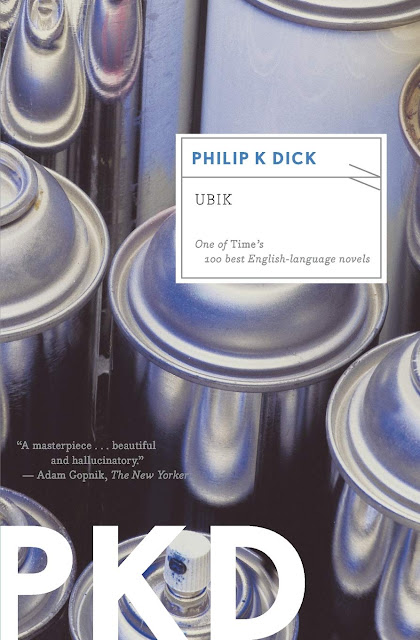
Time for some classic sci-fi Obscurists. Today we’re discussing “Ubik” by Philip K. Dick which is also a sneaky scary story too.

Philip K. Dick


***The Non-Spoiler part of this review***


What I love about this book:

“Ubik” is weird—weird even for a guy who came up with the story that would become “Blade Runner.” It’s also a sort of techno-nightmare, which is clearly what I like the most about it as a story.

Without spoiling too much, reality gets real weird real fast in this book, which causes a palpable atmosphere of unease. This drives the plot briskly because the characters are racing against time as the world around them is literally degrading.

I also like the old-timey sci-fi feel of this novel, an effect I’m certain wasn’t intended when it was written. Like most of its contemporaries, there are many fantastic futuristic technologies in its case in the form of; psychics, starships, a certain amount of mastery over death—but it fails to foresee the revolution in computers. There is something quaint about stories from this era because of this blindspot. Like how in “I, Robot,” we’ve somehow managed to master life-like androids but not the personal computer for some reason. Also—to be clear—stories from this era aren’t unaware of computers and their uses. It’s just that they undersell their ubiquity and how they would mesh into every corner of our lives.


What I don’t love about this book:

Overall, women don’t get an excellent portrayal in “Ubik,” they’re not all terrible or useless, nothing like that. But they are less characters than archetypes, which I’m not the first to point out about Dick’s portrayal of women in all of his writing. Once you see it, you really can’t unsee it in his stories.

There is also a whole lot of talk about how a lot of these people have godlike psychic powers or powers that counter those psychic powers, but it’s really much to do about nothing. I’m not convinced that the plot couldn’t have gone on fine by itself and just drop superpowers. They are used a few times for—I don’t know—effect or fun? But they don’t actually contribute a lot to the story because it isn’t about having awesome superpowers. It’s a story about death and what happens after.

The ending of “Ubik,” typically my favorite part of a story, doesn’t exactly work for me. I get the effect, adding one more layer of uncertainty, but it arrives with the same sort of thrill of Freddy or Jason—shone to still be alive at the end of the tale. Great, if a sequel is being planned, but there wasn’t, so it’s just a useless appendix that only raises concerns and questions with no resolution.


This preview is an Amazon Affiliate link; 
as an Amazon Associate, I earn from qualifying purchases


***The Spoiler part of this review***
***Ye be warned to turn back now***


The quick and dirty synopsis:

“Ubik” hits the ground running with super sci-fi technology, and we’re introduced to several new innovations of this world. First up, companies employ telepaths and precogs (people who can see the future, and if that sounds like a Tom Cruise movie, that is because it is), and there are companies who specialize in countering those powers. Second, technology is so advanced that the recently deceased can be put into a kind of cold storage and granted a sort of mental half-life.

Friday, October 29, 2021

"The Name of the Wind" by Patrick Rothfuss--Fiction Review

Time for some fantasy, Obscurists. This week I’m talking about “The Name of the Wind” by Patrick Rothfuss, a sweeping heroic fantasy novel, and the first of “The King Killer Chronicle.”


Patrick Rothfuss


***The Non-Spoiler part of this review***


What I love about this book:

If you’re a fan of fantasy worldbuilding, Rothfuss is your guy. “The Name of the Wind” has richly detailed settings, people, cultures, and a rigorous magic system that is all intricately planned out by the author. It also works one of my favorite angles in fantasy: magic as science or technology—there are rules and limitations that are to be discovered, and it isn’t just handwaved.

Rothfuss is also really good at character voice, and his characters, like the world they inhabit, are well designed—on the protagonist side of things and also with the more neutral characters. I can’t say there was ever a character in this story that I thought was poorly conceived. The antagonists are certainly scary but scary the way lightning is when you’re out in a storm and not under any cover.

There are big exciting action sequences at the beginning of the book and the end that were a lot of fun. They act as tent poles on either side of the story. There are conflicts in between but smaller in magnitude.

The musical angle in this book is something I have always admired in books when they’re pulled off well. I think it’s because I can read music and hold a tune, but I’m still a pretty dreadful musician. I was a clarinetist of middling natural skill in school, coupled with an appalling lack of motivation—but that never stopped me from admiring people of great talent and dedication to music. I just wish I was better in that regard. Anyway, through his main character, Rothfuss injects so much passion for music that it’s arresting in a wondrous way and creates a whole new dimension to this guy.


What I don’t love about this book:

So I’ve been hedging on whether or not to write a review of this book. It’s one of those big fantasy books that I’ve been told by multiple people that it is their absolute favorite book, and I should totally read it and love it like them. I thought it was ok. It’s really long, and the framing story is actually the story I’m more interested in, which robbed a lot of my enthusiasm for the actual main story. 

Kvothe, other than persistent poverty, is also a bit of a male Mary Sue. He’s inexplicably naturally talented at anything he decides to take up. This doesn’t make him immune to mistakes, which is why I qualified “a bit of,” but he always tends to be leaps and bounds better than he ought to be at his age, regardless of the task. His most significant character flaw seems to be his arrogance, but I’d be arrogant too if I were a master swordsman/magician/musician/scholar/adventurer.

The worldbuilding, like I said before, is excellent. You can easily tell that Rothfuss has spent a lot of time thinking about and intricately planning out how his fantasy world looks, feels, and operates. I wish there was a bit more of that planning evident in the plot. I say this because “The Name of the Wind” is actually several subsequent stories that just sprawl and spread out, taking a while to focus in on what’s happening next in the story.


This preview is an Amazon Affiliate link; 
as an Amazon Associate, I earn from qualifying purchases


***The Spoiler part of this review***
***Ye be warned to turn back now***


The quick and dirty synopsis:

The story starts with a frame story, set in a typical small fantasy farm town and centered on the local tavern and its keeper—a man named Kote. Early on, the villagers and a traveling scribe called Chronicler are threatened by giant demon-like spiders. Chronicler is only saved by the mysterious Kote, who Chronicler correctly deduces isn’t just a simple tavern owner but the legendary figure named Kvothe, who has gone into hiding since the whole King killing business he was involved with apparently.

Monday, March 15, 2021

Micro Mention "The Six and the Crystals of Ialana"

Katlynn Brooke


The Six and the Crystals of Ialana” by Katlynn Brooke is one of those epic fantasy books targeting a YA audience where a band of scrappy teenagers uses the power of friendship to fight an evil tyrant. That aside, it also has some interesting world-building ideas too.

I call it YA, but I feel like that other than a few PG-13 moments of fantasy violence, it's a great book for the niche of working as a bridge between middle-grade readers transitioning to young adult readers. If you want my full review you can get it here.


This preview is an Amazon Affiliate link; 
as an Amazon Associate, I earn from qualifying purchases.

Author's Website: https://katlynnbrooke.com/


Friday, October 2, 2020

"The Six and the Crystals of Ialana," by Katlynn Brooke--Fiction Review

Alright, my obscure readers, today we’re talking about a YA fantasy novel by Katlynn Brooke, “The Six and the Crystals of Ialana.” Other than fantasy violence at the same level as “The Hobbit” or “The Lord of the Rings,” this book might be a good pick as an introduction to fantasy for younger readers.  


Katlynn Brooke


***The Non-Spoiler part of this review***


What I love about this book:

This book has a similar feel to it to Leigh Bardugo’s “Six of Crows,” which was a novel I rather quite liked. Like that story, you can see that Brooke spent a lot of time developing the world of Ialana. There is a robust feeling of place and description of all of the various settings that the characters pass through throughout the book. Furthermore, Brooke has the knack of making these different places and societies feel like they continue on with their own motives and plans even when the lens we view the world through moves on to somewhere else.  

The whole narrative is a bit of a mystery, there is this reincarnation angle to it, and you’re gradually figuring out what original mission the six were on, before their untimely deaths, with them. It’s an interesting spin on a coming of age story to also have the characters deal with the idea they were reincarnated, and it didn’t go well last time. 

I like the lost advanced civilization motif in my fantasy and extra points to shifting the style toward the end of the story from a straight sword and sorcery fantasy to a more science fantasy angle. Some of my favorite stories from my formative years go that direction. I seriously could listen to a set up of magic as a technology for ages. 


What I don’t love about this book:

Unfortunately, the character work is one of the weakest parts of the story to me, especially with the antagonists of the story. 

The six break down to three boys, three girls—and yes, they all pair off in some way, which I find annoying—and one spare guy named Blaidd, whom I wouldn’t trust on a walk to the local coffee shop, let alone across a continent. It continually strikes me as weird that they let him keep on with them, and the explanation is: well, he’s Adain’s friend. Ok, but why? Well, they just were since they were kids, and it seems like he was always a narcissistic sociopath then too, but there you go. 

Now, this is going to be a weird thing to say in this section for some, get your pitchforks ready, but this novel’s start reminded me a whole lot of “The Eye of the World” first book of the “Wheel of Time” series. So—I am not in love with “The Eye of the World.” In fact, it’s one of the only books I stopped reading for years before going back to it and finishing it. I know—I know, but the “Wheel of Time” is foundational for so many people? Brandon Sanderson himself finished the series! How do you sleep at night—you monster!? But you know, the good news is if you like that whole set up of the farm boys and girls, with a magical destiny, like “The Eye of the World,” then you might like this book—and I might just have something wrong with me.  


This preview is an Amazon Affiliate link; 
as an Amazon Associate, I earn from qualifying purchases.

Author's Website: https://katlynnbrooke.com/


***The Spoiler part of this review***
***Ye be warned to turn back now***


The quick and dirty synopsis:

So, much like “Eye of The World,” this book opens with something violent happening to people we don’t know yet. There is a torture bit, some telepathy, and some talk about setting a backup plan in motion. Then the perspective character catches an ax to the brainpan. 

Friday, September 4, 2020

"The Final Empire," by Brandon Sanderson--Fiction Review

Good Morning dear obscure readers of the interwebs, how about we talk about an epic fantasy by one of the best in the business, “The Final Empire” by Brandon Sanderson. It’s got a whole complex mythos and rigorously detailed magic system.

Brandon Sanderson


***The Non-Spoiler part of this review***


What I love about this book:

As the first book of the Mistborn trilogy, “The Final Empire,” serves to introduce this sweeping epic world and its strange magic called Allomancy. As one of the all-time best world builders I’ve read, how Brandon Sanderson sets up the world of the Mistborn is immensely impressive. There is a depth of world history and a complexity to not only how that world works, but he builds fine-tuned cultures that inhabit this world. 

Sanderson’s character work is also first-rate, this skill, combined with his talents as a worldbuilder, is what makes him one of the best fantasy writers of today. Each of the characters, from the primary protagonist Vin, her mentor Kelsier, to Kelsier’s crew of thieves, are all exquisitely fleshed out and polished to a gleam. No two characters sound the same, and they all have their distinctive roles within the narrative. 

I find the antagonist of this novel, the Lord Ruler himself, to be the most interesting character of the story. The protagonists find the journal of this malevolent figure, who once held ultimate power and changed the very world itself with the power of a god and created the first allomancers. He’s a figure that has lived for thousands of years, enslaved generations of people, and ruled as a tyrant since the beginning of his reign. But in the journal, the Lord Ruler seems like a kind soul. He’s a man who doesn’t shrink from violence but wants what is best for all. It’s an interesting mystery of how the past idealistic man in the journal became the despot tyrant of the present.  


What I don’t love about this book:

More a critique about all of Brandon Sanderson’s epic fantasy work, then just this novel specifically—but he has a way of meandering in one location for way, way too long. Sanderson creates sandboxes the size of continents, populated with diverse and exciting people, and then—especially in this novel—we spend almost all our time in the same twenty square miles of that continent-sized sandbox. Luthadel, where we spend most of that time, is an interesting city, don’t get me wrong, Sanderson packs so much into it it’s like a fantasy version of old New York City—but it is still just one city, and the Final Empire covers a whole planet.   

For me, the revelation of how the Lord Ruler became the way that he is, felt like a massive cop-out and was ultimately disappointing. It’s the main reason I didn’t enjoy the ending of “The Final Empire” as much as I thought I would. Well, that’s not entirely true, at the time that I read it I thought I liked the ending, but then I stewed on it for a few days and was horrified to realize that I didn’t like the end. Horrified because I enjoyed the rest of the book so much, and endings are my favorite parts of stories—so how could I not love the ending? It was a whole existential crisis for me, well, as first-world reading problems go, that is, I mean, it’s no scavenging for food in the wilderness kind of problem.   


This preview is an Amazon Affiliate link; 
as an Amazon Associate, I earn from qualifying purchases.


***The Spoiler part of this review***
***Ye be warned to turn back now***