Showing posts with label Historical Fiction. Show all posts

Saturday, July 30, 2022

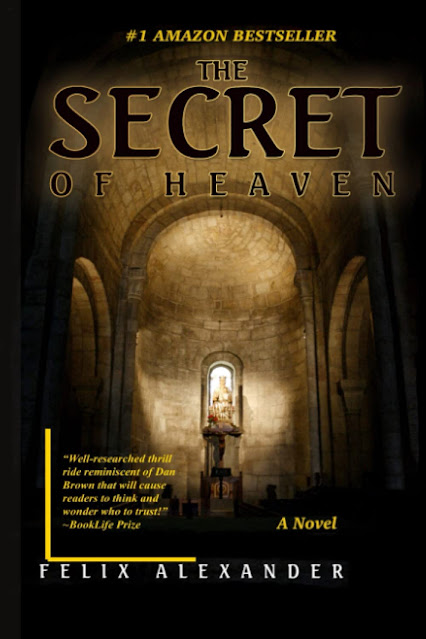
"The Secret of Heaven" by Felix Alexander--Fiction Review

Today’s book, Obscurists, is “The Secret of Heaven” by Felix Alexander, a historical religious thriller that revolves around theological controversies that span thousands of years.


Felix Alexander


***The Non-Spoiler part of this review***


What I love about this book:

Despite not being a religious person myself, I enjoy theological lore, albeit from a strictly literary and historical perspective. Right off the bat with his writing, it’s easy to tell that Alexander is well versed in this subject—more so than I am, at least. Which is one of the chief things I liked about this book because, even though it’s fiction, I got to learn new things. 

Undoubtedly a bit of Dan Brown in this book’s DNA, with even a sly nod and wink at Brown’s titular protagonist. Typically, I’m not the biggest fan of that kind of thriller/historical fiction and have to be in an odd humor to pick up such a book. Still, though, I’m glad I picked up “The Secret of Heaven” because it managed to surprise me by grabbing my attention early on and holding it all the way to the end.

There is no denying that it’s an exciting book. The characters are almost always on the move, and even in the rare moments they aren’t, the tension gets ramped up with every scene as more-and-more revelations come to light. This only makes the antagonists of this story even more deadly as they become increasingly desperate to find the lost bible.

Supernatural elements are present in this book, but I really liked how Alexander primarily played them off stage from the main plot.


What I don’t love about this book:

This world is lousy with secret societies doing—whatever secret societies do with their endless amount of free time and resources. I’m skeptical of secret societies in fiction that control the whole worldwide economy because—to put it delicately—people suck at keeping anything secret. So skeptical, in fact, that I find a secret society that has been masterfully kept to the shadows for centuries to be more fantastical than angels or dragons. That’s how little of an opinion I have of people being able to keep a secret.

At the beginning of this novel, which sort of just trails off, amnesia is introduced as a story element, and, yeah, like I said in my “Project Hail Mary” review, it isn’t one of my favorite story devices. In “The Secret of Heaven,” other than obscuring the details of how precisely Aiden’s mentor Lazzaro de Medici died, it doesn’t add much to the story. Basically, it goes, “ugh, who am I?” “You’re Aiden Leonardo, respected Professor of Biblical Studies, and this is your fiancé, who is also a doctor of archaeology, is incredibly beautiful, incredibly talented, incredibly smart, and incredibly fit with martial arts training.” “Oh, yeah, I guess I am Aiden Leonardo.”


This preview is an Amazon Affiliate link; 
as an Amazon Associate, I earn from qualifying purchases


***The Spoiler part of this review***
***Ye be warned to turn back now***


The quick and dirty synopsis:

Our story begins with the aforementioned amnesia-riddled Aiden finding out from his fiancé that he is the prime suspect in the murder of Lazzaro de Medici, Aiden’s mentor, and adoptive father.

Saturday, June 18, 2022

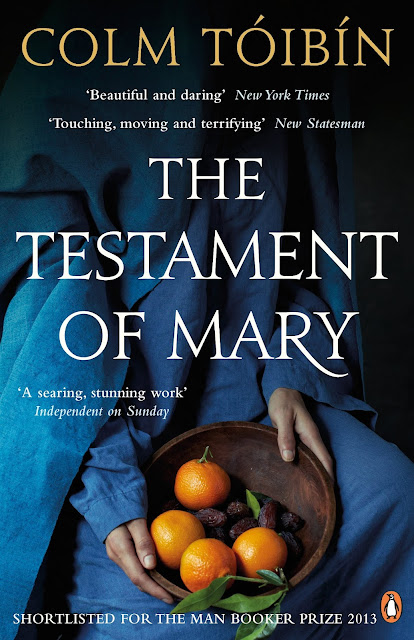
"The Testament of Mary" by Colm Tóibín--Fiction Review

Today Obscurists, we’re going to dip our toes into a new field of fiction I’ve not covered a whole lot, a religious, historical novel about the life of Mary, mother of Jesus Christ. The novella is “The Testament of Mary” by Colm Tóibín.


Colm Tóibín


***The Non-Spoiler part of this review***


What I love about this book:

This book, in my opinion, takes a rather agnostic view on the divinity of Jesus of Nazareth. While the character of his mother, Mary, might doubt his divinity, it’s never exactly refuted. It’s undoubtedly challenged throughout the plot but never wholly suppressed. 

To get a completely different view of the life of Jesus and from his mother’s perspective was very interesting to me. It feels grounded in the world that Mary and her life and perceptions were of our flesh and blood world.

This is also one of those times I feel a first-person perspective really works and sells the story. The entire story is relayed to us by Mary herself. It’s an incredibly intimate experience of this woman’s life, who loves her son while doubting his purpose and the reasons for his demise. At no point does the narrative romanticize what happened to Jesus. It was brutal, vicious, bloodthirsty, and done out of blood lust.


What I don’t love about this book:

It’s challenging to grasp how much time passes in “The Testament of Mary.” The narrative seems to start at the end with the crucifixion of Jesus, and then it dives into Mary’s story, but it didn’t start where I assumed it would, the beginning. It begins when Jesus was already a man and had followers, but it’s unclear how long this has been happening.

As much as I like the intense character study of a doubting Mary, all the other characters in the novella are mere wisps of characters compared to her. Even Jesus, the larger-than-life figure he was, is barely characterized. This may be an intentional choice, given the brevity of this story. Still, if you don’t immediately latch on to Mary’s story and perspective, there really isn’t anything else in this story. 

Ultimately, given its succinctness, “The Testament of Mary” feels like part of a larger work. We get allusions to Jesus’s childhood but no explicit scenes of that childhood. A lot of the goings on around Mary rely heavily on the reader having a secondary insight of the gospels and other Christian historical understanding, which is a long tradition in the western literary canon, but still, it’s a limiting factor for the audience.


This preview is an Amazon Affiliate link; 
as an Amazon Associate, I earn from qualifying purchases

Author’s Website: http://www.colmtoibin.com/


***The Spoiler part of this review***
***Ye be warned to turn back now***


The quick and dirty synopsis:

“The Testament of Mary” starts with Mary talking about her lonely existence after her son’s death. How she is kept—like a pet—by his followers who bring her food and money but expect her to go along with and support their version of Jesus’s life. Her recollection, however, doesn’t particularly jive with the “authorized” version of events told by presumably the apostles. They typically react to her non-canonical asides with exacerbation and scorn.

Friday, October 15, 2021

"The Last Kingdom" by Bernard Cornwell--Fiction Review

We’re going back in time this week, Obscurists, to resist and fight the Vikings—he said with no sense of irony—so grab your blades! Ok, don’t do that, just pick up this book “The Last Kingdom” by Bernard Cornwell.


Bernard Cornwell


***The Non-Spoiler part of this review***
 

What I love about this book:

I loved a character in Cornwell’s “Agincourt” novel, which I described as a human grizzly bear with a heart of gold in my review of that book. Sadly though, that character wasn’t actually the protagonist of that story. In “The Last Kingdom,” though, Uhtred is very much like that character but younger, and we follow him as he grows up. So I loved that. He’s compelling to me because he’s practical, often irreverent, and sarcastically funny with a touch of cynicism.

Cornwell weaves in his plot and his characters alongside historical persons, places, and events beautifully. Maybe I’d see the seams a little better if I knew my English history better, but it’s hard to imagine that I, as an American jack-of-all-trades when it comes to books, will ever achieve the same depth of understanding of the subject as Cornwell. So I probably won’t ever be able to detect a historical inaccuracy in his work that snaps my suspension of disbelief.

The action scenes in this book are all rigorously detailed from the characters’ perspectives. It’s hard to tell how any one battle is really going or what is happening until a character directly tells us, but I think that’s a stylistic choice. It simulates the fog of war, and there isn’t ever an omnipotent godlike narrator describing the battle—just Uhtred.


What I don’t love about this book:

So at first, I was a little hesitant to pick up “The Last Kingdom” because even though I had a great time with Cornwell’s standalone novel “Agincourt,” this book is the first of a very long series. It’s not that I don’t like a series of books. It’s just that it takes me a long, long time to finish any series by the nature of how I read books, all scattershot and whatnot. So any series I decide to pick up will be with me for probably years as I plod my way through it.

I am generally not one to get in a twist about prologues—which seem fashionable to hate nowadays—but that being said, it goes on for over an hour in the audiobook. Not only do I find that a bit long for a prologue it’s also about thirty minutes longer than my ideal chapter length. So really, the prologue is just a chapter one dressed up in a prologue’s undergarments. Parading around in those underpants for way—way too long, its corpulence threatening to split the stitching. Also, it starts out on the rather unexciting dithering on alternative spellings of the protagonist’s name—historically a real problem, but interesting to few.

Also, all the chapters are quite long, and per usual, I’m not such a big fan of that fact.


This preview is an Amazon Affiliate link; 
as an Amazon Associate, I earn from qualifying purchases


***The Spoiler part of this review***
***Ye be warned to turn back now***


The quick and dirty synopsis:

“The Last Kingdom” begins with a framing story of Earl Uhtred as an old man telling the story of his youth—which includes a rather lengthy prologue of how he became known as Uhtred. It was his father’s name, who was an Ealdorman of Northumbria, a sort of Duke or Earl. Anyway, it was a family tradition that the eldest son is named Uhtred, but that was actually our Uhtred’s eldest brother. But the brother is murdered by invading Danes at the beginning of the story. Thus changing the protagonist’s name to Uhtred shortly before a decisive battle against the Danes where Uhtred’s father, the Ealdorman, was killed.

Friday, March 27, 2020

"The Kite Runner," by Khaled Hosseini--Fiction Review

We’re coming to the close of March this Friday, and today’s fiction review is “The Kite Runner” by Khaled Hosseini.

“The Kite Runner” is a literary, recent historical novel and is about the feel-good story of Afghanistan, assuming you’re a sociopath. Seriously, it’s an intimate novel about the lives of characters that lived in the city of Kabul. Taking place before and during the wars starting in the late seventies, which continued in one form or another until—well today. The subject matter covered in this novel gets dark, including war, murder, suicide, death in general, and even rape—so if any of that is going to be a problem for you, best skip this novel, and here’s your ripcord out of this review, here.  

Khaled Hosseini


***The Non-Spoiler part of this review***


What I love about this book:

When most westerners, especially those of us outside of the armed forces, think of Afghanistan, we’re usually thinking of Iraq. I’m guilty of this too—Iraq is just the more prominently focused on conflict in our media. So when we imagine Afghanistan, there is a tendency to think of it as desert hellscape, and when we think of a city in Afghanistan, we think—ruins in a desert hellscape.

But here is Kabul in winter:


You’ll notice first off it’s in the mountains—and it’s not a desert. It turns out the desert hellscape mental picture isn’t accurate—also to ruin it for nearly every war movie/tv show it isn’t all that accurate for Iraq either, but that’s a different topic. I’m going on about this is because I loved how Hosseini corrected my mental picture of Afghanistan, especially with his descriptions of winter in Kabul.

The author also does a great job of illuminating the fact that Kabul wasn’t always a terrifying place. In the early seventies, it even seemed like a reasonably pleasant place. He even describes that there were once regular American tourists who visited during the summers. I love all these details because it drives home the horror of what happens to a place after decades of war and enduring an extreme power vacuum where there is no legitimate government present. 


What I don’t love about this book:

I never grow to love Amir—respect sure—but even though this is an intimate story about his life, I never move past merely liking him, some of the time. He was a spoiled boy, who took for granted his best friend—though as a child never admitted that Hassan was his best friend—and grew into a man capable of doing the right thing, but only begrudgingly. 

The pacing of the novel is slow, which is more just a hallmark of novels that come down more on the literary side than the genre side of the fiction divide. So this is more of an argument that I prefer genre fiction over literary—and is less a comment on this particular story.


***The Spoiler part of this review***
***Ye be warned to turn back now***


The quick and dirty synopsis:

The novel opens with Amir the man—not Amir the boy—and he teases the story of his childhood. A tale of his perceived sins and regrets—the story of how he became what he is today.

Then we are transported back to nineteen seventy-five, and Amir is a boy hanging out with his inseparable companion, Hassan. The two of them are mischief-makers, but Amir points out that the mischief was always his idea, never Hassan’s. This is the dynamic between the two boys, Amir is the rich Pashtun boy, and Hassan is the poor Hazara boy—and Amir’s servant. Not Amir’s friend, Amir is always quick to point out. 

Of the two boys, Amir is the more bookish, but only because he’s literate and Hassan is illiterate. Much to Amir’s chagrin, Hassan is naturally a kinder, wiser soul, and is even loved by Amir’s father, which only stokes Amir’s jealousy. The two boys share a passion for kite fighting, a sport that involves flying kites and using the kite to cut the strings of other people’s kites and is even more brutal than it sounds because the lines of these kites are coated in tar and crushed glass. Then when a kite gets cut down, a mop of people race to claim the downed kite. Amir flies the kites, and Hassan, who has a preternatural talent for it, runs down the kites—hence the title of the novel.

Amir feels he needs to win the big kiting competition to earn his father’s love, because his father, a robust man, is often disappointed in his bookish son, and wishes he were more like the athletic Hassan. During the competition, Hassan, as always, is by Amir’s side and is just as thrilled when Amir wins the competition and has the last kite flying in the sky. Hassan then runs off to claim the last kite Amir cut down, for Amir, after saying “for you, a thousand times over.”

Hassan manages to find the kite, per usual but is waylaid before being able to return home. Amir goes out to find Hassan, worried that he was taking so long. Soon Amir discovers that the local bullies, led by one particularly sociopathic boy, have cornered Hassan in an alley—and are demanding the kite. Hassan, loyal to a fault, won’t give it up because he caught it for Amir, who was cowardly watching all of this from the mouth of the alley. The bullies then hold Hassan down, and the sociopath rapes him.

After that, when Hassan finally makes it home with the kite and gives it to Amir, their relationship dissolves, primarily because of Amir’s guilt. Eventually, Hassan’s father takes the boy away, and they move out of Amir’s father’s house.

Years later, after the Russians have invaded Afghanistan, Amir and his father have to flee the country and eventually end up in California. They go from being wealthy citizens of Kabul to scraping by in the United States. Eventually, Amir marries an Afghani woman whose family had also fled the wars in Afghanistan. Amir and his father finally reconcile before his father’s death, and Amir becomes a writer like he always wanted.

Now, living a good life, Amir gets a phone call from Pakistan, and it’s one of his father’s friends, who was like an uncle to Amir. He tells Amir, “there is a way to be good again,” to entice him to come to Pakistan because he’s aware of what happened between Hassan and Amir.

In Pakistan, Amir hears the story of Hassan’s life and even gets a letter from him. Hassan grew up strong, learned to read and write, found a wife, and had a son and were taking care of Amir’s father’s old house. Then Amir is rocked by several revelations from his father’s friend. Hassan wasn’t just Amir’s loyal friend and servant, but also his illegitimate half brother. He and his wife were also recently murdered by the Taliban, and Amir’s nephew was taken to an orphanage in Kabul. Amir then still had to be convinced, but ultimately, he does decide to brave the road back to Kabul to search for his nephew, where he ends up facing the Taliban. He barely escapes with his and his nephew’s lives.

Still, Amir intended to give his nephew to another orphanage all along, run by an American couple, until he finds out his father’s friend made them up to get Amir to go to Kabul. Again, ultimately, Amir does do the right thing and decides to adopt his nephew but has to find a way to get the psychologically traumatized boy who attempts to commit suicide, out of Pakistan, and to the United States.

When Amir gets his nephew back to California, it isn’t all sunshine and rainbows, all of the psychological trauma is still there, and it colors everything in the boy’s life. The novel does end on a positive note, though, when Amir, his wife, and his nephew are at a gathering of Afghanis living in San Francisco.  At the party, some people are kite fighting, and Amir manages to have a breakthrough with his nephew, and they compete. Then when they cut down their opponent’s kite, before Amir runs off to claim the downed kite, Amir says to his nephew, “for you, a thousand times over.”         


Analysis:

This novel is all about its characters’ relationships during a pivotal period in recent Afghanistan history. In addition to being historical fiction, there is a decent argument to be made that it’s also a family drama—even though neither Amir or Hassan have mother figures. They share a father, unknown to them for all of Hassan’s life, but both lost their mothers in different ways. Amir’s mother died during childbirth, and Hassan’s just left his adoptive father, whom he thought was his birth father. Though, it is nice that she does return into his life for a little while when he was an adult, and she has an adorable relationship with her grandson.

This character work is vital, staging the true horror of this novel, which is what society lost looks like and the depth of despair brought by that loss. It is tough to process the idea of the destruction of a civilization. It’s akin to visualizing a billion of any object. The human mind can’t really do it—so we don’t do it at all, sadly it’s a hole in our experience. Intellectually—unless you’re an asshole—we can reason a billion dead people is a bad thing and should be a sad thing, but the words are sterile, and the emotion doesn’t come. However, when we put a face to it—like when Hassan is dragged into the street by the Taliban. Loyal, Hassan, whose only dreams as an adult were to protect his family and see his brother again, is then shot in the head by some murderous bastard. That evokes an emotion. Especially when they then shoot Hassan’s wife, and get away with it all because there is no law, no justice, because they themselves made sure that there wouldn’t be anymore.

Make no mistake, when someone makes the pseudo-intellectual claim that the world would be a better place if we were just to kill off twenty percent, thirty percent, or whatever number they’d like of the world’s population—they are exactly like the Taliban.     


Parting thoughts:

I am suspicious of my dislike for Amir. It isn’t just that he’s a coward and ostensibly nobody likes a coward. Him being too cowardly to help Hassan in the alley reminds me of an incident in my past. Nobody was raped or even hurt. But there was a time when I stood by as a drunk stranger bullied a friend of mine. I told myself at the time that I was always there, and everyone knew I was present—I was waiting to intervene if anything turned violent. But the thing is—I don’t hate that drunk asshole, I hate my inaction, and who I was at that moment. That is why I suspect I never came around fully with Amir. He reminds me too much of myself during a moment in time I would rather forget.

Friday, January 10, 2020

"Agincourt," by Bernard Cornwell--Fiction Review

Today we’re talking about "Agincourt," a historical fiction by Bernard Cornwell, where people kill each other for no better reason than their collective belief that they think God wants them to do so. Thankfully, that shit doesn’t happen anymore today. It was an actual battle you can learn about in English history. In fact, it’s the big battle Henry the Fifth is often remembered for by not just the bard himself, but by anyone who calls themselves an Anglophile—which is a creepy word. I think because it has “phile” in it, and pedophile has really ruined that suffix for everything else.


Bernard Cornwell


***The Non-Spoiler part of this review***


What I love about this book:

Bernard Cornwell’s attention to historical accuracy and detail is done with a historian’s acumen—that’s my first and biggest love for this novel, or at least the intellectual in me makes that claim. Like in a lot of historical fiction, there are a couple places where the author warps events slightly to fit his narrative, but this is done so minimally, and at the end of the novel, the author outs himself where his alterations occurred in the story in an appendix. To give you an idea of the kind of changes he made: there is a siege in the novel’s middle. It takes up a considerable portion of the book, this event really did happen, and the results of the siege happened in the same way as in the novel. What the author changed were little details about the siege tunnels the attackers used for story reasons. It’s not like the siege itself was invented.

Also, I really appreciate Cornwell’s character work regarding the hero of the story and the major and minor characters that surround him. Cornwell understands that readers primarily want to get to know, relate to, and understand the protagonist and the people in his life. The plot, while important, isn’t worth anything if we don’t care about the people who live through that plot. Finally, and the real visceral reason I love this novel, Sir John Cornwall, no relation to the author, a major character in the story, a real person who fought at Agincourt, steals every scene he’s in from every other character. Every line of dialogue, every action he takes, if not over-the-top violence, suggests over-the-top violence—all that mixed with a heart of gold. An internal contrast of characteristics that jarring makes him by far the most fun character. The best way I can describe him is he’s exactly like a human grizzly bear. From a distance, cute, maybe even heartwarming. Up close, he’ll tear your limbs off and probably enjoy doing so immensely.
 

What I don’t love about this book:

For a novel about the battle of Agincourt, Agincourt is the seminal event of the story but only takes place at nearly the end. It’s a small quibble, but still, the book is titled Agincourt, and that battle is the last third of the end product. Another thing that happens a lot is that the plot relies heavily on coincidence—I’m forgiving of this point because, in the end, all events are really coincidences if you think about them too deeply.

Also, as much as I love the protagonists and heroes of this novel, most of the story’s antagonists are of the mustache twirler kind of villain. They aren’t evil for a specific reason or are even particularly misguided in thinking they’re in the right, somehow. A lot of them are just evil for the sake of being evil. I’m not saying there aren’t people like that, sadly there are, but this is a trait I can’t usually find engaging—sometimes I can when it comes to non-human characters or entities, but since this is historical fiction, there are none of those on hand.

Sure there is a paper-thin reason given for hostilities between the main character and his adversaries. They’re engaged in a long-standing family feud—but it isn’t like the evil murdering rapist priest is possessed—although he could be mad, it isn’t really clear. Mainly, he’s just a colossal dick, whose only function in the story is that, and the cathartic moment of…


This preview is an Amazon Affiliate link; 
as an Amazon Associate, I earn from qualifying purchases


***The Spoiler part of this review***
***Ye be warned to turn back now***


The quick and dirty synopsis:

…his end, which is where he gets shot to death in the dick. This isn’t exactly the start of the synopsis, but I really wanted that jump, and hey—it’s my blog, dear, apathetic internet strangers.