Showing posts with label Nature. Show all posts

Wednesday, September 1, 2021

Micro Mention "Desert Solitaire"

Edward Abbey


Edward Abbey was the Thoreau of his generation and somehow even more of a curmudgeon. Still, "Desert Solitaire" is one of those nature books that I deeply admire, and his prose about the wild places of the southwest sparkles even as it remains stark. He does with his words about the desert what many photos do of it, grabs your attention, and demands your focus. 

"Desert Solitaire" is just as much a book on philosophy as it is on nature. Abbey's worldview, much like his chosen preferred locale, is austere. Still, he holds to some old American values, even while not liking the government very much, while simultaneously working for that government as a ranger. So, he's a study in contradictions.

If you'd like to read my full review of this book, you can find it Here.


This preview is an Amazon Affiliate link; 
as an Amazon Associate, I earn from qualifying purchases.


Monday, August 16, 2021

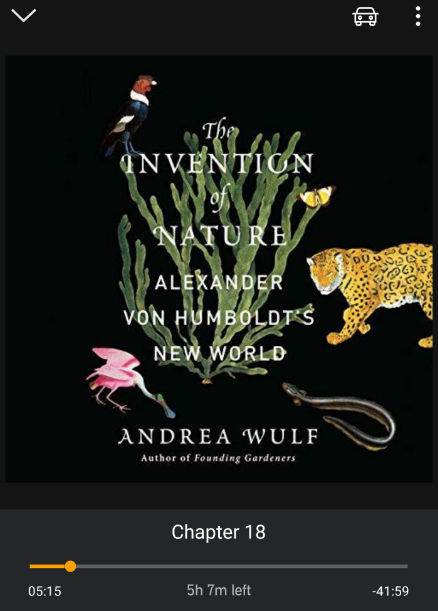
Micro Mention "The Invention of Nature"

Andrea Wulf


Everyone has heard of and read about Charles Darwin. But do you know who he read about before his adventures on the Beagle? Alexander Von Humbolt—and Andrea Wulf tells his story in "The Invention of Nature." He’s the original; let’s get out there and see nature, guy.

What I find amazing about this book is after reading it how many times I started noticing things and places named after Humboldt. It's an amazement that is dual-sided, though, because, on the one hand, it's nice to learn about an adventuring scientist I had previously not known about and is honored all over the world, but on the other side, he's been largely forgotten. Not a lot of people know why various squares, parks, and reserves are named Humbolt anymore.

Alexander Von Humboldt was a pioneer of the school of thought that nature should be studied and appreciated. I think we could all use a little more of that wisdom today, given the amount of environmental destruction prevalent in today's world.


This preview is an Amazon Affiliate link; 
as an Amazon Associate, I earn from qualifying purchases.

Author's Website: https://www.andreawulf.com/


Wednesday, April 21, 2021

Micro Mention "The Triumph of Seeds"


Consider the seed—the biology behind them and their evolutionary history is fascinating with how many different strategies nature has developed. Dr. Thor Hanson—the most awesome Dr. name ever—provides robust insight about the topic in his book "The Triumph of Seeds."

This book gives you just a taste of how truly complex and varied humble seeds can be; they really are little miracles. My favorite parts of this book have to be when Hanson explains the design—shaped via evolutionary processes of courseof different seeds and why they're successful in their particular niche in nature.


This preview is an Amazon Affiliate link; 
as an Amazon Associate, I earn from qualifying purchases.

Author's Website: https://thorhanson.net/

Monday, April 12, 2021

Micro Mention "Walden"

Henry David Thoreau


Sometimes it’s nice to just get away, get out in nature, take a walk, and maybe take a holiday in the mountains. No one quite did it like Thoreau, but luckily he wrote the experience down for us in “Walden.”

Like with Edward Abbey, who I very much thought was a spiritual successor to Henry David Thoreau, I admire Thoreau's fierce streak of independence. Of the transcendentalists, he's certainly the writer of that group that I've learned the most about, and he is, to me at least, a quintessentially American writer of the 19th century who was forward-thinking.

He was undoubtedly also a bit of a curmudgeon, a quality Abbey also shared with him. If you'd like to know more about Edward Abbey, I wrote a review of his book here.


This preview is an Amazon Affiliate link; 
as an Amazon Associate, I earn from qualifying purchases.


Monday, April 5, 2021

Micro Mention "Domesticated"

Richard C. Francis


Domesticated” by Richard C. Francis is an interesting nonfiction read about animals’ domestication and even *gasp* humans. As in, we domesticated ourselves—and not like a slavery thing—but as a capable of society thing. It explores how domestication has significant biological effects.

Ultimately, it's fascinating to find out just how much we've altered the natural world and how many animals we think of as natural wouldn't exist in the form they do without our influence. Even before genetic engineering, like in a laboratory, humanity's influence over nature has been so extreme for thousands of years that we've actually changed the DNA of countless animals over generations. It's a wild realization the longer you think about it.  


This preview is an Amazon Affiliate link; 
as an Amazon Associate, I earn from qualifying purchases.


Friday, January 22, 2021

"Desert Solitaire," by Edward Abbey--Nonfiction Review

Today we’re heading out into the dry country, deep into the desert of the southwest with Edward Abbey’s “Desert Solitaire.” It’s a Walden-Esque experience but in modern times.


Edward Abbey


What I love about this book:

Part of my psychology deeply admires the recluse who goes out and lives on the fringes of civilization and wilderness, and “Desert Solitaire” really scratches that itch for me. I’ve said this before, but Edward Abbey really feels like a reincarnation of Henry David Thoreau to me. Both men were writers, lovers of the wilderness, and had starkly serious political opinions that they somehow managed to express in folksy and sometimes slyly humorous ways.

Since Humboldt’s “Cosmos” and Thoreau’s “Walden,” there hasn’t been a book about the natural world and the wilderness that has so thoroughly captured my attention. In all its austere beauty, the southwest of the United States is interesting to me, and I don’t think anyone has ever described it as well as Abbey.

A lot of this book tells of Abbey’s time as a park ranger in the government’s employ, a government he wasn’t a fan of but so are many public servants. Anyway, the more he explained his job, and despite its obvious drawbacks, I found myself deeply envious of him. Something is alluring to me about the prospect of spending long days out in the middle of nowhere with little to do other than be a steward of a specific range of parkland. There is a simplicity and clarity of purpose to being a ranger that you really can’t find in many other professions.

I’ve always been a sucker for the stories of a lost cause—except, you know, for the confederacy, because they were traitors—and not just lost causes but vanishing ways of life. So I really enjoyed Abbey’s stories of the hardscrabble lives of the last generation of true cowboys in the old model. The grit and grime of the profession of driving cattle is romantic to me, paradoxically, because of how unromantic it was compared to the movies. Mostly, it was hard, dirty toil.


What I don’t love about this book:

This book underscores a very real degradation of the barriers between civilization and wilderness. And not just that, but the shrinking of the world’s wild places until they disappear. There may come a day when it’s no longer possible to literally go out and get away from people on the earth, and that’s a sad thought.

I loved reading about Abbey’s adventures and his descriptions of those adventures to places that few people have ever seen on earth. It saddens me to think that several of these places will never be seen again the way he saw them because some have been destroyed. When you build a dam, you do it as a boon to civilization, but it costs something to the natural world, and all the life behind that dam pays the price. There are some places that Abbey describes that are literally underwater now.

Abbey, at times, for all his genius, could be startlingly full of shit. At one point, he goes on about that it’s his job as a park ranger to preserve all life, and then, later on, he kills a rabbit with a stone and for no better reason than to see if he could. He doesn’t eat the rabbit, doesn’t feed it to anything. He just wanted to know if he could throw a stone and hit it in the head. Turns out yes.

The rabbit thing isn’t the only thing in his character that was objectionable. I’m pretty sure Abbey wouldn’t at first understand the charge, and once it was explained to him, he’d dismiss it out of hand as irrelevant, but he was an ableist. His prescriptions that when people go out to enjoy our shared common public lands—something all citizens and tourists of the United States should be able to enjoy—that they should be required to exclusively walk, ride a bike, or ride a horse—are narrow-minded.


This preview is an Amazon Affiliate link; 
as an Amazon Associate, I earn from qualifying purchases.


Parting thoughts:

Abbey didn’t have a great relationship with his fellow creatures—as in—human creatures. He seems like he could be amiable on an individual to individual basis, or even as a park ranger to a small group of people. Still, it becomes pretty clear that he wasn’t a fan concerning humanity in total. It isn’t so much in his direct comments, which there are numerous, that shows the true depth of his contempt for people, but in his more thoughtless remarks and suggestions. His implied assertion that public lands are only for the fit among us led me to think this about him.

I can knock down that sentiment by just pointing out some people are born without legs. Are they less entitled to nature? Sure, that’s an extreme example, but sometimes extremes are necessary to illustrate some ideas’ ludicrousness. A less extreme example is sometimes, people are injured, by no fault of their own, and lose limbs. Are they now less worthy? If your answer is anything but no, here is a rare unqualified statement from me—you’re an asshole. Just because someone is sick, injured, old, or disabled in any other way does not diminish their personhood.

In their love for the natural world, some people like Abbey forget that people are part of that world too. The impulse to rope everything off from the unworthy amongst us in the name of preservation is a tempting one. But precisely who gets to do the choosing of who gets to appreciate the natural world, and who does not? What criteria will they use?

In the end, I believe we should be more vested in educating people on why they should value and respect nature, more so than concerning ourselves with erecting barriers to entry. I believe this because we all spring from nature. We are all its progeny, and we are all its legacy and inheritors, not just a few elites who “get it.” We’re all subject to its cycles, and we must find that balance between both worlds, or there will be nothing for all sides, and all the lands of the earth will be emptier than even the harshest deserts today.


Friday, July 31, 2020

"The Wisdom of Wolves," by Jim & Jamie Dutcher--Nonfiction Review

This Friday, let’s tune into our wild side, hear the call of nature, and talk about “The Wisdom of Wolves” by Jim & Jamie Dutcher. A short nonfiction nature book, it’s about the Dutchers’ time studying a wolf pack they dubbed The Sawtooth Pack. 

Jim & Jamie Dutcher


What I love about this book:

The Dutchers make you fall in love with the wolves of their study. They make them come alive in the narrative of their lives by highlighting their differing personalities. Each wolf becomes a character who feels real and familiar. From the magnanimous alpha wolf—leader of the pack—Kamots to his stalwart but kind-hearted right-hand wolf Matsi, and Kamots’ aloof mate Chemukh and with various others, the Sawtooth pack was filled with dynamic individuals. My favorite wolf being beleaguered Lakota, Kamots’ brother and the largest of the wolves, but as a gentle giant, he often occupied the lowest rank in the pack. He, above all the other wolves, seemed to value play and harmony with his pack mates, even when they picked on him.

“The Wisdom of Wolves” clears up a very human misconception of what it means to be a good “alpha.” Too often, young men, and sometimes women, believe it to be synonymous in meaning to aggression, a never take “no” attitude, and put yourself first before everyone else and if they don’t like it fuck ‘em. A genuinely successful alpha wolf isn’t just a leader, but also a caretaker, a diplomat. He cares for the wellbeing of the pack before himself, putting himself between his pack and danger every time. Tyrants sow resentment, which comes to harvest as defiance and rebellion, but wise and fair leaders reap respect and loyalty.    

Structure wise, “The Wisdom of Wolves” is only ten sweet, short chapters. The language choice is direct and eschews most scientific terms to keep the message of the prose crystal clear—like water from a mountain spring. 

In “The Wisdom of Wolves,” the Dutchers decided to center each chapter around a different particular quality or value of wolves or wolf society that we as people should share or, at the very least, admire. Things like: trust, family, kindness, loyalty, recreation, curiosity, compassion, et cetera, which means that the book doesn’t flow chronologically. It creates a feeling of being unbound by time. Every moment in the narrative is present and past. 


What I don’t love about this book:

Honestly, my biggest problem with this book is it’s too short. When I finished it, I found myself wanting more and to spend more time with the pack. On the other hand, I can appreciate that maybe the point of its brevity is to underscore how short wolves’ lives are, which creates the necessity to pack as much passion into a brief period of time as possible. 

I worry that this book flirts with the line of over anthropomorphizing the members of the Sawtooth pack, which is something they say in their introduction that they sought to avoid. It is incredibly difficult to not ascribe some human-like emotions on them, just like how people—myself included—do with their domestic dogs as though they're furry little people. 

Hearing the plight of the poor omega wolf Lakota is heartrending. He seemed like such a gentle giant who just wanted everyone to be happy only to get bullied a lot of the time. Of course, intervention is out of the question. The point of the Dutchers’ wolf camp was to study wolves in a way that was as close to natural as possible. It is nice to know that Lakota doesn’t spend his entire life as the Omega, but still, a lot of his life seemed marked by unfairness, which is tragic.    


This preview is an Amazon Affiliate link; 
as an Amazon Associate, I earn from qualifying purchases.

Author's Website:https: //www.livingwithwolves.org/

Parting thoughts:

When environment change and destruction are discussed, typically, what is being discussed in the current zeitgeist is global warming, which is an important topic that desperately needs to be taken seriously. However, I feel that we as a species tend to forget that we share this world with not just each other but a whole host of various creatures that, for the most part, have little autonomy here in the age of the Anthropocene—the age of humans.  

To me, our capacity to take, and take, and take, seems incredibly unfair to the other creatures that share Earth with us. Even if I were to acknowledge the idea that we were divinely appointed to be stewards of this planet and all its inhabitants, I’d still argue that we are very poor stewards indeed. It isn’t just that American ranchers go out of their way to shoot wolves, either. There is plenty of blame to go around for the whole human family and not just Americans. We kill elephants and rhinos for their ivory to use it as decoration. We cut down forests and jungle that several large cat species rely on as habitat. We drain swamps, and sometimes whole lakes, destroying whole small ecosystems, which doesn’t even compare to the staggering amount of garbage we’ve thrown into the oceans.

The big game hunters who slaughter rare and often endangered species are just the most galling aspect of the supreme callousness toward not just animal life, but the concept of life itself. Every time one of them shows up on social media, having killed a rare albino giraffe for no better reason than to say they did—disappointment and rage are too soft of words to capture my reaction. 

Visceral emotions aside toward those awful human beings, we’re all guilty of a far more monstrous crime at various points in our life—apathy. Douchebag poachers aren’t actually causing the mass extinctions—sure they aren’t helping, and every time a lion eats one of them, I root for the lion—but what is really causing the most significant loss of life is our collective refusal to care for the natural world. Why this happens is because, like with everything, we exploit it to make a buck, which in itself is a phrase about shooting a male deer to make money. Everything, from our language to our creature comforts, to our society presumes that the natural world will always be there to provide us with more and more stuff, except for one problem, everything is finite in the end. You and I should care about what we do to our planet because what we do will be how we’re remembered, and history is the only form of immortality that’s been proven to work so far.