Showing posts with label biography. Show all posts

Monday, May 16, 2022

Micro Mention "American Prometheus"

 
Kai Bird & martin J. Sherwin


J. Robert Oppenheimer is a tragic figure of American history whose accomplishments were all overshadowed by one thing; he was the father of the atomic bomb. Once a hero, then painted a villain and torn down by his own. “American Prometheus” by Kai Bird and Martin J. Sherwin captures that narrative.

I talk about that idea in more detail in my full review

What I want to point out, though, for this little piece is, isn't it amazing how like in this book, when the conservative political party froths its way up into a moral panic, lives are ruined, and careers are destroyed.

But when a right-wing politician straight up breaks the law, they fly away in their helicopter with no consequences. Or fights an entire debacle shadow war with no consequences. Or an actual conventional war, twice, with little to no plan with no consequences. Or, finally, continues to be president after seriously suggesting protestors be shot in the legs or to cure a virus with bleach injections.


This preview is an Amazon Affiliate link; 
as an Amazon Associate, I earn from qualifying purchases.


Wednesday, January 19, 2022

Micro Mention "Grant"

Ron Chernow


"Grant" by Ron Chernow hasn't just made me a fan of Chernow as a historian but has made Ulysses S. Grant my favorite American president in history. Honestly, even if you read no other nonfiction/history book this year, you should read "Grant."

History is important. It tells where we've been, what we've done, and what we should have done. I don't respect opinions about policy and governance when the source of those opinions is ignorant about historical facts. That's my biggest problem with today's armchair politicians and, frankly, actual politicians. We've somehow swept back to the idea of loyalty to the individual over loyalty to the republic, and it absolutely boils my blood.

I talk about this book in greater detail in my full review here

The last point I want to make here in this piece is, so far as I'm aware of, Ulysses S. Grant, like George Washington, is the last great American president called to the presidency and did not seek it on his own initiative. We've lost this quality in our modern politics, and we are poorer for it.


This preview is an Amazon Affiliate link; 
as an Amazon Associate, I earn from qualifying purchases

Author's Website: https://ronchernow.com/


Wednesday, November 24, 2021

Micro Mention "Helter Skelter"

Vincent Bugliosi


"Helter Skelter" is a long but incredibly in-depth look into the world of the Manson Family murders written by the prosecuting attorney Vincent Bugliosi. Starting with the murders then moving through the investigation and litigation, Bugliosi spares no detail.

I touch on this idea in my full review, but could you imagine the sort of damage and mischief Manson could have gotten up to if he were born just say thirty years later, or so, and was around for our modern era and social media? I think that's the scariest thought this book inspired for me—because it isn't like people, who are like him, have stopped being born.


This preview is an Amazon Affiliate link; 
as an Amazon Associate, I earn from qualifying purchases


Friday, November 12, 2021

"Hidden Figures" by Margot Lee Shetterly--Nonfiction Review

We're doing another space book, Obscurists. Well, sort of, it is more a history of NASA and some of the most talented women to ever work there whose contributions were sadly mostly forgotten until recently. Today's book is "Hidden Figures" by Margot Lee Shetterly.


Margot Lee Shetterly


What I love about this book:

So I'm a big lover of all things space—I'm not so crazy that it's become the playground of billionaires—but still, I love the history of the space race and the ambition and talent that drove NASA forward. I love this book because it shines a light on the contributions of black women who participated, immensely, it turns out, to our success in space.

"Hidden Figures" isn't just a history of NASA's earliest days during the Mercury missions but primarily a biography of Katherine Johnson, Mary Jackson, and Dorothy Vaughan. It shows how all three black women—and more like them—contributed mathematical prowess in the computing departments and engineering expertise in Jackson's case. All of this was at a time when women, in general, were typically discriminated against in the workplace.

Racial prejudice is focused on in far greater intensity in the movie based on this book than the book itself. I'm in no way trying to suggest that it didn't exist back then or that it didn't exist at NASA, and I'm sure these women were faced with that ugly truth. After all, black people don't get to stop being black ever, not for one moment. We should live in a world where color doesn't matter, but that goal has yet to be achieved. 

What I mean is this book reaffirms NASA's core value of excellent research above all else. Any skilled person can describe a good idea or the truth about nature, regardless of uterus status or skin color. That is and always was, most important at NASA. While admitting there were still segregation laws in force at NASA, Katherine Johnson even said that she personally didn't feel it during her time there because the mission was most important at work. I'm paraphrasing from this quote: "... didn't feel the segregation at NASA, because everybody there was doing research. You had a mission and you worked on it, and it was important to you to do your job ... and play bridge at lunch." She added: "I didn't feel any segregation. I knew it was there, but I didn't feel it."

  1.  "Katherine Johnson Interview: NASA's Human ComputerHistoryvsHollywood.com. CTF Media. 2016. Archived from the original on March 3, 2017. Retrieved March 2, 2017.


What I don't love about this book:

The movie focuses on the racial element of the story pretty hard because it's a reliable story beat to gain audience support—at least a certain non-racist audience—but in doing so, it miss characterizes this book, in my opinion. Sure, generally, the past in the late '50s and the early '60s overall had a more in-your-face sort of race problem. However, telling the story of these women as a way of saying they succeeded despite the old racists at NASA is kind of disingenuous and lazy. NASA was a pretty progressive place back then, maybe not to our standards today, but still, the Mercury missions took place on the tail end of the Jim Crow era. The idea that black people and women, too to boot, were trusted with genuine, hard, and necessary—life or death work was radical for the day. 

So the actual shameful thing—the real no-joke insidious racism—that this book points out is how we just forgot these women, who they were, and what they did. It's insidious because of its banality. Women like Johnson, Jackson, and Vaughan were always there up to the modern era. They just weren't given any sort of visibility to the public, in either the media or in popular movies—movies I like which saddens me to no end.

The Hollywood movie is the way that it is, in my opinion, because we like to see the past being somehow less enlightened on this front—across the board—and that we, the wise non-racists, have grown and transcended this problem. Except that's bullshit, and we haven't. We're just much more sensitive to being called out for when we're doing some racist shit. Ignoring the contributions of some, belittling them, denying them representation or just plain apathy toward an ethnic group is, in fact, racist.

Where I am going with this point is that this book's quality that makes it feel like a revelation isn't a good thing as the movie version supposes. It isn't a breath of fresh air, some grand rediscovery—it's a goddamn American tragedy. The idea that we as a society tacitly allowed the perception that NASA employed nothing but exclusively white dudes with pocket protectors from the flight director all the way down to the janitor and no one else—is as tragic as it is wrong.


This preview is an Amazon Affiliate link; 
as an Amazon Associate, I earn from qualifying purchases.


Parting thoughts:

So for my parting thoughts, I'd like to shift gears here. Recently, it has become fashionable, we'll say, for some groups of Americans to vocally and stupidly claim that we never landed on the moon—and also that the Earth is flat. I don't know, probably.

This is one of those things like Mr. McConaughey's character in "Interstellar" that instantly gets under my skin and annoys me. On the face of it, not only is it wrong, with nearly every country verifying that our radio signals from the Apollo missions came from the moon. Countries including Russia, who was famously competing with us at the time to do just that. Not only is it a denial of the single greatest technological feat we as Americans have ever accomplished, including the atomic bomb, and that there are literal mirrors on the moon that we still use in experiments today left by the Apollo astronauts. It is a slap in the face of every brilliant American astronaut, scientist, engineer, mathematician, and physicist who sacrificed so much, sometimes their very lives, to accomplish that dream.

This insult typically comes from the same group of people who can't even spell algebra, let alone pass it in high school. So why do they insist on their factually wrong position and that we take their non-expertise as valid? I've meditated on this point for a long time, and I believe the answer is actually quite simple.

They are Americans who hate America.

That is a loaded and admittedly inflammatory statement that requires qualification—which I will provide. More precisely, they hate America as it is, and as it always has been, which is a broad land of immigrants from all corners of the Earth, with different skins, beliefs, religions, and languages cohering together as one society. They do, however, love their imaginary America that they've constructed in their mind. An America that was somehow uniformly white, Christian (whichever brand they subscribed to), and the reason that there are literally any problems whatsoever is that we've gotten away from that.

There is this sick love for conspiracy where there is no conspiracy. Instead of admitting that maybe their lives are mediocre because they are, in fact, mediocre. They've never taken the time or effort to change that about themselves. Instead, they invent cabals of satan worshiping pedophiles that somehow hold back their natural all-white awesome American-ness.

The denial of the moon landing stems from the same poisoned fruit that we couldn't possibly have succeeded at such a challenge because the people who did it weren't pure as defined by some wackjob. The people who did the work, the math, the planning, and took the risks to make it possible were diverse in ethnicity, gender, and religion.

And that has no place in their imaginary America. So it didn't happen.


Friday, September 10, 2021

"American Prometheus" by Kai Bird & Martin J. Sherwin--Nonfiction Review

In this review, we’re talking about the Pulitzer Prize-winning biography “American Prometheus” by Kai Bird and Martin J. Sherwin. It tells the story of J. Robert Oppenheimer—father of the atomic bomb.


Kai Bird & Martin J. Sherwin


What I love about this book:

As someone interested in technology, physics, and history, this book satisfies all of those interests in one fell swoop. At first, I assumed it would be strictly a biography of Oppenheimer during his time with The Manhattan Project and shortly after that because that’s when he was the director at Los Alamos, where we all know him for his work—the building of the first nuclear weapons. “American Prometheus” is actually the entire story of J. Robert Oppenheimer’s life from the cradle to the grave. As such, it provides us with great context for how and why he became the father of the atom bomb. 

Oppenheimer was someone whose life straddles two sides of a pivotal moment in history. I enjoyed vicariously seeing the world—as best you can imagine through books like these—through his eyes and perceptions. It has been growing in my mind this idea that while we may have been on the winning side of World War Two, we won at a significant cost to our nation’s soul and character. 

The World Wars are often expressed in numbers—number of dead—number of planes, tanks, and ships lost—number of dollars spent. So the intangibles get left by the wayside because they’re impossible to quantify. What I mean by our national character and soul is that when we fought against Nazi Germany, Fascist Italy, and Imperial Japan, we were morally in the right and superior to our foes. 

But then we won, and things change. An ugly thing started to creep into America, the presumption that we would always be morally right and superior to our adversaries—no matter what we did because we dubbed ourselves the good guys. It stood to reason that any actions done by the good guys would have to ex post facto be good and justified for the greater good. Even when objectively it wasn’t true. This book shows in the latter half how our paranoia caused us to turn on our own, seeing traitors and communists everywhere in our midst, including our national luminaries such as Oppenheimer.

This is not the focus of this book but is given context through Oppenheimer’s life that it occurred to me when reading “American Prometheus” that there is a kind of repetitive beat to the American character. We fought the American Civil war, and the crux of it was that all people are people and should be able to partake and enjoy the fruits of freedom, against a foe who, based on an odious theory of race, disagreed. Then after we won, we backslid with the death of reconstruction. In World War Two, something similar happened, and after we won, we backslid again. 

The argument could be made that this has always been our central conflict. It’s been with us even all the way back to the Revolutionary War against Britain because our founding fathers pointed out, as a central justifying point for our rebellion, the question; what is a King? Is he not but a man? And as just a man, how could he be any more than merely equal to his fellow-men?


What I don’t love about this book:

So this book won a Pulitzer Prize in biography in 2006—and that’s great, don’t get me wrong—but my complaint is for such an esteemed book, and it’s a great book, how is it the audiobook version is produced so poorly? 

The narrator isn’t totally to blame. He’s fine. But somewhere along the line, the editing got sloppy, and the sound levels are all over the place. In one sentence, it’ll sound like Jeff Cummings is right next to you. The next, he’ll sound like he’s across the room, and then right back next to you a heartbeat later. I get it’s an older audiobook, but—holy hell—it’s not like 2007 when the audiobook was released was the dark ages. For a ninety-five percent exclusive audiobook reader, it was beyond distracting for me.

My chief complaint about the content of this book is that the authors will state a point, share a quote, and then make sure to repeat it again. This typically happens at the beginning of one of their usually very long chapters—my feelings about that topic are well documented—and then rehammer that point or quote later in the chapter. It isn’t clever. It just adds to a whole circular repetitive feel to the whole book. You might have noticed I just did something similar with nearly every sentence in this paragraph, and it was annoying then too!


This preview is an Amazon Affiliate link; 
as an Amazon Associate, I earn from qualifying purchases.

Author's Website: https://kaibird.com/

Parting thoughts:

One of the most terrible things about American culture over great periods seems to be our proclivity to vacillate back and forth on our beliefs. It’s uncomfortable—to me at least—how many times we defeat a foe either ideologically, on the battlefield, or both only to then cede ground to them. Then some of our number spontaneously decide something like, “well, maybe those objectively terrible people had a point!”

Again calling back to the civil war period, we did it with the Confederacy, then the Ku Klux Klan, and now some people openly call themselves Nazis. All of those original groups engaged in slavery and genocide to varying degrees. It does a disservice to the men and women who sacrificed so much to put them down that we now allow them a seat at the table as though they had something legitimate to add to the conversation. Now I get this is starting to sound like an anti-free speech argument, and that isn’t my intention. I believe in free speech. I believe you should be allowed to say nearly anything you want without censorship from the government, as defined in the first amendment.

What I don’t believe in is immunity to consequences because of your words or a guaranteed platform provided by privately or publicly owned companies. The first amendment protects you from the government, but any other entity which isn’t the government is free to decide not to do business with you because you went on a racist tirade on Youtube. I cannot begin to tell you how much it makes me grind my teeth when people get this wrong still when they accuse Youtube or Facebook, their job, or whatever else that isn’t part of the government of violating their first amendment rights.

I digress—and I’m straying from my original point—I can’t help but be horribly conflicted with what happened in Afghanistan. On the one hand, I never agreed with the war. I didn’t think we should have invaded in the first place. To continue to pour blood and treasure into the cause decades on, intellectually, I understand, would be folly. But it smacks a lot of what I was saying earlier. It kind of smells like the age-old American tradition to cede ground because we’re tired of the fight—and maybe this fight wasn’t worth fighting in the first place. I thought so and still think so.

But watching people cling to the outside of American planes in takeoff—people who fought with us, people who believed in us, only to fall to their deaths—how did it come to this? 

There had to be a better way.


Tuesday, August 31, 2021

Talking In Obscurity, "A Crime in the Family," by Sacha Batthyany

Sacha Batthyany


Or Download This Episode Here:


It's podcast day Obscurists! Today Steve and I are talking about "A Crime in the Family," by Sacha Batthyany a memoir about the author's family and their actions and inactions during the worst times of WW2. I've already reviewed this book on the blog and you can check out that full review here. 


This preview is an Amazon Affiliate link; 
as an Amazon Associate, I earn from qualifying purchases.

Friday, August 20, 2021

"A Crime in the Family" by Sacha Batthyany--Nonfiction Review

We’re talking about Sacha Batthyany’s “A Crime in the Family,” which is a hard historical look at a small picture of WW2 in Hungary. It shines a light on the great question of the last century; how could normal people tolerate and abide such evil?


Sacha Batthyany


What I love about this book:

Often books about the holocaust and WW2 are broad in scope, fixated on the numbers of victims and the titans and tyrants of the day. And while that can be fascinating in its own right, I appreciate that this book is about individuals who lived through those times. I like the human scale Batthyany adheres to wherever possible.

I was especially taken with the excerpts taken straight from journal entries of people who lived through the events of Hungary’s participation in the war as a Nazi ally. The journals were from the perspectives of a Hungarian Jew and a minor noblewoman who wasn’t Jewish—both lost everything in their own turn. One when the Nazis came, and the other when the Russian Red Army steamrolled through Hungary.

There is something morbidly fascinating about Batthyany’s story of his great aunt. Maybe she didn’t directly participate in a massacre of Jews at Rechnitz—maybe—but she was still hostess to Nazis and threw the party that involved people getting drunk while casually murdering Jewish laborers. When discovering such a terrible secret about your family, what do you do? Writing a book about it and shining a light on it seems the only responsible thing to do, like Sacha Batthyany did with this book.

This book is unsparing and withering toward the Batthyanys, and it was written by a Batthyany. There is a certain amount of courage to admit the truth that Great Aunt Margit was flat out, stone-cold, evil—and the rest of the family carried that stain with them in their cowardice that also resulted in the deaths of more Jewish people through inaction.

This had to be an incredibly difficult book to write, and I admire Sacha Batthyany for doing it because he didn’t just summarize the past from journal entries. He really did the work, faced the past, went to all the places, talked to surviving family members of the Jewish family who were so entwined with his own. I can’t imagine how anxiety-ridden he must have been facing Agnes and her daughters to talk about the past and how his family failed them in varying degrees.


What I don’t love about this book:

I’ve said this before with nonfictions; I like a little distance between biographer and subject, which is impossible with this book because Batthyany is writing about his family, which obviously he is a member of that family. 

What I really don’t like about this book is when he deviates or creatively imagines what might have happened or how a thing was said when his source materials don’t provide the necessary detail. He imagines how certain family members interacted, sometimes in more than one way, down to their tone, and imagines motivations behind those actions. In my opinion, this is all naval gazing at its absolute worst, and every time he engaged in it, I understood he was trying to inject more character and life into the story. Still, the story didn’t need it—the journals and family stories spoke enough for themselves. They didn’t need his novelistic touches.

Batthyany also includes a lot of his conversations with his psychiatrist in this book, and while I was reading it, I wasn’t sure if I liked that aspect of this book or not. I’m still not sure—so it’s not a dislike per se, but I think my unease with it is, I feel, seeing a psychiatrist or psychologist is a very personal medical thing. Most people don’t talk about their regular doctor visits with strangers. It’s the same thing to me. To me, sharing your experiences with therapy or your doctor is your choice, but it’s odd to me to do it with strangers and not just with family and close friends. I wasn’t against hearing the details of his sessions with his therapist, but I was confused about why he’d want me, a stranger, to know this about him. Maybe the point is to show a ripple effect through the generations of his family from actions and inactions his family took in the past that has had a profound impact on him today.


This preview is an Amazon Affiliate link; 
as an Amazon Associate, I earn from qualifying purchases.


Parting thoughts:

Cowardice is important thematically in this book, and it’s something that is nearly universally disdained. Though, in the moment of crisis—if we’re all being honest—it’s hard to know whether or not we have the fortitude to rise to the challenge and stand up for what is right. I know I’ve struggled with this topic before. Sometimes, I’ve had occasion to be proud of my actions, others—not so much.

It’s a hard thing to realize you’re a coward. Admitting it to yourself is soul-wracking. But, what I’ve learned through personal experience is that just because you were a coward today doesn’t necessarily mean you have to be one tomorrow.

Bravery, like any skill, is something that can be practiced and improved. I have many social anxieties, not a shocking revelation—most introverts do, I imagine. Parties or really any social gathering greater than five people make me uncomfortable, as my starting position. I don’t know where to stand, what to do with my hands, how to engage in conversation with someone I don’t know very well, what to do when someone smiles, or even how to ask basic questions. In theory, I do. You just do it. But in practice, I find myself wandering the space aimlessly and wraith-like, not really interacting with anything or anyone just existing in this space.

That’s all just typical human interaction with nothing but a little embarrassment at stake. So when faced with the hypothetical of real consequences, like do I stand up to the Nazis who, for the most part, would think nothing about murdering me, I’m incredibly uncertain. I can understand why the Batthyanys were who they were. Also, why, they, for the most part, were universally against talking about the past. The answer is shame, pure and simple. 

It was vital to tell the story of that shame, though, as Sacha Batthyany did because it provides practice in the realm of the hypothetical for everyone who reads it. Shame can transcend the moment and pass like a stain from one generation to the next. It’s essential to learn that and know that—feel its weight and impact if only vicariously, for maybe that will be your only defense when faced with a test similar to the ones the Battyhanys collectively failed.


Monday, August 16, 2021

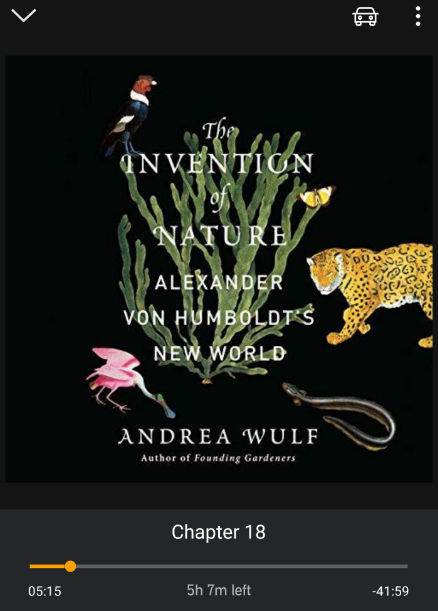
Micro Mention "The Invention of Nature"

Andrea Wulf


Everyone has heard of and read about Charles Darwin. But do you know who he read about before his adventures on the Beagle? Alexander Von Humbolt—and Andrea Wulf tells his story in "The Invention of Nature." He’s the original; let’s get out there and see nature, guy.

What I find amazing about this book is after reading it how many times I started noticing things and places named after Humboldt. It's an amazement that is dual-sided, though, because, on the one hand, it's nice to learn about an adventuring scientist I had previously not known about and is honored all over the world, but on the other side, he's been largely forgotten. Not a lot of people know why various squares, parks, and reserves are named Humbolt anymore.

Alexander Von Humboldt was a pioneer of the school of thought that nature should be studied and appreciated. I think we could all use a little more of that wisdom today, given the amount of environmental destruction prevalent in today's world.


This preview is an Amazon Affiliate link; 
as an Amazon Associate, I earn from qualifying purchases.

Author's Website: https://www.andreawulf.com/


Friday, May 7, 2021

"Grant," by Ron Chernow--Nonfiction Review

In today’s nonfiction review, we’re talking about General, and President Ulysses S. Grant, in Ron Chernow’s biography “Grant.” Ulysses S. Grant may have had his problems when he resided in the white house—because he wasn’t a natural-born politician—but due to the sum total of his life, he’s become my favorite historical American President.


Ron Chernow


What I love about this book:

I love how comprehensive Chernow is with this biography. He gives us warts and all of Ulysses S. Grant, what made him a great leader, and what his blind spots were. Grant was an incredibly honorable man who always sought to do what he promised and intended to do and couldn’t conceive that the people closest to him wouldn’t necessarily give the same effort. Chernow highlights that this was even a problem during Grant’s incredible military career during the Civil war, but it was a veritable Achilles heel during his presidency.

It was fascinating to discover how Grant thought and what his skills and weaknesses were in life, and even more so than his own memoirs, I feel like “Grant,” the biography is the closest thing we can get to reading his mind. General Sherman put it best that Grant was a unique intermingling of strength and weakness and that he was a mystery—even to himself. 

This is a biography from birth to death which gives us a complete picture of the subject. A thing I loved about the man—that Chernow’s biography taught me—is that Grant had experienced failure multiple times in his life but constantly reinvented himself to meet the current challenges of his life. He started as a shy boy who loved horses who would one day rise to the highest possible military rank, and hero of the republic, then President of the United States, a world traveler, and finally, a best-selling author posthumously.

The quality that General Grant possessed that I think I admire the most about him—and I feel is lacking in politicians today—was his ability to recognize when he was wrong and change his mind about things. He was the son of an abolitionist, but as a young man, he was noncommittal on the subject of abolishing slavery. He even once owned a slave, given to him by his father-in-law. But, over the course of his life, he freed his one slave, and during his military career and as President, he evolved as a person and became an ardent defender of equal rights. Grant, as President, even uncharacteristically passionately railed against southern atrocities where black men and women were murdered in orgiastic periodic paroxysms of death, sanctioned tacitly by southern officials.


What I don’t love about this book:

As a biography, “Grant” is amazing, and there isn’t much I can talk about that I didn’t like about it. It can be accused of being a bit long, but I forgive that because the subject matter is so interesting to me. My old nemesis of super-long chapters raises its head in this book, but I get why Chernow wrote them this way.

Mainly, I can talk about what I didn’t like about the subject of the biography, General Grant himself. Ulysses S. Grant became a personal hero of mine as I read this biography and his own memoirs, and it always hurts the most when your heroes fail to live up to your expectations, falter, and show their human failings. I’m not one to attack Grant for his drinking problem—and he was undoubtedly an alcoholic—many a “lost causer” have already beat that point to death, and I don’t respect them as people or historians. The two things that hurt the most for me were reading about General Order No. 11—a frankly racist order that is ironic when you consider the war’s aims—that targeted exclusively Jewish people, and how Grant wasn’t there for John Rawlins when he died. It broke my heart how after Rawlins served Grant so faithfully during the war, and how important loyalty was to Grant, that he barely mentioned him in his memoirs and when Rawlins lay dying, Sherman had to lie to him, telling him Grant would be there soon—just five more minutes—when he knew Grant couldn’t possibly make the journey in time.

I know I said above that I like complete biographies—but one of the terrible side effects of reading one is that when you find yourself genuinely admiring the person the biography is about, you start dreading the end. After all, the hero always dies at the end of a biography of their entire life. At several points in the last third of the book, I started slowing down because I knew from other sources than this book, primarily from a docudrama of the same name, that the end of Grant’s life was awful. Despite being the hero of the union—the man in the field who ultimately made it possible to save America—Grant died nearly destitute, writing his memoirs while dying in agony from throat cancer to save his family from poverty.


This preview is an Amazon Affiliate link; 
as an Amazon Associate, I earn from qualifying purchases.

Author's Website: https://ronchernow.com/

Parting thoughts:

This book reminded me that we have a long, shameful history of forgetting our heroes here in America. As you might imagine from above, I’m not too keen on “the lost cause” historical theory of the American Civil war, which recasts General Lee as a hero and General Grant as a bumbling idiot and butcher.

I’m also currently reading a biography of J. Robert Oppenheimer. Again, we let something like McCarthyism destroy a man who—for better or worse—changed the course of human destiny, giving us the ability to control nuclear power.

On a far less controversial note than the father of the atomic bomb, the first responders of nine-eleven didn’t get a guarantee from these United States that their healthcare would be paid for in perpetuity until 2019. Nine-Eleven happened in 2001, by the way. We thanked them for their courage and bravery during the worst terrorist attack in modern American history, and then—for nearly twenty years after—we started hem hawing away about cost. In the wealthiest country in the world, as our literal living heroes began dying of cancer which tore their lungs and other organs apart—cancer they got saving lives in the ruins of the twin towers—congress wanted to have a serious discussion about nickels and dimes.

Even after they had to be shamed into doing the right thing as a group, two senators, Mike Lee of Utah and Rand Paul of Kentucky, still voted against it. Literally and unequivocally stating that dollars are more important than human lives—even heroes. Mitch McConnell, also from Kentucky, who I do not like for numerous reasons, wasn’t even so callous as that. Both Lee and Paul claim to be upstanding members of the party of Lincoln and Grant—and oh—how far the GOP has come.

Friday, March 26, 2021

"Helter Skelter," by Vincent Bugliosi & Curt Gentry--Nonfiction Review

This book, “Helter Skelter,” written by Vincent Bugliosi and Curt Gentry, is the true-crime gold standard. The Manson family murders and their motivations behind their crimes were beyond the pale in ghoulishness, and at its core, this book is really about one man, Charlie Manson. It’s a biography of how one charismatic vicious cult leader set off one of the most chilling crimes of the last century.  


Vincent Bugliosi


What I love about this book:

Since Bugliosi was the prosecuting attorney during the Manson Family murder trial, this is the ultimate insider story about the case. Bugliosi and his co-author go into exquisite detail about the twists and turns of first the crime, then investigating the crime, and then the circus that was the actual trial. It’s such an outlandish story it almost screams for a theatrical treatment, which is probably why it was made into a movie—more than once.

My favorite part of the story is the actual trial itself, which I know can sound dry. Still, there is something about a lawyer explaining exactly how the criminal process works that’s always captivated me, another reason why I like this nonfiction book. Often my problem with trials in fiction is they’re written by people who aren’t lawyers, and I’m always left wondering, is that right?

I know this isn’t very high-minded, forgiveness for all and whatnot, but I derived a certain amount of schadenfreude pleasure when finally, Manson and his “family” get what was coming to them, and their murderous make-believe world crumbled around them. As a rule of thumb, I don’t believe in the death penalty, and when it was repealed, sparing him and the girls from it, I still felt life in prison, wasting away slowly but inexorably, was a fitting punishment. 


What I don’t love about this book:

So one of the grossest things to come out of all the Manson family trial publicity is the ever-enduring inappropriate admiration for the man himself. It’s the same thing that happened with Ted Bundy. Even after hearing all he’s accused of, there are people, still, somehow, who are attracted to him.  Or sometimes it’s his philosophy, or—worst of all—both.

This happens because of how high profile the murder investigation and trial was, and when that happens, more people hear about a thing. Gather a big enough crowd of people, and eventually, you’ll strike weirdo pay dirt. Oddballs that when confronted with facts like Manson once shot a man in cold blood and is suspected of murdering and dismembering at least one other person, they’re still going to think he’s dreamy.

I’m positive Bugliosi was a fantastic lawyer. Why am I confident of this? Because of all of the copious notes upon notes he clearly took about this crime, investigation, and trial. And I hear, you dear obscure reader, metaphorically, not really—that would be weird. Anyway, you’re saying, why is this in this section? This all sounds like they are good things. They are, but it also feels like Bugliosi didn’t leave out even one single note from this book, and it shows in the length of the book. Let’s just say it’s not a quick read.   


This preview is an Amazon Affiliate link; 
as an Amazon Associate, I earn from qualifying purchases.

Parting thoughts:

So—in many ways, Manson and his followers were ahead of their time when it comes to unhinged nutters. Like a prototype Q-Anon, Manson told his followers that they were special, smart people who were aware of and needed to prepare for the coming revolution. That was what he said “Helter Skelter” meant. Specifically, there would be a race war. Supposedly black people would overthrow everything. Afterward, Manson and his family—who would have survived the revolution by hiding in the desert—would return to be the ruling class in the new world order. 

Why would they be literally the ruling family after the black revolution while being some of the most lily-white dickheads to exist? Well, this is going to come as a complete shock, but other than being a murderous asshole, Manson was also profoundly racist—who would have guessed? Anyway, he figured that black people would be capable of revolution, but he didn’t think they could create and maintain an actual society. So they would need Charlie Manson to be their King, or Emperor, or whatever the fuck he’d call himself.

All of this sounds as grandiose as it is ridiculous, and hindsight has only made it more so, not less. It does lead to my final point I want to make today though, this impulse we have—and we all have it, don’t try to fool yourself—to self-delude ourselves about the nature and consistency of objective reality isn’t a new thing.  This isn’t something that only Capitol rioters are specifically afflicted with but a feature of us as a species. It’s a bone-deep belief that reality, or the universe, or in some people’s cases—god—can be reasoned with or better yet bargained with, and the outcomes of our lives can be changed by simply wanting it bad enough. Put another way, wishing. 

This is why I go on and on about magical thinking and why it becomes exponentially more dangerous the more advanced we get as a species. It’s because charismatic and misguided individuals have way—way more power today than ever before. The last four years in the United States ought to have proved that beyond a shadow of a doubt.

Magic makes for great fantasy but poor everyday life. Just because you want to believe something is genuine or conversely don’t want to believe something is real—the coronavirus, for instance—doesn’t make it true. This belief either, consciously or unconsciously, that reality can bend to wishes is a delusion and a dangerous one. We can only change our world through concentrated and often cooperative action. Usually, that last part requires a leader of some sort, and ask yourself, do you want to have any shadow of a doubt that leader is unglued from reality? I know I don’t. 

Remember—as the cliché goes—the bill always comes due at the end. Reality has a way of catching up eventually. Every. Time.


Friday, March 5, 2021

"How Star Wars Conquered the Universe," by Chris Taylor--Nonfiction Review

Get your lightsabers ready, Obscurists. Today, we’re talking “Star Wars” in Chris Taylor’s “How Star Wars Conquered the Universe,” a book that not just looks at the history of the epic franchise but its creator as well. 


Chris Taylor


What I love about this book:

It’s no secret; I love “Star Wars,” and this is a book primarily about loving “Star Wars,” so even though it’s an incredibly obvious point to make, clearly I love this book, and felt to not address that flat out would be a disservice.

I think the primary reason why I love this franchise, which this book brings up in great detail, is the sheer escapism that this far, far away galaxy provides us that George Lucas created. For as complicated and arcane as these stories have grown into, the central thesis and messaging have remained straightforward. There is a light side and a dark side, and no matter your intentions, it’s your actions that damn or redeems you.

So this book spends a lot of time giving us a biography of the man who gave us “Star Wars.” I really enjoyed getting to know where George Lucas came from, what his early work was like, his values and flaws, and “How Star Wars Conquered the Universe” lays it all out for us.

Even more, I enjoyed the stories of not just how Lucas made “Star Wars” but the fans over the years who have loved it, as much and sometimes even more so than myself. The guys and gals who create their own film quality Stormtrooper armor have my immense respect for the dedication to their thing. And while I’d never find the time to pursue that myself—I’ve never been a cosplayer for any franchise—I’m glad to know these people are out there and form their own little communities. Something about it just tickles me. Why they choose to be the cannon fodder bad guys, no idea, but you all do you 501st legion—you’re awesome.  


What I don’t love about this book:

So I don’t think any talk about “Star Wars” could be complete without talking about the fandom’s toxic undercurrent. I believe this was an important thing to bring up in this book—but it still sucks. Pretty much every entry after “Return of the Jedi” has about the same response from the fans—arguments—endless, endless vitriolic arguments. It gets quite nasty. This can lead to the labeling of “true fans,” which can lead to accusations of being “not real fans.” This might come as a complete surprise—if you’re a crustacean—but sometimes these adjudicators of who is and isn’t a “real fan” take on a chauvinistic tone. I know—shocking. 

Another thing that wearies me about the fandom to “Star Wars,” which will sound weird coming from a guy who analyzes books—on a blog of all anachronistic things—is the never-ending spiraling critique/over-analysis of every single aspect of the franchise. This book is a very long book about “Star Wars’” past, present, and future, and it’s also about “Star Wars” fans and points this out about them while simultaneously engaging in that very same behavior. It is possible to love something too much—there is a fine line.

This is petty, so that’s why it’s at the end of this segment. But near the beginning of this book, there is a story about an elderly Native American man who has never seen “Star Wars” before, and he’s seeing it for the first time ever after it’s been translated into his native language. Small spoiler here, but that gentleman didn’t stay to the end, and it doesn’t seem to occur to the author that maybe he just didn’t like it. That’s what I mean when I suggest that overindulgence in fandom can be a bad thing. We have so much of ourselves wrapped up in the fandom that when we encounter someone who doesn’t like it, there is disbelief, and then we feel like they’re personally attacking us, leading to anger and so forth and so on. 


This preview is an Amazon Affiliate link; 
as an Amazon Associate, I earn from qualifying purchases.


Parting thoughts:

I’m about to share an unpopular opinion here. Gene Roddenberry, the creator of “Star Trek,” and George Lucas, within their respective franchises, were wonderfully imaginative and driven pioneers, but the quality of writing improved after their tenure in the long term. Both men, in my opinion, when given absolute creative control, with no one to check them, let their worst creative impulses flow. Roddenberry had a problem with establishing conflict in his story, and Lucas, while obsessive on specific details, was inexcusably light on others.

If you watch “A New Hope,” really just “Star Wars” back in the day, you’ll notice, if you’re honest, that the acting is a bit wooden, mainly because the dialogue is stilted. If you then progress into the next two movies, you’ll also notice that this seems to clear up and isn’t as profound a problem. But when you go and watch the prequel trilogy, you’ll notice that everyone sounds weirdly wooden again—and even more so than in “A New Hope.” So what gives?

One of the things you’ll learn if you read this book or do your own research is that Lucas didn’t have to answer to too many people in the original movie and exercised nearly complete creative control. He is also very bad at writing dialogue. I can sympathize, and it’s one of my flaws too. I would also argue that, for the most part, beyond creating archetypes, Lucas isn’t all that skilled at creating characters either. 

He’s a visual guy, a fast-paced move the plot from one place to the next kind of storyteller. His most incredible skill, though, is the spectacle. Right in that first movie, he blows up a planet and then blows up the planet blower-upper by the end of the film—plus there are laser sword fights and space fighter jets dogfighting, and space wizards—and it’s just awesome. OK? So while he didn’t quite commit to who these people are, other than superficially, he can easily be forgiven.

My personal theory about the prequel movies is that they were his honest attempt at telling a more in-depth allegorical story, and they spectacularly didn’t work. They didn’t work because, by the time he set out to make them, Lucas was at the height of his creative powers, much like the Emperor. So no one was going to question the master on his opus. If they didn’t get it while he was making it, clearly, they just weren’t appreciating his genius and would see it once it all came together. That’s why they were so disappointing to many people because they never came together in the end.

What made the original trilogy so good, in my opinion, was because he was forced to work together with other people, and those people enhanced his strengths as a storyteller and smoothed his weaknesses. He was still a scrappy kid back then, and other people were around him and wanted to help him succeed, a bit like Luke.

Here is a paradoxical idea for you—I think that the George Lucas, who wrote the prequels, was a better, more mature writer than the George Lucas, who wrote the original trilogy. He had some excellent ideas woven into those stories. He started setting up some of those ideas in the first movie that most people deride as the absolute worst of the three. 

The whole concept that Jar-Jar, offensive as he is, may have been a sith all along playing the fool would have been a great slow burn twist had Lucas not got cold feet because people hated the character so much. My response would have been, “they hate the character? Good, they should hate the character! He’s going to be revealed to be a sneaky duplicitous dickhead soon, and won’t they feel good that they intuited that he wasn’t a good guy.” Of course, this is marred because Jar-Jar also has an uncomfortably inexplicable racial tone to him, so I could see dropping the twist on that ground. Because to then reveal him as an evil schemer too—well, there are some problems with that messaging, to say the least.

Anyway, my point is that the prequels’ problems weren’t that George Lucas was phoning it in, or didn’t grow as a writer, or regressed. It’s that he mostly went it alone in telling the story. Pretty ironic when you think about how “Star Wars” has always been a story about a group of like-minded friends banding together to save the day and everyone who goes it alone, for individual glory’s sake, flames out to their ruin in the end.


Friday, August 28, 2020

"The Pirate Hunter," by Richard Zacks--Nonfiction Review

Avast ye mateys of the obscure waters, we be talking about pirates this week, savvy? And we be doing it in the most stereotypical way imaginable, and not even on talk like a pirate day—further demonstrating my supremely poor sense of timing. This is just like that time I proposed marriage to me bonny lass, Cynthia, in a cemetery, at her uncle’s funeral… Anyway, today’s book is “The Pirate Hunter: The True Story of Captain Kidd” by Richard Zacks.     

Richard Zacks


What I love about this book:

The introduction spells out what this book is about, and the author’s viewpoints, and introduces the thesis that Captain Kidd wasn’t precisely a pirate, but was maligned—to his death. From there, the rest of the book is building that case about the man.

I love a good nautical adventure, be it fiction or non-fiction, and this book doesn’t disappoint. Despite being non-fiction, this book has a Jules Verne, “Twenty Thousand Leagues Under the Sea,” feel about it. What I mean by that is there is excellent attention to details of how the ship operates and how the crew lives and works. This book, though, could be more accurately described as an inverse to Verne’s work, which was forward-looking for his day of what technology will one day look like on a ship because “Twenty Thousand Leagues Under the Sea” is science fiction. “The Pirate Hunter: The True Story of Captain Kidd” is a historical look at pirates and ships of the past. 

The whole legend of pirates burying their treasure was a thing no pirate really did—they tended to spend their booty. The legend of pirates burying their treasure started because it was something Captain Kidd did with his valuables while trying to clear his name of the charge of piracy, which is a neat detail this book brings up. 

I found all of the research Zacks did regarding Captain Kidd’s rival, Robert Culliford, to be illuminating. He isn’t a figure you hear about as much as Kidd, and that guy was absolutely a stone-cold pirate. Captain Kidd, despite his failings, seemed to me to be a man who set out to do right by his crew and country, but external events conspired against him, mixed with his own vanities and occasional temper. 

This is a double-edged sword here, but Zacks spares no detail about the life of Captain Kidd and the world he inhabited, he goes into minutia that is genuinely impressive that he manages to summon up. At times, this biography feels more like a novel because of that level of detail. 


What I don’t love about this book:

It goes on for a very, very long time. You know how I said all the detail was a double-edged sword? Zacks goes into such exquisite detail that if you can pay attention, you can virtually see the world in which Captain Kidd lived, in your mind’s eye. But the operative word is—if—because with the sheer tower of detail into which Zacks infuses this book means that if your focus wavers, it topples over and becomes dense.

Furthermore, the flow of this book tends to meander off into points and with people that are only tangentially important to the overall message. Sure, on the one hand, you could argue this is the author giving historical color to his thesis, but I think it’s equally valid to say that Zacks is so enamored with his subject he allows it to carry him away. 

Also, while I like the introduction—it concisely explains what the rest of the book is about—Zacks’ opinion that Captain Kidd was sold down the river, and was largely innocent of all charges of piracy, can feel a tad hero worship-like. Ultimately, he convinces me that Kidd didn’t get a fair shake at defending himself, and didn’t deserve his fate. Still, Zacks’ narrative about the man’s life can feel at times a little over-eager to prove that point.


This preview is an Amazon Affiliate link; 
as an Amazon Associate, I earn from qualifying purchases.


Parting thoughts:

The justice system of Kidd’s day wasn’t up to our standards of today, and this book works as a chilling reminder of why fair and impartial due process is so important. The kangaroo style court proceedings at the end of the book are downright appalling.

In today’s world, it worries me when I hear people express attitudes that can only be described as quick to judge and prescribe swift punishment. 

Our ideals of justice are supposedly founded on the notion it is better that nine guilty persons should go free rather than one innocent should suffer, sure it’s a cliché, but all clichés start as memorable ideas. It’s why I’m so uncomfortable about the notion of the death penalty, that the state has the right, nay the mandate, to murder one of its citizens.

I get the visceral reasons why people desire the death penalty for violent, murderous criminals—it’s as old as it is biblical, an eye for an eye. But it is a policy born from rage, which that alone, to me, should raise the question does that make it wise?

The other reasons for the death penalty—other than biblical justice described above—are deterrence, protecting law-abiding citizens, and not spending money from the state’s coffers to feed and house a violent murderer for the rest of his natural-born life.

Let’s take them one by one. There is no evidence to support the idea that the death penalty has any impact on the rate of homicide, and this isn’t a particularly controversial idea either and has been studied by such bodies as Northwestern University, School of Law. The idea that it protects law-abiding citizens is accurate in the sense that particular murderer won’t be harming anyone else unless you believe in ghosts—but you know what else does that? Someone being sentenced to life in prison without the possibility of parole. This brings us to the final argument I hear the most often on this topic, money. So when a person is sentenced to death, a lot of things happen, primarily there are a lot of automatic appeals that have to be dealt with by the legal system, which means legal fees, and a lot of hours worked, by a lot of people, and it’s all costly. So costly, in fact, that it tends to be cheaper just to warehouse these people for the rest of their life.

My final argument here is, so far as we know—excluding various religious theories—this is it, this is all the time we get, and that includes murderers too. So what sounds more punishing? To be strapped to a gurney and be put to sleep, like we do with desperately ill pets? Or spending years, upon years, in a cell, never leaving, never interacting with the outside world in a meaningful way, feeling your body become frailer and more wasted with each day to only one day be consigned to oblivion—unwept and unmourned.

I want to think that if faced with the unimaginable, and someone I loved was taken by such a criminal, that I would have the fortitude to stick to my ideals. But I don’t know if that’s true, can’t know if it’s true, and hope I never have to face that ultimate worst moment. That is, however, my point, people who are in this emotional hurricane should not be the ones influencing the hand of justice because rage and hate are like an uncontrolled inferno—blind to what they burn. The truly insidious thing about those two human impulses is that they feel like wisdom in the moment but rarely result in positive outcomes. Don’t believe me? Please take a look at the world we live in right now. Do you think our problems stem from our overabundance of love and compassion for each other?

Friday, June 19, 2020

"Leonard," by William Shatner--Nonfiction Review

Good morning, space cadets, today we’re going to talk about “Leonard” by William Shatner, which is an excellent biography of Leonard Nimoy. It’s a sweet look at the life of the man who created Mr. Spock, as told by Captain Kirk himself.  

William Shatner


What I love about this book:

Shatner delves into aspects of Leonard Nimoy’s life that as someone who primarily knows his work on Star Trek—and precious little else—that I found fascinating. He describes their shared Jewish heritage and what it meant to Leonard and himself. It’s neat to find out Mr. Spock could speak Yiddish like the best of them.  

One of the funny little things about him that I learned via this book was that Nimoy was a poet. He specialized in writing love poetry. Think about that for a moment. For most of his adult life, he portrayed a character who didn’t feel emotion normally, especially not love. Then in his spare time, the actor wrote love poetry. In a way, though, it occurs to me that it really isn’t all that unusual. It was something he couldn’t often express in his television career as Spock, and the other characters he played in movies and TV series, while not as tightly wound as Mr. Spock, weren’t exactly gushing with emotion. So as a deeply sensitive and creative man, he’d need to outlet that somehow.

Leonard Nimoy was also an accomplished photographer, which is another thing I learned via Shatner, and his love for art and artists ran very deep. Listening to how Nimoy starred in a play about Vincent van Gogh made me jealous that I’ll never get to see that performance. 

The thing that I loved the most about this book is how funny Leonard Nimoy was, a talent that, as Mr. Spock, I rarely got to see. So when he got to direct “Star Trek IV” and “Three Men and a Baby,” he got to flex those creative muscles, and Shatner takes the time to delve into what that meant to Leonard.

Overall, this book left me with a deeper appreciation of the friendship between Nimoy and Shatner—for its complexity and richness spread out over decades. Shatner doesn’t hide from the fact that they had their ups and downs, which lends authenticity to his words.  


What I don’t love about this book:

Shatner not being at Nimoy’s funeral still bugs me. He explains it in the book why it happened, and he talks about the distance that grew between them toward the end of Nimoy’s life that they never resolved, which Shatner will forever regret. The fact that William Shatner can own that he’s not a perfect person is admirable since to say he is without ego would be incredibly misleading. So to admit fault, must be that much more difficult for him. 

To a degree, I understand Shatner’s decision and his explanation that he was represented at the funeral by his daughter. He had made a commitment, he stood by that commitment, and he even stresses he finds it more important to celebrate the living. Still—your life long friend only has one funeral—so it is disappointing that he didn’t go, and that’s a hard thing when your heroes let you down. But to play devil’s advocate and defend Shatner—he didn’t deserve the controversy that followed. There is a fine line between being disappointed by something a person did or did not do, and then there is castigating a man who is clearly in mourning over the passing of his friend because he isn’t grieving in the way we would like him to—in public.

One of the more painful revelations in the book isn’t anything to directly with the relationship between William Shatner and Leonard Nimoy, but between Nimoy and Gene Roddenberry—the creator of Star Trek. Roddenberry is a creative genius, in my opinion. He’s the man who had the optimistic vision of the future that would spawn an entire universe. What’s painful to find out is that Roddenberry could be a tyrant to his actors. There is one story that I find particularly disheartening where Roddenberry told Nimoy to fire his agent after that agent got him a job, that paid well for an actor who was struggling to get by like Nimoy was at the time. What’s even worse, Roddenberry wanted twenty percent of the paycheck to “represent” Nimoy for the said job the other agent got him. Nimoy refused—and their relationship was cold ever after.

Now I’m not saying I dislike these parts, and therefore Shatner shouldn’t have included them in his book. I think he was right to include all of this with everything else, why I dislike these stories is all in the vein of it’s always your heroes that can disappoint you the most. William Shatner, Leonard Nimoy, and Gene Roddenberry were all childhood heroes of mine, so reading about their flaws as people, when I’m an adult, is a particularly uncomfortable experience.          


This preview is an Amazon Affiliate link; 
as an Amazon Associate, I earn from qualifying purchases.

Author's Website: https://williamshatner.com/

Parting thoughts:

Star Trek has been a big part of my formative years, and while the bulk of his career was behind him before I was introduced to the show, Leonard Nimoy always feels present in every version of Star Trek. Unlike William Shatner’s indomitable captain Kirk, Nimoy got to define a race of fictional aliens, every actor who played a Vulcan after him, shaped their characters after his original role. Such moments of defining creativity are rare, and I can’t imagine another actor doing so with as much grace and class as Leonard Nimoy.

It’s a prevailing fear of actors to become typecast in particular roles, and Nimoy was no exception. He wrote two books about that very concept, “I am not Spock,” and “I am Spock.” The second one, where he embraced the character in “I am Spock,” was the better book, in my opinion—which is biased if I am being sincere.

Every time I find myself looking at the stars or staring at the night sky or maybe just thinking about space in general, inevitably, my thoughts will turn to Star Trek. As such, when I think of Star Trek, I think of Leonard Nimoy. For me, Mr. Spock did more for my love of space than even Carl Sagan, so when Leonard Nimoy died in 2015, it was as if one of those stars I’d grown to love because of him, went out. I’ve since changed my views on this, in no small part because of this book by William Shatner. Leonard Nimoy, like innumerable creative storytellers, will never truly die—for he is immortalized in fiction, and his life has been chronicled by those who loved him.