Showing posts with label History. Show all posts

Monday, May 16, 2022

Micro Mention "American Prometheus"

 
Kai Bird & martin J. Sherwin


J. Robert Oppenheimer is a tragic figure of American history whose accomplishments were all overshadowed by one thing; he was the father of the atomic bomb. Once a hero, then painted a villain and torn down by his own. “American Prometheus” by Kai Bird and Martin J. Sherwin captures that narrative.

I talk about that idea in more detail in my full review

What I want to point out, though, for this little piece is, isn't it amazing how like in this book, when the conservative political party froths its way up into a moral panic, lives are ruined, and careers are destroyed.

But when a right-wing politician straight up breaks the law, they fly away in their helicopter with no consequences. Or fights an entire debacle shadow war with no consequences. Or an actual conventional war, twice, with little to no plan with no consequences. Or, finally, continues to be president after seriously suggesting protestors be shot in the legs or to cure a virus with bleach injections.


This preview is an Amazon Affiliate link; 
as an Amazon Associate, I earn from qualifying purchases.


Saturday, May 7, 2022

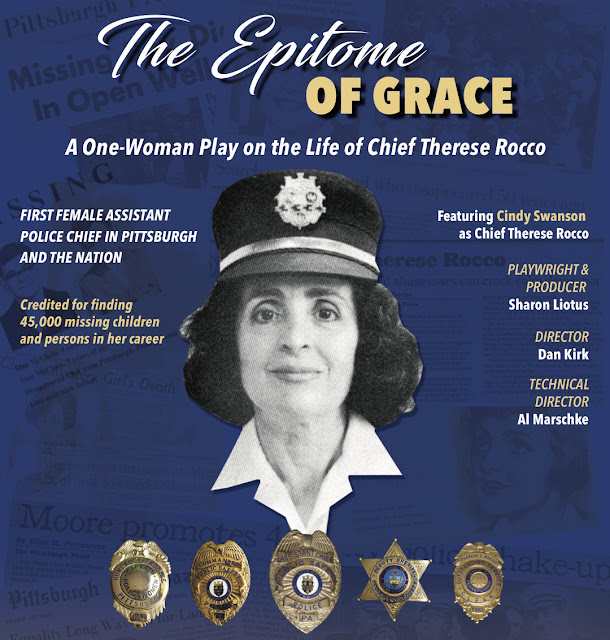
"The Epitome of Grace" by Sharon Liotus--Play Review

Sharon Liotus


This is unusual for me because I don’t normally review anything other than books on this blog. Still, here we are, and today I’m talking about “The Epitome of Grace,” a one-woman play featuring Cindy Swanson as Chief Therese Rocco. The playwright & producer is Sharon Liotus, who is a personal friend of mine—full disclosure—and it was directed by Dan Kirk, with Al Marschke as Technical Director.

As for why I’m reviewing a play out of the blue—there are many reasons—certainly, because I was asked to and because I went to see it for myself last Saturday, April 30. 

Most of all, I agreed to do this review because I’ve met Chief Rocco, who is a real person by-the-by for you non-Pittsburgh natives. She’s an amazing woman. Therese Rocco started her career in law enforcement in the middle of the 20th century, and it stretched all the way to the new millennium. By the end of that illustrious career, she was Pittsburgh’s first female assistant chief of police—and the first in the nation, according to at least one local newspaper that I’ve not rigorously fact-checked on that point.

That, however, is straying from what I want to discuss. 

I want to talk about what it was like to experience this play. As a one-woman show, it’s cleverly written from the perspective of and very much in the voice of Chief Rocco herself, telling us the story of her life. Liotus achieved this through her own friendship with Therese and through exhaustive interviews with those who knew and worked with the Chief.

At the performance I was at, Chief Rocco was in attendance. So it was a bit of a sight gag to see her in the crowd watching a woman on stage portraying a younger version of her. Like everyone else in attendance, Chief Rocco laughed when the play was funny. The vignette about how she caught the fleeing theater pervert by pulling down his pants as he tried to run away comes to mind, which has a certain amount of poetic irony about it when you think about it.

Alas, though, like with all true stories about police work, there are always the more sorrowful moments. It would be cliché if it weren’t so heartbreakingly true that every detective, given sufficient time on the job, inevitably has that one case that doesn’t get solved and haunts them—even long into retirement. The case of Mary Ann Verdecchia is that case for Chief Rocco, and the pathos that Swanson infuses into her performance describing that hole in time and space where Mary Ann disappeared walking home one day rends the soul. Mary Ann didn’t have a traditional family—her mother and father weren’t around, and she was being raised by a relative. The world took even more from her, and so far, the quest for justice has been left unfulfilled. Still, hope holds out that answers will be forthcoming one day.

Watching and experiencing—however vicariously and fleeting—Therese Rocco’s rise through the ranks in the police department is an absolute joy that this play captures. It was a journey with its ups, the promotions, and support—and downs, the constant roadblocks put in her path by those who had no motivation other than they didn’t like the idea of a woman being in her role. When Chief Rocco was tapped to be on the shortlist of candidates to be recruited for the U.S. Marshals and then ultimately betrayed for craven political reasons and blocked, again, because she was a woman, the indignity was palpable in the theater.

The concluding implicit message of the play, however, I think is its most powerful; that you can’t control the world and how it reacts to you, only how you respond to it in turn, and even if speaking for the truth is the losing position it’s still the correct one. There were many times throughout her long life and long career where Chief Rocco could have given up, thought of giving up, and had doubts—because that’s human.

In the end, though, what makes her legendary around here isn’t that she never had doubts or always succeeded. No, it’s that despite those doubts, she took what life threw at her on the chin and kept fighting for what was right, no matter how hard. 

That’s grace


This preview is an Amazon Affiliate link; 
as an Amazon Associate, I earn from qualifying purchases.


Additionally, Chief Rocco also wrote her memoir "Therese Rocco: Pittsburgh's First Female Assistant Police Chief," which inspired the play. I plan to review it here on WIO at a later date when I finish reading the book. So far, I'm loving it as much as I enjoyed the play.


Wednesday, April 20, 2022

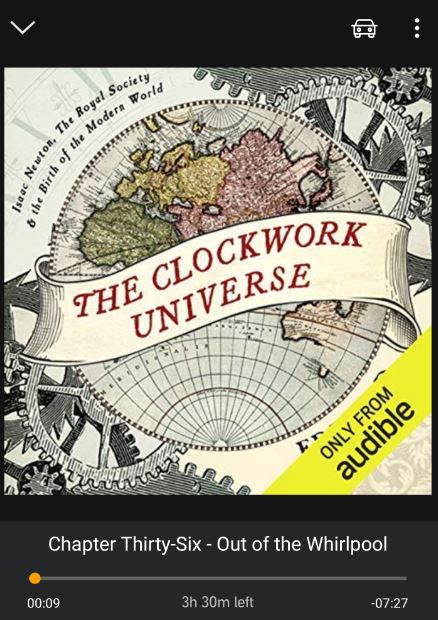
Micro Mention "The Clockwork Universe"

Edward Dolnick


“The Clockwork Universe,” by Edward Dolnick, is about many things—but most of all, it’s about the beginning of true scientific thought. The transitions from alchemy's magic potions to verifiable and reproducible results were painful and anything but clear cut.

It's a fascinating book that describes the early days of the scientific method and the people who made this school of thought that gave us the modern world. That turning point for us as a species is immeasurable in its impact on our collective destiny. It's not at all clear yet if scientific progress will eventually lift us to the point of transcendence or merely give us greater tools to destroy ourselves.


This preview is an Amazon Affiliate link; 
as an Amazon Associate, I earn from qualifying purchases.


Wednesday, April 13, 2022

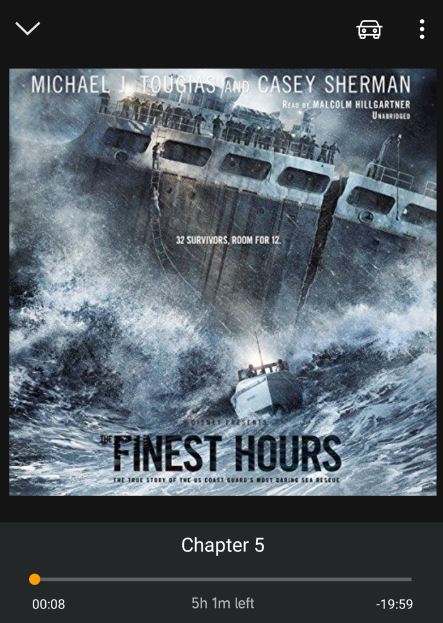
Micro Mention "The Finest Hours"

Michael J. Tougias & Casey Sherman


I always love a good nautical adventure—be it fiction or nonfiction—but this story by Michael J. Tougias and Casey Sherman, "The Finest Hours," is more a nautical horror story—a nightmare that really happened. Never underestimate the power of the sea.

I've talked about this before on this blog, but I have experience working on the water. Certainly nothing like this; I worked on riverboats that did day cruises, but anyone who has worked around any body of water knows that when the weather changes, the water changes, and it can easily be dramatic. Water on the move, in a storm, can feel like a vindictive and malevolent force. That's why this book reads like a horror story to me.


This preview is an Amazon Affiliate link; 
as an Amazon Associate, I earn from qualifying purchases.


Wednesday, March 9, 2022

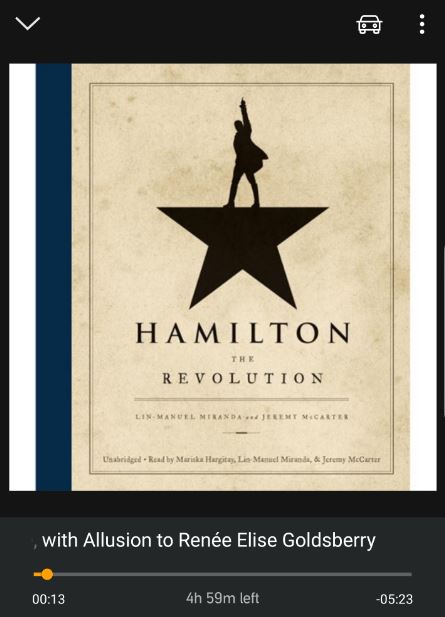
Micro Mention "Hamilton: The Revolution"

Lin-Manuel Miranda & Jeremy McCarter


I loved "Hamilton" the musical, so I was over the moon to listen to this book, "Hamilton The Revolution," by Lin-Manuel Miranda and Jeremy McCarter, to get all the background information about it that any obsessive nerd could possibly want.

It's incredible how this show managed to revitalize my interest in this period of American history and underline values from all the way back to the founding of the union that still persist today. Though, I sometimes worry that not every American values the principles of democracy as much as they should today.

Plus, despite listening to the whole show numerous times, beyond counting, I find myself listening to the songs today as if I hadn't heard them all a million times before. I still pick up subtle things I hadn't appreciated before, but this book is also a bit of a cheat sheet. So if nothing else, I'd suggest picking it up for that reason if you're a fan of the musical.


Wednesday, February 23, 2022

Micro Mention "The Fall of Carthage"

Adrian Goldsworthy


Honestly, before I read this book by Adrian Goldsworthy, "The Fall of Carthage," I had no idea what the Punic Wars were or what Carthage was—but I did know a fair bit about the Roman Empire. So it was surprising to find out that Carthage was an early rival to the empire.

What I find so interesting about the Punic wars is that if a couple rolls of the die went a little different, Rome would have lost it all. Or maybe it would have been significantly reduced. What would history have been like if Carthage was the major power of antiquity instead? It's one of those unanswerable questions but still a fun one to ask.


This preview is an Amazon Affiliate link; 
as an Amazon Associate, I earn from qualifying purchases


Wednesday, January 26, 2022

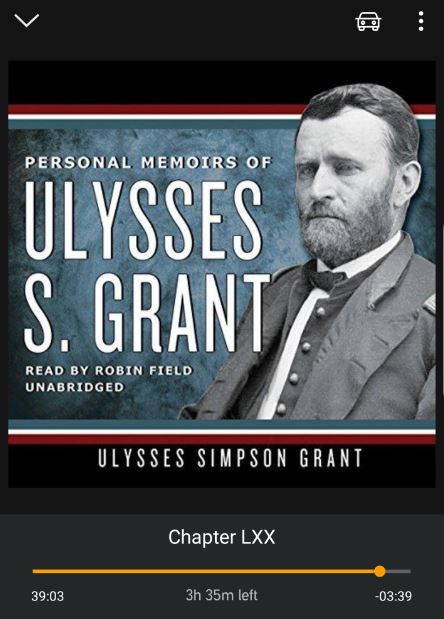
Micro Mention "Personal Memoirs of Ulysses S. Grant"

Ulysses S. Grant


So, soon after starting Chernow's excellent biography, I decided that I wanted to get the story of Ulysses S. Grant straight from the man himself. "The Personal Memoirs of Ulysses S. Grant" are startlingly intimate and powerful, and every American should read them. 

Anyway, fun fact, the "S" in Ulysses S. Grant doesn't stand for anything. It certainly doesn't stand for Simpson, making it weird that this audiobook edition proudly displays it as his full name. How do I know this? I read Chernow's book. In fact, his name was actually Hiram Ulysses Grant, but he went by his middle name. When he was accepted to West Point, the military academy dubbed him U. S. Grant through a clerical error.

Also, of all weird things, the terrible movie "Wild Wild West" gets it right that President Grant went to West Point when Will Smith's character realizes that he's talking to Kevin Kline's character in disguise by noticing him wearing the wrong school ring. Quite a clever moment for an otherwise stupid movie. Of course, it loses all cleverness points because earlier in the scene, Kline's master of disguise character costumed as Grant offers Smith's character whiskey. Grant was incredibly sensitive about his drinking and the perception that he was an alcoholic. As president, he would have never been caught dead drinking in front of anyone in the White House.


This preview is an Amazon Affiliate link; 
as an Amazon Associate, I earn from qualifying purchases

Friday, November 12, 2021

"Hidden Figures" by Margot Lee Shetterly--Nonfiction Review

We're doing another space book, Obscurists. Well, sort of, it is more a history of NASA and some of the most talented women to ever work there whose contributions were sadly mostly forgotten until recently. Today's book is "Hidden Figures" by Margot Lee Shetterly.


Margot Lee Shetterly


What I love about this book:

So I'm a big lover of all things space—I'm not so crazy that it's become the playground of billionaires—but still, I love the history of the space race and the ambition and talent that drove NASA forward. I love this book because it shines a light on the contributions of black women who participated, immensely, it turns out, to our success in space.

"Hidden Figures" isn't just a history of NASA's earliest days during the Mercury missions but primarily a biography of Katherine Johnson, Mary Jackson, and Dorothy Vaughan. It shows how all three black women—and more like them—contributed mathematical prowess in the computing departments and engineering expertise in Jackson's case. All of this was at a time when women, in general, were typically discriminated against in the workplace.

Racial prejudice is focused on in far greater intensity in the movie based on this book than the book itself. I'm in no way trying to suggest that it didn't exist back then or that it didn't exist at NASA, and I'm sure these women were faced with that ugly truth. After all, black people don't get to stop being black ever, not for one moment. We should live in a world where color doesn't matter, but that goal has yet to be achieved. 

What I mean is this book reaffirms NASA's core value of excellent research above all else. Any skilled person can describe a good idea or the truth about nature, regardless of uterus status or skin color. That is and always was, most important at NASA. While admitting there were still segregation laws in force at NASA, Katherine Johnson even said that she personally didn't feel it during her time there because the mission was most important at work. I'm paraphrasing from this quote: "... didn't feel the segregation at NASA, because everybody there was doing research. You had a mission and you worked on it, and it was important to you to do your job ... and play bridge at lunch." She added: "I didn't feel any segregation. I knew it was there, but I didn't feel it."

  1.  "Katherine Johnson Interview: NASA's Human ComputerHistoryvsHollywood.com. CTF Media. 2016. Archived from the original on March 3, 2017. Retrieved March 2, 2017.


What I don't love about this book:

The movie focuses on the racial element of the story pretty hard because it's a reliable story beat to gain audience support—at least a certain non-racist audience—but in doing so, it miss characterizes this book, in my opinion. Sure, generally, the past in the late '50s and the early '60s overall had a more in-your-face sort of race problem. However, telling the story of these women as a way of saying they succeeded despite the old racists at NASA is kind of disingenuous and lazy. NASA was a pretty progressive place back then, maybe not to our standards today, but still, the Mercury missions took place on the tail end of the Jim Crow era. The idea that black people and women, too to boot, were trusted with genuine, hard, and necessary—life or death work was radical for the day. 

So the actual shameful thing—the real no-joke insidious racism—that this book points out is how we just forgot these women, who they were, and what they did. It's insidious because of its banality. Women like Johnson, Jackson, and Vaughan were always there up to the modern era. They just weren't given any sort of visibility to the public, in either the media or in popular movies—movies I like which saddens me to no end.

The Hollywood movie is the way that it is, in my opinion, because we like to see the past being somehow less enlightened on this front—across the board—and that we, the wise non-racists, have grown and transcended this problem. Except that's bullshit, and we haven't. We're just much more sensitive to being called out for when we're doing some racist shit. Ignoring the contributions of some, belittling them, denying them representation or just plain apathy toward an ethnic group is, in fact, racist.

Where I am going with this point is that this book's quality that makes it feel like a revelation isn't a good thing as the movie version supposes. It isn't a breath of fresh air, some grand rediscovery—it's a goddamn American tragedy. The idea that we as a society tacitly allowed the perception that NASA employed nothing but exclusively white dudes with pocket protectors from the flight director all the way down to the janitor and no one else—is as tragic as it is wrong.


This preview is an Amazon Affiliate link; 
as an Amazon Associate, I earn from qualifying purchases.


Parting thoughts:

So for my parting thoughts, I'd like to shift gears here. Recently, it has become fashionable, we'll say, for some groups of Americans to vocally and stupidly claim that we never landed on the moon—and also that the Earth is flat. I don't know, probably.

This is one of those things like Mr. McConaughey's character in "Interstellar" that instantly gets under my skin and annoys me. On the face of it, not only is it wrong, with nearly every country verifying that our radio signals from the Apollo missions came from the moon. Countries including Russia, who was famously competing with us at the time to do just that. Not only is it a denial of the single greatest technological feat we as Americans have ever accomplished, including the atomic bomb, and that there are literal mirrors on the moon that we still use in experiments today left by the Apollo astronauts. It is a slap in the face of every brilliant American astronaut, scientist, engineer, mathematician, and physicist who sacrificed so much, sometimes their very lives, to accomplish that dream.

This insult typically comes from the same group of people who can't even spell algebra, let alone pass it in high school. So why do they insist on their factually wrong position and that we take their non-expertise as valid? I've meditated on this point for a long time, and I believe the answer is actually quite simple.

They are Americans who hate America.

That is a loaded and admittedly inflammatory statement that requires qualification—which I will provide. More precisely, they hate America as it is, and as it always has been, which is a broad land of immigrants from all corners of the Earth, with different skins, beliefs, religions, and languages cohering together as one society. They do, however, love their imaginary America that they've constructed in their mind. An America that was somehow uniformly white, Christian (whichever brand they subscribed to), and the reason that there are literally any problems whatsoever is that we've gotten away from that.

There is this sick love for conspiracy where there is no conspiracy. Instead of admitting that maybe their lives are mediocre because they are, in fact, mediocre. They've never taken the time or effort to change that about themselves. Instead, they invent cabals of satan worshiping pedophiles that somehow hold back their natural all-white awesome American-ness.

The denial of the moon landing stems from the same poisoned fruit that we couldn't possibly have succeeded at such a challenge because the people who did it weren't pure as defined by some wackjob. The people who did the work, the math, the planning, and took the risks to make it possible were diverse in ethnicity, gender, and religion.

And that has no place in their imaginary America. So it didn't happen.


Wednesday, November 10, 2021

Micro Mention "Masters of War"

Andrew R Wilson


Suppose you've any interest in military history or just strategic thought in general. In that case, you can't go wrong with the great courses "Masters of War: History's Greatest Strategic Thinkers" taught by Andrew R. Wilson.

So if you're like me, you find war to be terrible but fascinating. Wars are like thunderstorms in that regard, only interesting if you've got some sort of separation from the actual event. For instance, you might watch a thunderstorm from your window and be entranced, unless, of course, it turns into a tornado and blows your house down. Then it's just terrible. Both storms and wars kill people, and choosing to not understand them isn't actually a defense.

Strategic thought, however, is a lesson the history of war can teach you, and luckily it can be divorced from national death contests to enhance other aspects of your life. I think people commonly go wrong when they read things like "The Art of War" is because they then equate everything to a "war" like business or negotiation. But the real lesson and the point is to see things as a strategic puzzle to be solved. Domination is only one sort of solution and often not even the best. War hawks fall into that fallacy because they can't ever imagine solutions other than violence.


Friday, October 22, 2021

"The Plantagenets" by Dan Jones--Nonfiction Review

For this review, we’re taking a deep dive into English history with “The Plantagenets,” written by Dan Jones. It’s a book about early English Kings and the royal family that surrounded them.


What I love about this book:

This is the third book by Dan Jones I’ve read, and I absolutely adore how he tells history. He captured my attention because he’d taken the time to flesh out each historical figure with who they were, what their strengths and weaknesses were, what their ambitions were, and what their family was like around them.

He also takes the time to highlight how certain Kings were tied to popular myth, like Richard the Lionheart and his younger brother John, King of England. Both Kings were prominent side characters in most versions of the legend of Robin Hood—in some, Robin even goes crusading with Richard. John was presented as more of a vicious idiot in the myth. In the actual history presented by Jones, John was undoubtedly vicious but wasn’t exactly an idiot. He was more short-sighted.

A lot of this book reads like a generational family drama novel. Presenting the book that way, Jones helped cement for me who, when, where, and under what circumstances these people lived. I found it fascinating how the descendants of Kings had their lives shaped and directed by circumstances informed by their ancestors long before they ever took over and ruled for themselves. Then watching over the years covered in this book as they either rose to the occasion and ruled well or… not so well.


What I don’t love about this book:

Maybe this is because I’m an American and Jones is British, but I found him a little too enamored with his subjects—at times. The only Kings I like are in fantasy books, and in reality, I feel the only good King is a deposed King. For me, Kings and Queens, Emperors and Empresses, are just dictators who typically have God complexes. I’m vehemently against anything that sounds like a right to rule is a birthright and that some people are just super extra awesome because they had the right incestuous parents.

Narratively this book subtly shows its hand revealing a preference for one King over another and genuine like for some. The first part I can understand—I guess—the second not at all. 

A thing I just generally don’t like about history and isn’t specific with this book is how long we as a species played along with this game of; that some people, by virtue of their station in society, are just special. We, as the un-special, are not only required to regard them as such but to also love them. And we’re supposed to regard it as an absolute tragedy when their rich kid gets drunk with all his friends, crashes their expensive—yet poorly designed—white ship into some rocks, and drowns because they all wear stupidly heavy fancy clothes that just soak up the water. I know it’s vicious, and I’m not proud of the schadenfreude, but maybe that bit should have been in the “what I love about this book” section.


This preview is an Amazon Affiliate link; 
as an Amazon Associate, I earn from qualifying purchases.


Parting thoughts:

To me, it feels like some of us have vacillated back to the idea of admiration for “the strong man” of government. Without getting too far in the “well, both sides do it” navel-gazing, because I find when someone wants to tell me about how the left is just as bad as the right, they’re about to reveal that they don’t actually have any real ideas of their own on how to fix things. Yes, both sides of what is widely accepted as the political spectrum have engaged in propping up a “strong man” as head of the government and supreme authority in various places all over the Earth.

Now, that aside, a King is really the ultimate conservative ideal. A man—appointed by God himself—is bestowed magically through birth inheritance with all the skills and wisdom he will ever need to rule his lessers via divine providence. He may be a flawed instrument, but no matter what, no matter how many lies he speaks or how provably wrong he is shown to be, he has to be correct—because God sent him.

There are many, many reasons why I don’t like that prospect. Mainly though, it’s because it’s the same fucking story countless tyrants have told us about why they are in charge and why we, the peasantry, should be just THRILLED to send our sons and daughters to die in some distant land.

I agree with the founding fathers of the United States on this topic. No one should be King. In that name or any other. No one is special from birth. Though that last bit has been a point of lively debate over the years, so much so that we fought a bloody civil war over it.


Friday, September 10, 2021

"American Prometheus" by Kai Bird & Martin J. Sherwin--Nonfiction Review

In this review, we’re talking about the Pulitzer Prize-winning biography “American Prometheus” by Kai Bird and Martin J. Sherwin. It tells the story of J. Robert Oppenheimer—father of the atomic bomb.


Kai Bird & Martin J. Sherwin


What I love about this book:

As someone interested in technology, physics, and history, this book satisfies all of those interests in one fell swoop. At first, I assumed it would be strictly a biography of Oppenheimer during his time with The Manhattan Project and shortly after that because that’s when he was the director at Los Alamos, where we all know him for his work—the building of the first nuclear weapons. “American Prometheus” is actually the entire story of J. Robert Oppenheimer’s life from the cradle to the grave. As such, it provides us with great context for how and why he became the father of the atom bomb. 

Oppenheimer was someone whose life straddles two sides of a pivotal moment in history. I enjoyed vicariously seeing the world—as best you can imagine through books like these—through his eyes and perceptions. It has been growing in my mind this idea that while we may have been on the winning side of World War Two, we won at a significant cost to our nation’s soul and character. 

The World Wars are often expressed in numbers—number of dead—number of planes, tanks, and ships lost—number of dollars spent. So the intangibles get left by the wayside because they’re impossible to quantify. What I mean by our national character and soul is that when we fought against Nazi Germany, Fascist Italy, and Imperial Japan, we were morally in the right and superior to our foes. 

But then we won, and things change. An ugly thing started to creep into America, the presumption that we would always be morally right and superior to our adversaries—no matter what we did because we dubbed ourselves the good guys. It stood to reason that any actions done by the good guys would have to ex post facto be good and justified for the greater good. Even when objectively it wasn’t true. This book shows in the latter half how our paranoia caused us to turn on our own, seeing traitors and communists everywhere in our midst, including our national luminaries such as Oppenheimer.

This is not the focus of this book but is given context through Oppenheimer’s life that it occurred to me when reading “American Prometheus” that there is a kind of repetitive beat to the American character. We fought the American Civil war, and the crux of it was that all people are people and should be able to partake and enjoy the fruits of freedom, against a foe who, based on an odious theory of race, disagreed. Then after we won, we backslid with the death of reconstruction. In World War Two, something similar happened, and after we won, we backslid again. 

The argument could be made that this has always been our central conflict. It’s been with us even all the way back to the Revolutionary War against Britain because our founding fathers pointed out, as a central justifying point for our rebellion, the question; what is a King? Is he not but a man? And as just a man, how could he be any more than merely equal to his fellow-men?


What I don’t love about this book:

So this book won a Pulitzer Prize in biography in 2006—and that’s great, don’t get me wrong—but my complaint is for such an esteemed book, and it’s a great book, how is it the audiobook version is produced so poorly? 

The narrator isn’t totally to blame. He’s fine. But somewhere along the line, the editing got sloppy, and the sound levels are all over the place. In one sentence, it’ll sound like Jeff Cummings is right next to you. The next, he’ll sound like he’s across the room, and then right back next to you a heartbeat later. I get it’s an older audiobook, but—holy hell—it’s not like 2007 when the audiobook was released was the dark ages. For a ninety-five percent exclusive audiobook reader, it was beyond distracting for me.

My chief complaint about the content of this book is that the authors will state a point, share a quote, and then make sure to repeat it again. This typically happens at the beginning of one of their usually very long chapters—my feelings about that topic are well documented—and then rehammer that point or quote later in the chapter. It isn’t clever. It just adds to a whole circular repetitive feel to the whole book. You might have noticed I just did something similar with nearly every sentence in this paragraph, and it was annoying then too!


This preview is an Amazon Affiliate link; 
as an Amazon Associate, I earn from qualifying purchases.

Author's Website: https://kaibird.com/

Parting thoughts:

One of the most terrible things about American culture over great periods seems to be our proclivity to vacillate back and forth on our beliefs. It’s uncomfortable—to me at least—how many times we defeat a foe either ideologically, on the battlefield, or both only to then cede ground to them. Then some of our number spontaneously decide something like, “well, maybe those objectively terrible people had a point!”

Again calling back to the civil war period, we did it with the Confederacy, then the Ku Klux Klan, and now some people openly call themselves Nazis. All of those original groups engaged in slavery and genocide to varying degrees. It does a disservice to the men and women who sacrificed so much to put them down that we now allow them a seat at the table as though they had something legitimate to add to the conversation. Now I get this is starting to sound like an anti-free speech argument, and that isn’t my intention. I believe in free speech. I believe you should be allowed to say nearly anything you want without censorship from the government, as defined in the first amendment.

What I don’t believe in is immunity to consequences because of your words or a guaranteed platform provided by privately or publicly owned companies. The first amendment protects you from the government, but any other entity which isn’t the government is free to decide not to do business with you because you went on a racist tirade on Youtube. I cannot begin to tell you how much it makes me grind my teeth when people get this wrong still when they accuse Youtube or Facebook, their job, or whatever else that isn’t part of the government of violating their first amendment rights.

I digress—and I’m straying from my original point—I can’t help but be horribly conflicted with what happened in Afghanistan. On the one hand, I never agreed with the war. I didn’t think we should have invaded in the first place. To continue to pour blood and treasure into the cause decades on, intellectually, I understand, would be folly. But it smacks a lot of what I was saying earlier. It kind of smells like the age-old American tradition to cede ground because we’re tired of the fight—and maybe this fight wasn’t worth fighting in the first place. I thought so and still think so.

But watching people cling to the outside of American planes in takeoff—people who fought with us, people who believed in us, only to fall to their deaths—how did it come to this? 

There had to be a better way.


Tuesday, August 31, 2021

Talking In Obscurity, "A Crime in the Family," by Sacha Batthyany

Sacha Batthyany


Or Download This Episode Here:


It's podcast day Obscurists! Today Steve and I are talking about "A Crime in the Family," by Sacha Batthyany a memoir about the author's family and their actions and inactions during the worst times of WW2. I've already reviewed this book on the blog and you can check out that full review here. 


This preview is an Amazon Affiliate link; 
as an Amazon Associate, I earn from qualifying purchases.

Friday, August 20, 2021

"A Crime in the Family" by Sacha Batthyany--Nonfiction Review

We’re talking about Sacha Batthyany’s “A Crime in the Family,” which is a hard historical look at a small picture of WW2 in Hungary. It shines a light on the great question of the last century; how could normal people tolerate and abide such evil?


Sacha Batthyany


What I love about this book:

Often books about the holocaust and WW2 are broad in scope, fixated on the numbers of victims and the titans and tyrants of the day. And while that can be fascinating in its own right, I appreciate that this book is about individuals who lived through those times. I like the human scale Batthyany adheres to wherever possible.

I was especially taken with the excerpts taken straight from journal entries of people who lived through the events of Hungary’s participation in the war as a Nazi ally. The journals were from the perspectives of a Hungarian Jew and a minor noblewoman who wasn’t Jewish—both lost everything in their own turn. One when the Nazis came, and the other when the Russian Red Army steamrolled through Hungary.

There is something morbidly fascinating about Batthyany’s story of his great aunt. Maybe she didn’t directly participate in a massacre of Jews at Rechnitz—maybe—but she was still hostess to Nazis and threw the party that involved people getting drunk while casually murdering Jewish laborers. When discovering such a terrible secret about your family, what do you do? Writing a book about it and shining a light on it seems the only responsible thing to do, like Sacha Batthyany did with this book.

This book is unsparing and withering toward the Batthyanys, and it was written by a Batthyany. There is a certain amount of courage to admit the truth that Great Aunt Margit was flat out, stone-cold, evil—and the rest of the family carried that stain with them in their cowardice that also resulted in the deaths of more Jewish people through inaction.

This had to be an incredibly difficult book to write, and I admire Sacha Batthyany for doing it because he didn’t just summarize the past from journal entries. He really did the work, faced the past, went to all the places, talked to surviving family members of the Jewish family who were so entwined with his own. I can’t imagine how anxiety-ridden he must have been facing Agnes and her daughters to talk about the past and how his family failed them in varying degrees.


What I don’t love about this book:

I’ve said this before with nonfictions; I like a little distance between biographer and subject, which is impossible with this book because Batthyany is writing about his family, which obviously he is a member of that family. 

What I really don’t like about this book is when he deviates or creatively imagines what might have happened or how a thing was said when his source materials don’t provide the necessary detail. He imagines how certain family members interacted, sometimes in more than one way, down to their tone, and imagines motivations behind those actions. In my opinion, this is all naval gazing at its absolute worst, and every time he engaged in it, I understood he was trying to inject more character and life into the story. Still, the story didn’t need it—the journals and family stories spoke enough for themselves. They didn’t need his novelistic touches.

Batthyany also includes a lot of his conversations with his psychiatrist in this book, and while I was reading it, I wasn’t sure if I liked that aspect of this book or not. I’m still not sure—so it’s not a dislike per se, but I think my unease with it is, I feel, seeing a psychiatrist or psychologist is a very personal medical thing. Most people don’t talk about their regular doctor visits with strangers. It’s the same thing to me. To me, sharing your experiences with therapy or your doctor is your choice, but it’s odd to me to do it with strangers and not just with family and close friends. I wasn’t against hearing the details of his sessions with his therapist, but I was confused about why he’d want me, a stranger, to know this about him. Maybe the point is to show a ripple effect through the generations of his family from actions and inactions his family took in the past that has had a profound impact on him today.


This preview is an Amazon Affiliate link; 
as an Amazon Associate, I earn from qualifying purchases.


Parting thoughts:

Cowardice is important thematically in this book, and it’s something that is nearly universally disdained. Though, in the moment of crisis—if we’re all being honest—it’s hard to know whether or not we have the fortitude to rise to the challenge and stand up for what is right. I know I’ve struggled with this topic before. Sometimes, I’ve had occasion to be proud of my actions, others—not so much.

It’s a hard thing to realize you’re a coward. Admitting it to yourself is soul-wracking. But, what I’ve learned through personal experience is that just because you were a coward today doesn’t necessarily mean you have to be one tomorrow.

Bravery, like any skill, is something that can be practiced and improved. I have many social anxieties, not a shocking revelation—most introverts do, I imagine. Parties or really any social gathering greater than five people make me uncomfortable, as my starting position. I don’t know where to stand, what to do with my hands, how to engage in conversation with someone I don’t know very well, what to do when someone smiles, or even how to ask basic questions. In theory, I do. You just do it. But in practice, I find myself wandering the space aimlessly and wraith-like, not really interacting with anything or anyone just existing in this space.

That’s all just typical human interaction with nothing but a little embarrassment at stake. So when faced with the hypothetical of real consequences, like do I stand up to the Nazis who, for the most part, would think nothing about murdering me, I’m incredibly uncertain. I can understand why the Batthyanys were who they were. Also, why, they, for the most part, were universally against talking about the past. The answer is shame, pure and simple. 

It was vital to tell the story of that shame, though, as Sacha Batthyany did because it provides practice in the realm of the hypothetical for everyone who reads it. Shame can transcend the moment and pass like a stain from one generation to the next. It’s essential to learn that and know that—feel its weight and impact if only vicariously, for maybe that will be your only defense when faced with a test similar to the ones the Battyhanys collectively failed.


Monday, August 16, 2021

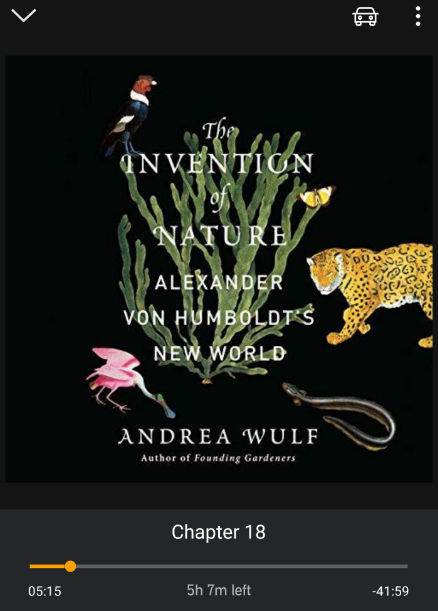
Micro Mention "The Invention of Nature"

Andrea Wulf


Everyone has heard of and read about Charles Darwin. But do you know who he read about before his adventures on the Beagle? Alexander Von Humbolt—and Andrea Wulf tells his story in "The Invention of Nature." He’s the original; let’s get out there and see nature, guy.

What I find amazing about this book is after reading it how many times I started noticing things and places named after Humboldt. It's an amazement that is dual-sided, though, because, on the one hand, it's nice to learn about an adventuring scientist I had previously not known about and is honored all over the world, but on the other side, he's been largely forgotten. Not a lot of people know why various squares, parks, and reserves are named Humbolt anymore.

Alexander Von Humboldt was a pioneer of the school of thought that nature should be studied and appreciated. I think we could all use a little more of that wisdom today, given the amount of environmental destruction prevalent in today's world.


This preview is an Amazon Affiliate link; 
as an Amazon Associate, I earn from qualifying purchases.

Author's Website: https://www.andreawulf.com/


Friday, July 30, 2021

"The Devil in the White City" by Erik Larson--Nonfiction Review

Time for something light and fun, like the Chicago World’s Fair of 1893, oh and murder—mustn’t forget the murder. Okay, so maybe not so, light and fun, but Erik Larson’s “The Devil in the White City” is still a good read.


Erik Larson


What I love about this book:

So this book was recommended to me by way of; it’s about an early American serial killer who built his own “Murder Castle” while the Chicago World Fair was happening. The biography Larson writes up about H. H. Holmes is chilling. Certainly, the man was the kind of sociopath with absolutely no scruples, and on top of being a murderer, he was also a petty thief and fraudster.

What took me by surprise is that a considerable amount of this book is wholly devoted to just describing the Chicago World’s Fair’s history. Larson tells you about the fair’s organizers, the architects, setting up the fair, running the fair—and far more. He even sketches out the lives of many people directly involved with the fair with a historian’s attention to detail.

I found the bits of this book about the Ferris Wheel, which made its debut as an attraction at the World Fair of 1893, riveting. I’m generally not one to even think about Ferris Wheels in the first place—to me, they’ve always just been a vertical carousel—a somewhat amusing but ultimately bland ride. I did not realize that the original Ferris Wheel was nothing like your local small-town fair Ferris Wheel. It was 264 feet tall and had a capacity of over two thousand riders—simultaneously! This was built and operated in the 19th century, maybe near the end of but firmly still in the era of “hope this steam boiler we barely understand doesn’t explode and kill us all.”


What I don’t love about this book:

While I may like both parts of this book, it feels a whole lot like two books fused together. On one side, we’re learning about the murderous H. H. Holmes, and that’s fascinating. On the other, we’re learning about the Chicago World Fair of 1893, which I didn’t even know I wanted—but I never found myself loving the ping-ponging back and forth between the two. Holmes used the World Fair as cover for his murderous activities—to be sure—but it isn’t like he wasn’t a murderer before and after the fair.

Related to the issue of bouncing back and forth between these two topics—there didn’t feel like there was a logical flow. The reason why Larson would be talking about certain events in the murder side of the book alongside whatever interesting bit of history he would next tell you about regarding the fair never clicked for me. The only impression I got was maybe he was following a loose chronological association between events.

After the World Fair portion of this book, and we return to the premise that brought me to this book in the first place, I found myself missing the fair. Because we’re really just into the depressing details about the end of Holmes’s murder spree, which I was now no longer in the mood for because I personally was in a much lighter mindset. That’s in a nutshell why I think this should have been two books, tell the story of Holmes, sure talk about the World Fair going on around that time, but I felt it should have focused mainly on him. Certainly, there’s a contrasting element between the two sides of this book, playing off the title, but the why of it—other than for its own sake—eluded me.


This preview is an Amazon Affiliate link; 
as an Amazon Associate, I earn from qualifying purchases.

Author's Website: https://eriklarsonbooks.com/

Parting thoughts:

There is a prevailing thought that the world was somehow safer in the past, more wholesome—especially in the United States in my experience. People just didn’t do that sort of thing back then, no sir. It’s usually followed up by a statement of “we never even locked our doors in our neighborhood and nobody worried about their kids playing outside.”

I am here to tell you that the nostalgia-drenched, sanitized view of the past is bullshit. The world is and always has been a dangerous place. Prior generations may have been less cautious than we are today, but not because the world was a safer, more loving place, crack open a history book—or hell, use this book as an example. Serial killers, rapists, genocidal maniacs—oh my—have always been with us, making prey out of the unwary when least expected.

It isn’t unusual for me to go on about how astounding our technological improvements have been over the last century on this blog—but you want to know what hasn’t changed nearly as much over the previous one hundred years? People—and to steal a Scrubs reference—they were bastard coated bastards with bastard filling back then, and they are bastard coated bastards with bastard filling today.

Sure, that’s a bit cynical, but here is my argument, people—just like any other life form on this planet change slowly over generations, which isn’t so with technology. I’m old enough to remember when the “internet” was a thing that came in over a physical phone line, and to connect to it, you first had to sit there and let it scream at you for a couple minutes. That statement has no meaning to people born not generations later than me but just a decade or so younger than me.

So why is the past perceived to be so much safer than today? Because we were just less aware of the dangers around us. Think about it—it was a world with no social media, no networked databases, far less social mobility, telecommunications, or surveillance. People got their news nearly exclusively from the radio, the newspaper, a guy on tv, and neighbors. This was all compounded by the fact that people back then were far less likely to talk about icky subjects like, say—cousin Tom was accused of trafficking sex slaves. Tom could just move to the other side of the Rocky Mountains and start calling himself Jerry, and that was a viable option for disappearing. You didn’t even have to pretend to learn Spanish and fuck off to Mexico if you don’t make the national news—just cut your hair differently, go work at some gas station in Oregon for a while, and get that trafficking ring back in business.

Sorry, Tom(s). I’m just using your name as an example here. I’m sure you’re lovely people and hardly own any sex slaves… I mean, don’t own any sex slaves. Stop owning people, Tom(s). You have a real problem!

To bring this back to a more positive note—if anything—if crime statistics are believed, we’re actually safer today than ever before precisely because we’re so aware of the potential dangers out there. There are far fewer predators per capita because it’s so much more likely we’re going to catch the Tom(s) of the world. It might not seem like it, but I do believe people, despite being prickly at times, self-centered, and selfish—are for the most part good, at about 95 percent. But let me remind you that a beverage that’s 5 percent arsenic will probably kill you. So—caution is vital in life.


Monday, July 26, 2021

Micro Mention "Medieval Myths & Mysteries"

Dorsey Armstrong


I once referred to the medieval period as the dark ages, which isn’t super relevant to this course “Medieval Myths & Mysteries” by the Great Courses, but I remember Dorsey Armstrong saying once not to do that, and I’ve guilt-wracked ever since.

On a more serious note, even though this is one of the shorter courses, it's got a lot to offer. I especially liked lecture 4 on King Arthur because you'd be hard-pressed to find any other figure than the legendary King of England, who is more mythologized. Whether or not there ever was a historical figure that the legend is based on is endlessly debatable. In any case, if he did exist, a lot of the stories attributed to him are embellished, and the best candidates lived in a time before a lot of the pageantry of kingship existed in England as we know it.


Monday, May 17, 2021

Micro Mention "Ancient Civilizations of North America"

Edwin Barnhart


"Ancient Civilizations of North America" by the great courses taught by Edwin Barnhart is eye-opening in how little indigenous peoples' culture makes it into the modern zeitgeist. People lived on this land for thousands of years before us, and no, they didn't all live in Tipis and hunt buffalo.

My favorite part of this course was learning about the complex cities that were built and ultimately lost in antiquity. Most ancient cities and ruins of the Americas were thought of as being exclusively in South America, but it isn't true. 

The depressing side of all this is, most of the evidence and artifacts of the ancient civilizations in the north were just obliterated by uncaring European peoples who were "settling" the land and "reeducating" the indigenous populace. So, it isn't that there weren't just as vital and interesting cultures and civilizations in North America as South America. It's just that their annihilation was far more complete in the continental United States, making the story of who they were far more patchy and remembered by smaller, and smaller groups of people living today.

Wednesday, May 12, 2021

Micro Mention "Iron, Fire and Ice"

Ed West


This book, "Iron, Fire, and Ice" by Ed West, is a fun, popular history book that is a scattershot survey of history, providing insight into the bits of the past that might have inspired George RR Martin’s “A Song of Ice and Fire.”

While not being the most robust of history books, it is incredibly entertaining—If you happened to watch "Game of Thrones" or read "A Song of Ice and Fire." Otherwise, you're not really going to get the unifying theory of this book as it jumps from Sparta, China, and then to Hadrian's Wall. 


This preview is an Amazon Affiliate link; 
as an Amazon Associate, I earn from qualifying purchases.

Author's Website: http://www.edwest.co.uk/