Showing posts with label post-apocalyptic. Show all posts

Saturday, June 25, 2022

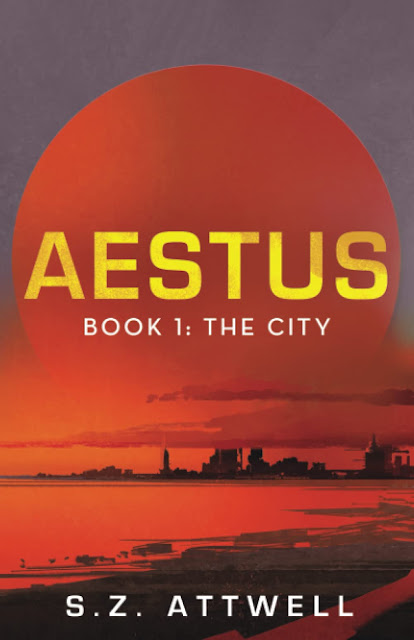
"Aestus Book 1: The City" by S.Z. Attwell--Fiction Review

Today, Obscurists, we’re traveling to the city—in S.Z. Attwell’s “Aestus Book 1: The City.” It’s a post-apocalyptic story where the status quo isn’t what it seems, and it underlines that in nearly every conflict, there are heroes and villains on all sides.

S.Z. Attwell


***The Non-Spoiler part of this review***


What I love about this book:

That ending! A lot goes down quickly, and it was like getting a jolt. The energy and tension suddenly crescendo at the end of the plot, and it’s been in my head since I finished reading “Aestus: Book 1: The City.” I’m of more than one mind about the end, but I’ll get into more later. Overall, I’d say I loved it.

I’ve brought this up in a prior review, but I like my post-apocalypse(s), in fiction, unexplained, hinted at, but never spelled out. This book pulls that effect off well. The end of the world probably came about because of runaway global warming, but the exact causes, timeframes, et cetera are left up to the reader’s imagination. The world is this way now, and the characters that inhabit that world don’t ever digress or pine for a long-lost world. They’re too busy surviving. No one has time to break into a soliloquy about the folly of humankind and bemoan the paradise lost.

Even though there were many of them, I enjoyed the characters in this novel. Attwell pulls off so many characters so well because there is clearly a defined core group and major and minor characters supporting that group’s story. This is partly achieved because “Aestus: Book 1: The City” is a long book.


What I don’t love about this book:

To reiterate from above. It is a really long book. And sure, there were a lot of characters to flesh out and give them their moment in the sun, but it also felt like every scene was at least twice as long as it should have been.

Also, I hated the uncle character from the jump. Nobody says “my dear” that much and isn’t awful. I don’t care—you get four or five “my dear(s),” and then you’re officially a wackadoo—yes, that’s the clinical term for it.

I like Jossey, our protagonist in this story. She’s intelligent, resourceful, and not afraid to take action. But she has some Katniss Everdeen levels of obliviousness when it comes to anyone—literally anyone—showing even a modicum of romantic interest in her. I get it’s an intentional character flaw that rounds the character and makes her seem more like a real person to give her this insecurity, but from a taste perspective, it’s an eye roller for me.


This preview is an Amazon Affiliate link; 
as an Amazon Associate, I earn from qualifying purchases

Author’s Website: https://szattwell.com/


***The Spoiler part of this review***
***Ye be warned to turn back now***


The quick and dirty synopsis:

We’re introduced to our protagonist, Jossey, through a childhood memory—not a good one. It was the day she was attacked when visiting the surface to see the moon. Her brother also disappeared during the attack.

Friday, August 6, 2021

"A Girl Called Ari" by P.J. Sky--Fiction Review

Today obscurists, we’re talking about P.J. Sky’s “A Girl Called Ari,” a post-apocalyptic adventure and journey to get back home—where ever that may be.


P.J. Sky


***The Non-Spoiler part of this review***  


What I love about this book:

This story isn’t a reimagining or even directly references this at all, but “A Girl Called Ari” reminded me of the feel of “Journey to the West.” I feel this way because of the relationship between the two protagonists and their adventures together. Characters from different worlds must travel together, in this case over a post-apocalyptic wasteland—and there are numerous challenges and setbacks that must be overcome. 

I like Ari, the character the story is titled after a lot. I’m always a big fan of a practical person who can—albeit sometimes with a bit of coaxing—see the value of empathy. Plus, Ari shows herself to be tough, resourceful, and creative in her own ways—typically when she’s employing violence, but hey, she’s lived almost all of her life out in the wasteland.

I also appreciated that P. J. Sky never feels the need to info dump or over-explain how the world has gone to shit. They just throw you into the story, and the details come in time when pertinent to the story.


What I don’t love about this book:

Without spoiling anything, directly at least, one of the protagonists at the end of this story makes a decision that just baffled me. It’s kind of telegraphed in an earlier conversation, so it’s not totally out of left-field. Still, it wasn’t a conversation that the character initiated, so I guess my problem is I had a break in understanding this character’s motivations, which I wasn’t a fan of at basically the conclusion of the novel. I’m guessing it’s addressed in the sequel.

Dogs are present in this book, and it doesn’t work out well, and that always makes me very sad. It’s effective in terms of getting me to instantly despise a character—so there is that. But if a character hurts a dog—I hate them. Rarely can I see beyond that point and be understanding.

Like Starla, I don’t really understand the antagonists’ motivations in this story. Power and influence over her father, maybe? But why did it involve a kidnapping plot that relied on leaving the city? There might be good reasons why keeping a hostage in the city wasn’t desirable compared to out in the wasteland, but I missed them. This meant, for me, the reason we’re out in the wasteland is that the plot demands it and not that it was logically inevitable.


This preview is an Amazon Affiliate link; 
as an Amazon Associate, I earn from qualifying purchases

Author's Website: https://pjsky.wordpress.com/

***The Spoiler part of this review***
***Ye be warned to turn back now***


The quick and dirty synopsis:

Starla Corinth, daughter to the mayor of “the city,” goes to a party on her 18th birthday. Despite her privileged position, she’s dissatisfied because she feels as if she’s trapped in an ivory tower—with no real control over her life. Not much is revealed yet about this “city” other than it’s surrounded by a wasteland. Shortly before her father gives a speech at the celebration, a mysterious young man cryptically warns her that she’s in danger.

Monday, August 2, 2021

Micro Mention "What Branches Grow"

T.S. Beier


“What Branches Grow” by T.S. Beier scratches that “Fallout” itch if you’re a video gamer or “Mad Max” if you’re a movie aficionado. Still too obtuse? It's kickass post-apocalyptic Sci-fi, and it’s a fun read.

This was actually the first book I picked up when I decided to dedicate at least one review each month to an indie author, rather than when I unintentionally happened upon one and reviewed it. It was an excellent first book for that challenge, it's been more than half a year since I finished reading this novel, and I still find myself thinking about its story and characters from time to time.

The broad strokes of Delia's and Gennero's journey through Beier's fictional wasteland are still clear in my mind. I think why it sticks in my mind is because of its Oregon Trail-like aspects to its story. There is something timeless about people banding together to travel to a distant land out of the hope for a better life. Strictly speaking, they aren't pioneers or settlers because their ultimate goal is a city, which survived the war and not a new land.

You can check out my original full review of this novel: Here!


This preview is an Amazon Affiliate link; 
as an Amazon Associate, I earn from qualifying purchases.


Friday, January 8, 2021

"What Branches Grow," by T.S. Beier--Fiction Review

Happy Friday to you and for all you reading this in the future on a print out you found in the ruins of some building, a slice of home in today’s review. Today’s book “What Branches Grow,” by T.S. Beier is post-apocalyptic science fiction. 


T.S. Beier


***The Non-Spoiler part of this review***


What I love about this book:

As a big science fiction fan, a fan of the subgenre of post-apocalyptic sci-fi, and a video gamer—I feel Beier’s book is like a ride-along with someone’s character in a “Fallout” game. She even captures that particular game world’s aesthetics. “What Branches Grow” is mostly a survival story set in the grim reality typical of the subgenre, but it also engages in the wackier flights of fancy and humor cruising just under the surface of the narrative—like “Fallout.” When the characters visit the town of sex-crazed “vampires,” who aren’t really undead, it reminds me of the same sort of absurdist high-concepts for post-apocalypse settlements that I’d expect to find in the capital wastes.

Our main characters of this novel are a likable bunch, and some of my favorite parts of the story were the slower bits. Don’t get me wrong, the action scenes are fun too, but I enjoyed the occasions when the group got to put up their feet and shoot the shit—that is until the arguments started up. My favorite downbeat moment, between advancements of the plot, was probably on the golf course. Delia, who is typically deathly serious, and Gennero, who generally is too nervous around Delia, let their collective guards drop a bit to go on a joy ride on a still working golf cart. They also use the golf cart to get into some mischief involving Perth.   

I liked that Delia and Gennero, despite their circumstances, are avid readers. For someone who talks about books all the time, I like book people, even book people who wander wastelands.

Mort, the pug, was also a fun element to this story. He was primarily attached to his owner Perth, but his presence added a bit of levity to this book, which I think is vital in any setting that can become grimdark at any turn. Conversely, Mort also added to my anxiety and the stakes of any situation where violence broke out because “what about the dog” still works on me thousands of stories later. 


What I don’t love about this book:

The cultural references before the red war, a time synonymous with our own, only make sense when Perth is doing the reminiscing—or any other character who lived before the apocalypse. When the narration does it as an: if so-and-so lived before the red war then x popular culture reference,  those parts felt out of step to me. 

Overall, I liked the central romance sub-plot to this book. What I didn’t like is that it wasn’t just slow burn but sometimes felt like the beats of indecision were repeated too many times. I often felt that with the male character in the equation, a scene would go by, and I, as the reader, would be like, you see that right there? That was your moment. You missed your moment. Then he’d do it again, and again, and again.

Another issue and I have this problem with “Fallout” and “Mad Max” as well, and many other stories in the post-apocalyptic subgenre, which can be summed up like this: what is with all the antagonists with such minimal regard for self-preservation? It just seems like raiders are always ready to go in on a swarm, wave after wave of bodies into a stream of fire, at the drop of a hat. These people had to have survived this long in the wasteland. It just seems like caution would be a dominant trait amongst everybody, not only the protagonists.  


This preview is an Amazon Affiliate link; 
as an Amazon Associate, I earn from qualifying purchases.


***The Spoiler part of this review***
***Ye be warned to turn back now***


The quick and dirty synopsis:

The adventure begins when a mysterious woman—Delia—shows up in the post-apocalyptic settlement of Churchill, named after its founder and leader. He immediately tries to pressgang this well-armed mercenary woman into his town’s brothel. It doesn’t go well.