Showing posts with label Dante Alighieri. Show all posts

Saturday, June 18, 2022

"The Testament of Mary" by Colm Tóibín--Fiction Review

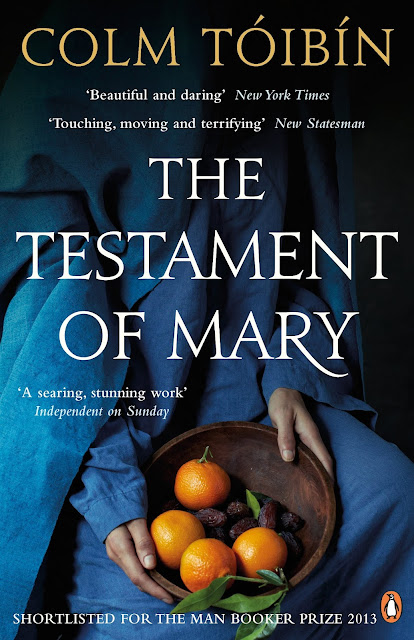
Today Obscurists, we’re going to dip our toes into a new field of fiction I’ve not covered a whole lot, a religious, historical novel about the life of Mary, mother of Jesus Christ. The novella is “The Testament of Mary” by Colm Tóibín.

Colm Tóibín


***The Non-Spoiler part of this review***


What I love about this book:

This book, in my opinion, takes a rather agnostic view on the divinity of Jesus of Nazareth. While the character of his mother, Mary, might doubt his divinity, it’s never exactly refuted. It’s undoubtedly challenged throughout the plot but never wholly suppressed. 

To get a completely different view of the life of Jesus and from his mother’s perspective was very interesting to me. It feels grounded in the world that Mary and her life and perceptions were of our flesh and blood world.

This is also one of those times I feel a first-person perspective really works and sells the story. The entire story is relayed to us by Mary herself. It’s an incredibly intimate experience of this woman’s life, who loves her son while doubting his purpose and the reasons for his demise. At no point does the narrative romanticize what happened to Jesus. It was brutal, vicious, bloodthirsty, and done out of blood lust.


What I don’t love about this book:

It’s challenging to grasp how much time passes in “The Testament of Mary.” The narrative seems to start at the end with the crucifixion of Jesus, and then it dives into Mary’s story, but it didn’t start where I assumed it would, the beginning. It begins when Jesus was already a man and had followers, but it’s unclear how long this has been happening.

As much as I like the intense character study of a doubting Mary, all the other characters in the novella are mere wisps of characters compared to her. Even Jesus, the larger-than-life figure he was, is barely characterized. This may be an intentional choice, given the brevity of this story. Still, if you don’t immediately latch on to Mary’s story and perspective, there really isn’t anything else in this story. 

Ultimately, given its succinctness, “The Testament of Mary” feels like part of a larger work. We get allusions to Jesus’s childhood but no explicit scenes of that childhood. A lot of the goings on around Mary rely heavily on the reader having a secondary insight of the gospels and other Christian historical understanding, which is a long tradition in the western literary canon, but still, it’s a limiting factor for the audience.


This preview is an Amazon Affiliate link; 
as an Amazon Associate, I earn from qualifying purchases

Author’s Website: http://www.colmtoibin.com/


***The Spoiler part of this review***
***Ye be warned to turn back now***


The quick and dirty synopsis:

“The Testament of Mary” starts with Mary talking about her lonely existence after her son’s death. How she is kept—like a pet—by his followers who bring her food and money but expect her to go along with and support their version of Jesus’s life. Her recollection, however, doesn’t particularly jive with the “authorized” version of events told by presumably the apostles. They typically react to her non-canonical asides with exacerbation and scorn.

Wednesday, February 17, 2021

Micro Mention "Classical Mythology"

Elizabeth Vandiver


I have been on a whole mythology kick for a while now, and I've found that "Classical Mythology" from the Great Courses lectured by Professor Elizabeth Vandiver was very useful for background information when I was reading "Circe."

This course is a great place to get a boilerplate understanding of myth in the western literary canon. The Greek and then Roman traditions would help shape later luminaries such as Shakespeare, Milton, Alighieri, and too many more to list here. So if your aim is to enhance your understanding of the earliest works of the western literary canon, like those writers, this course might be a good start.

Friday, May 1, 2020

"The Odyssey," by Homer & Translated by Emily Wilson--Fiction Review

Welcome to May, my dear internet strangers! Today we’re going to discuss “The Odyssey” by Homer and translated by Emily Wilson. So obviously, unless you at least speak Greek and understand the older incarnations of that language, there is no way to “read” the original “The Odyssey,” which isn’t something I can do, despite the rumors that I’m a time-traveling demon. 

What this effectively means is that if you are like me and are incapable of understanding ancient Greek, not that time-traveling demon business, then to enjoy “The Odyssey,” you’ll have to read some scholar’s translation. So, since there are several to choose from, you should know the experience is always heavily influenced subjectively by that particular translator. 

Homer Emily Wilson

***The Non-Spoiler part of this review***


What I love about this book:

I like Emily Wilson as a translator. Her language choice is accessible to a modern audience, which makes the text of this ancient story of a Greek hero easier to understand. There is an argument, in some scholarly circles, that this makes the experience less pure—but I feel that’s nonsense. They reason that since this is a foundational story of the western literary canon, then the language choice should be elevated, antiquated, and often arcane. I find that all stupid because archaic English and ancient Greek have about as much in common as beagles and badgers—in the sense that they’re related if you go backward in time far enough, but not too closely.

I also like Odysseus as a character from the Greek pantheon of heroes—in fact, he’s probably my favorite of them. “Hero” means something very different to us in modern times, then in Homer’s day. Odysseus is often a duplicitous dick; in fact, he’s celebrated for that fact because he’s the cleverest man of his age. He might not be the most heroic person, to our modern sensibilities, but he is the one that figured out that whole let’s give the Trojans a giant horse trick, that won the war. Unlike Hercules or Achilles, Odysseus rarely needs to use his martial skill to solve a problem—typically, it’s his guile that sees him through any situation.       


What I don’t love about this book:

So like with all ancient stories I’ve experienced, “The Odyssey” has a social commentary that is rooted in its particular place and time, and it’s often uncomfortable to modern ears. Women aren’t treated well for one, and the values of the age aren’t the most liberally minded. Odysseus is a legendary warrior who would have lived during what is known as a “heroic age.” The defining trait of heroic ages is they suck for ordinary people—think like the Roman Empire has just collapsed and you’re a peasant on your way into the dark ages, and you’ll get the idea. In such a period, the law is really just what the toughest local bastard says it is, so that means most people get randomly murdered. It’s important to remember this and that “The Odyssey” is a product of a different time and place, so applying modern morals isn’t fair. But it’s also still cringe-worthy when our hero hangs a bunch of women because they got too familiar with the suitors trying to steal his wife and home.

Also, after years of being lost and presumed dead, when Odysseus does return home to Ithaca, there’s a scene where he meets his father, who doesn’t recognize him and is still grieving his death. So naturally, Odysseus uses this moment to screw with his father’s mind. Why? Because that’s what Odysseus does with everyone—he screws with them, he can’t help himself, but still not one of my favorite scenes. 


This preview is an Amazon Affiliate link; 
as an Amazon Associate, I earn from qualifying purchases.

***The Spoiler part of this review***
***Ye be warned to turn back now***