Showing posts with label The Great Courses. Show all posts

Monday, March 14, 2022

Micro Mention "Stress and Your Body"

Robert Sapolsky


Feel stressed sometimes? Stressed right now, maybe? Want to learn what it does to your body? Then this course, "Stress and Your Body," lectured by Robert Sapolsky, is just the thing.

This is the second lecture series I've listened to by professor Sapolsky, and I've also read his memoir "A Primate's Memoir." He's obviously brilliant, but what I think I value most about him as an educator is his objectivity mixed with a wry sense of humor. It's dry humor, sure, but I'm always surprised how quickly his lectures seem to go by because of how engaging I find him.


Wednesday, February 16, 2022

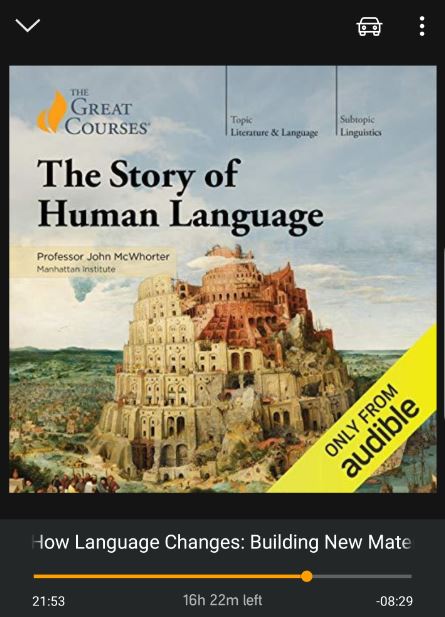
Micro Mention "The Story of Human Language"

John McWhorter


How languages evolve, split, and combine over time is an interesting subject for me, so I really enjoyed Professor John McWhorter's course presented by the Great Courses, "The Story of Human Language."

If you pick up this course, McWhorter takes you down several unexpected twists and turns on how language functions and even changes with time. There is this odd conception that language degrades with time and becomes coarser and less refined. All of which, in my opinion, is just another symptom of overindulgence in nostalgic thinking, this erroneous belief that back in the past, there was some golden age that we've all just gotten away from. If only we all still wandered about speaking perfect Latin at each other, things would be better.

It wouldn't.

In any case, McWhorter helped me understand that language is a vital thing, a living thing that changes and reflects the people whose mouths—or hands, or whatever electronic assistance devices—speak it.


Wednesday, December 29, 2021

Micro Mention "The Addictive Brain"

Thad A. Polk


Addictions come in many forms—often, they have tragic consequences on our lives or maybe the lives of our friends and families. In this course by The Great Courses, "The Addictive Brain," lectured by Thad A. Polk, there is great insight to be had about why we become addicted.

This is one of those topics I find everyone has an opinion on, informed or not. Often it's lumped in with a discussion about low-income housing or welfare, again, informed or not. Typically, it gets oversimplified to "well, just don't do it, and you won't get addicted." But one of the things I learned in this course is how the mechanisms of addiction are far more nuanced and complicated, which means that simple solutions don't actually cut it.  


Wednesday, November 10, 2021

Micro Mention "Masters of War"

Andrew R Wilson


Suppose you've any interest in military history or just strategic thought in general. In that case, you can't go wrong with the great courses "Masters of War: History's Greatest Strategic Thinkers" taught by Andrew R. Wilson.

So if you're like me, you find war to be terrible but fascinating. Wars are like thunderstorms in that regard, only interesting if you've got some sort of separation from the actual event. For instance, you might watch a thunderstorm from your window and be entranced, unless, of course, it turns into a tornado and blows your house down. Then it's just terrible. Both storms and wars kill people, and choosing to not understand them isn't actually a defense.

Strategic thought, however, is a lesson the history of war can teach you, and luckily it can be divorced from national death contests to enhance other aspects of your life. I think people commonly go wrong when they read things like "The Art of War" is because they then equate everything to a "war" like business or negotiation. But the real lesson and the point is to see things as a strategic puzzle to be solved. Domination is only one sort of solution and often not even the best. War hawks fall into that fallacy because they can't ever imagine solutions other than violence.


Monday, October 4, 2021

Micro Mention "Analysis and Critique"

Dorsey Armstrong


"Analysis and Critique: How to Engage and Write about Anything," from the great courses and taught by Dorsey Armstrong, is incredibly useful. On a separate note, Dorsey Armstrong, I hope you never discover how poor a student I actually am in making use of your lessons.

I love these courses because I love learning new things, and they appeal to my inherent laziness in not wanting to actually have to do homework and tests like in a real college class.

What you can expect to get out of this course is succinctly covered by its title, and if you fancy yourself a writer, I can't recommend it any more highly. I've listened to a few courses from Professor Armstrong now, and so far, I've always come away having learned something either useful or fascinating.


Monday, July 26, 2021

Micro Mention "Medieval Myths & Mysteries"

Dorsey Armstrong


I once referred to the medieval period as the dark ages, which isn’t super relevant to this course “Medieval Myths & Mysteries” by the Great Courses, but I remember Dorsey Armstrong saying once not to do that, and I’ve guilt-wracked ever since.

On a more serious note, even though this is one of the shorter courses, it's got a lot to offer. I especially liked lecture 4 on King Arthur because you'd be hard-pressed to find any other figure than the legendary King of England, who is more mythologized. Whether or not there ever was a historical figure that the legend is based on is endlessly debatable. In any case, if he did exist, a lot of the stories attributed to him are embellished, and the best candidates lived in a time before a lot of the pageantry of kingship existed in England as we know it.


Wednesday, July 14, 2021

Micro Mention "Crashes and Crises"

The Great Courses


The stock market is a thing that everyone is aware of, especially when it periodically crashes and everyone suffers for it. Find out why that happens, at least historically, in “Crashes and Crises: Lessons from a History of Financial Disasters,” by the Great Courses lectured by Connel Fullenkamp.

There has been a long, long tradition of people who think they can predict or outguess where the markets are going, and this course can explain, in exquisite detail, the hubris in that. The problem at the end of the day, in any financial system, are the individual actors who participate in it—fallible, duplicitous humans. It's amazing over the years how many times hordes of people let their good sense give way to irrationality because of greed, but I guess it isn't all that surprising.


Wednesday, July 7, 2021

Micro Mention "Law School for Everyone"

The Great Courses


The law is complicated, and the study of it is hard. You can get an idea of how hard in "Law School for Everyone" by the Great Courses & lectured by various legal scholars. I know, keen insight like the law is hard is why you follow me, and I imagine it's nice to feel more intelligent than someone.

Seriously though, this course gave me a great mental framework of the legal system—maybe I should specify the legal system in the United States. In any case, I think it's valuable to know about topics, such as the law, even if it isn't exactly interesting to you—because ignorance about something doesn't mean you won't have to face it one day. It's always better to know something rather than nothing, in my opinion.


Monday, June 21, 2021

Micro Mention "English In America: A Linguistic History"

English In America: A Linguistic History


This course by the great courses “English In America: A Linguistic History” taught by Natalie Schilling is one part engaging history of the English language in the United States and one part fascinating survey of regional dialects and their features.

People have strong opinions on linguistics and what is and isn't "proper" English, and they usually all have one thing in common; they've never attended a lecture from a "proper" course on linguistics. I was surprised with this course, and others I've taken on the topic, that real linguistics professors tend to be way more laid back about the subject of what is and isn't the proper way to use a language. It makes sense when you consider that languages are like everything else. They change and evolve to better suit the times—and that is a good thing!

Monday, May 24, 2021

Micro Mention "The Science of Sci-Fi"

Erin MacDonald


The Great Courses “The Science of Sci-Fi” is a short course by Erin Macdonald, but it offers a wonderful survey of the technology in Science Fiction and how it relates to actual physics and quantum mechanics at a pop-science intro level. 

If you're ever interested in common science and technology tropes in science fiction stories, and how to think about them, and how they relate to real-world science, then this course is worth a listen. Honestly, any aspiring science fiction writer would be served well by taking the time to listen to this short course.


Monday, May 17, 2021

Micro Mention "Ancient Civilizations of North America"

Edwin Barnhart


"Ancient Civilizations of North America" by the great courses taught by Edwin Barnhart is eye-opening in how little indigenous peoples' culture makes it into the modern zeitgeist. People lived on this land for thousands of years before us, and no, they didn't all live in Tipis and hunt buffalo.

My favorite part of this course was learning about the complex cities that were built and ultimately lost in antiquity. Most ancient cities and ruins of the Americas were thought of as being exclusively in South America, but it isn't true. 

The depressing side of all this is, most of the evidence and artifacts of the ancient civilizations in the north were just obliterated by uncaring European peoples who were "settling" the land and "reeducating" the indigenous populace. So, it isn't that there weren't just as vital and interesting cultures and civilizations in North America as South America. It's just that their annihilation was far more complete in the continental United States, making the story of who they were far more patchy and remembered by smaller, and smaller groups of people living today.

Wednesday, April 28, 2021

Micro Mention "King Arthur: History and Legend"

Dorsey Armstrong


This course, from the great courses “King Arthur: History and Legend” by Dorsey Armstrong, is a real deep dive into the history, the legend, and the literature of King Arthur. If you go in for that sort of thing—like me—you should consider it.

Professor Armstrong gives you an in-depth look at the legendary King of England by first taking you through the ancient history of events and people who may have been the earliest things that shaped the Legend of King Arthur as we know it. It's interesting because it's a time right after the Roman Empire withdrew from England, well on its way to collapse. So, the people of England who formally saw themselves as Roman citizens now found themselves alone and surrounded by barbarians on all sides. Then, historical evidence suggests that a great leader, or maybe a couple great leaders, rose up to defend the people, and this could be the historical inspiration of King Arthur, but he bore minimal resemblance to how we would come to see him through the lenses of later stories about him and his knights' adventures.

The other part of this series examines all of the prominent stories that tell the Legend of King Arthur and how it evolved over time, with each period contributing to the legend.  

Monday, March 8, 2021

Micro Mention "Why You Are Who You Are"

 Mark Leary


Ever wonder why people are the way they are? Or maybe, you’re even puzzled over some of your own motivations and behaviors? "Why You Are Who You Are," from the Great Courses lectured by Professor Mark Leary, is illuminating for both questions.

It's a lecture series that touches on psychology, sociology, and culture. Using all of those subjects and more, Professor Leary provides you with genuine insight on why people are, well, like they are. From a creative writing perspective, I found it most useful in helping me to flesh out and create better characters.


Monday, March 1, 2021

Micro Mention "How Conversation Works"

Anne Curzan


This is an interesting albeit short course from The Great Courses, lectured by one of my favorites on the platform, Professor Anne Curzan. Fair warning, though, after listening to it, you'll be hyper-aware of how you talk to people for a few days afterward.

Communication is the cornerstone of any career, and struggling with communication effectiveness is something a sizable number of people experience. So of all "The Great Courses" I've listened to, this is one of the most practical, with one of the widest applications.  


Wednesday, February 17, 2021

Micro Mention "Classical Mythology"

Elizabeth Vandiver


I have been on a whole mythology kick for a while now, and I've found that "Classical Mythology" from the Great Courses lectured by Professor Elizabeth Vandiver was very useful for background information when I was reading "Circe."

This course is a great place to get a boilerplate understanding of myth in the western literary canon. The Greek and then Roman traditions would help shape later luminaries such as Shakespeare, Milton, Alighieri, and too many more to list here. So if your aim is to enhance your understanding of the earliest works of the western literary canon, like those writers, this course might be a good start.

Monday, January 25, 2021

Micro Mention "Language Families of the World"

John McWhorter


One of my favorite platforms for learning something new is The Great Courses, and this course, “Language Families of the World” by John McWhorter, is incredibly illuminating on how language evolves, and how different languages relate to each other. I personally have learned more about English, where it came from, and why it is the way that it is, and how it fits in with the other languages of the world in this course than my entire time as a student in public education. 

Outside of linguistics, Professor McWhorter might be divisive to some. Still, it can't be denied how intelligent he is, and even when I find myself disagreeing with him on one political point or another, I always respect how well thought out he makes his arguments.


Wednesday, January 6, 2021

Micro Mention "History of Bourbon"

Ken Albala


We're friends now, no, really, that was an incantation, and by reading it, we're now friends forever. Anyway, BFF, I feel comfortable telling you about two of my great loves—other than books—whiskey and The Great Courses. So a Great Course about whiskey is a no-brainer. 

Come for the excellent education on whiskey stay for the classic drinking songs. Thank you, Professor Albala, very much for this first-rate course.

Primarily focussed on bourbon, a kind of whiskey, for the non-whiskey drinkers out there, this course is also an interesting look at all whiskeys' history in general.


Friday, May 1, 2020

"The Odyssey," by Homer & Translated by Emily Wilson--Fiction Review

Welcome to May, my dear internet strangers! Today we’re going to discuss “The Odyssey” by Homer and translated by Emily Wilson. So obviously, unless you at least speak Greek and understand the older incarnations of that language, there is no way to “read” the original “The Odyssey,” which isn’t something I can do, despite the rumors that I’m a time-traveling demon. 

What this effectively means is that if you are like me and are incapable of understanding ancient Greek, not that time-traveling demon business, then to enjoy “The Odyssey,” you’ll have to read some scholar’s translation. So, since there are several to choose from, you should know the experience is always heavily influenced subjectively by that particular translator. 

Homer Emily Wilson

***The Non-Spoiler part of this review***


What I love about this book:

I like Emily Wilson as a translator. Her language choice is accessible to a modern audience, which makes the text of this ancient story of a Greek hero easier to understand. There is an argument, in some scholarly circles, that this makes the experience less pure—but I feel that’s nonsense. They reason that since this is a foundational story of the western literary canon, then the language choice should be elevated, antiquated, and often arcane. I find that all stupid because archaic English and ancient Greek have about as much in common as beagles and badgers—in the sense that they’re related if you go backward in time far enough, but not too closely.

I also like Odysseus as a character from the Greek pantheon of heroes—in fact, he’s probably my favorite of them. “Hero” means something very different to us in modern times, then in Homer’s day. Odysseus is often a duplicitous dick; in fact, he’s celebrated for that fact because he’s the cleverest man of his age. He might not be the most heroic person, to our modern sensibilities, but he is the one that figured out that whole let’s give the Trojans a giant horse trick, that won the war. Unlike Hercules or Achilles, Odysseus rarely needs to use his martial skill to solve a problem—typically, it’s his guile that sees him through any situation.       


What I don’t love about this book:

So like with all ancient stories I’ve experienced, “The Odyssey” has a social commentary that is rooted in its particular place and time, and it’s often uncomfortable to modern ears. Women aren’t treated well for one, and the values of the age aren’t the most liberally minded. Odysseus is a legendary warrior who would have lived during what is known as a “heroic age.” The defining trait of heroic ages is they suck for ordinary people—think like the Roman Empire has just collapsed and you’re a peasant on your way into the dark ages, and you’ll get the idea. In such a period, the law is really just what the toughest local bastard says it is, so that means most people get randomly murdered. It’s important to remember this and that “The Odyssey” is a product of a different time and place, so applying modern morals isn’t fair. But it’s also still cringe-worthy when our hero hangs a bunch of women because they got too familiar with the suitors trying to steal his wife and home.

Also, after years of being lost and presumed dead, when Odysseus does return home to Ithaca, there’s a scene where he meets his father, who doesn’t recognize him and is still grieving his death. So naturally, Odysseus uses this moment to screw with his father’s mind. Why? Because that’s what Odysseus does with everyone—he screws with them, he can’t help himself, but still not one of my favorite scenes. 


This preview is an Amazon Affiliate link; 
as an Amazon Associate, I earn from qualifying purchases.

***The Spoiler part of this review***
***Ye be warned to turn back now***