Showing posts with label The Odyssey. Show all posts

Friday, March 25, 2022

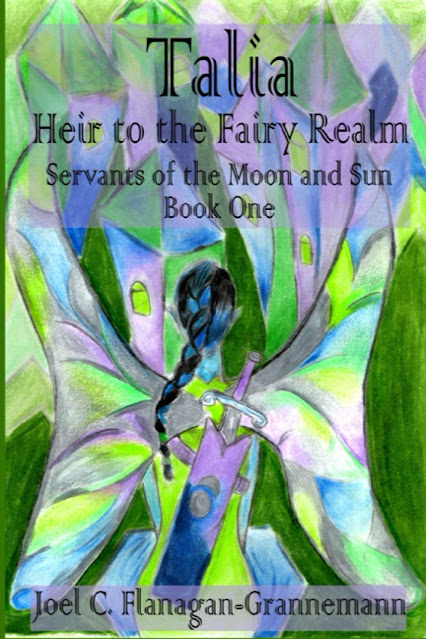
"Talia Heir to the Fairy Realm" by Joel C. Flanagan-Grannemann--Fiction Review

Today Obscurists, we’re going on a magical journey with some fairies—through enchanting vistas and sublime locales. Oh, and there will be blood, murder, betrayal, and mayhem in this fantasy novel about statecraft in “Talia Heir to the Fairy Realm” by Joel C. Flanagan-Grannemann. 

Joel C. Flanagan-Grannemann


***The Non-Spoiler part of this review***


What I love about this book:

At first, I thought this book would primarily be about Talia’s affair with the human prince, Bastile, but it turns out that event is really just inciting action, which surprised me. I liked that the book surprised me, especially because the outsider’s perspective looking into the fairy realm would have been a far easier way to do world-building. But the book is called “Talia Heir to the Fairy Realm” and not “Bastile,” so I appreciate that Flanagan-Grannemann stuck to his guns.

The whole story reads like mythic fiction like “Jason and the Argonauts” or the “Odyssey,” but with fairies, and frankly, in terms of numbers, Talia is much better at keeping her people alive than old Odysseus. What I’m driving at is Flanagan-Grannemann’s story has an episodic quality that I enjoyed regarding Talia and her ladies’ adventures. 

Flanagan-Grannemann manages a large number of protagonists as well or better than anyone else I’ve read. There are 19 fairies in Talia’s traveling group, and it was genuinely amazing, to me at least, that he managed to give most of them their time in the sun with their own little backstories.


What I don’t love about this book:

It’s a long book that still somehow manages to end feeling like it’s in the middle. I get it is part of a series, and there is a bit of a cliffhanger ending, but I expected some of the sub-plots to have seen some resolution as opposed to nearly none of them.

There is also the equivalent of a fairy Auschwitz in this story which was distressing to discover. I assumed that when the characters were visiting this particular location, there would be some sort of moral lesson—you know, other than rape and systematic murder are terrible. I’m not putting this observation here because I dislike per se that Flanagan-Grannemann would discuss such topics in a fantasy story. I think that any topic can be examined within the scope of fiction. It’s here because I’m horrified by the idea of forced labor or concentration-like camps, which is, I believe, the intended effect.


This preview is an Amazon Affiliate link; 
as an Amazon Associate, I earn from qualifying purchases


***The Spoiler part of this review***
***Ye be warned to turn back now***


The quick and dirty synopsis:

Talia, and the fairy court at large, are hosting a contingent of humans led by the human prince, Bastile. There has been a war before between the fairy and human realms, so tensions are high during these diplomatic visits. Despite the apparent strain, Talia manages to forge a connection with Bastile and rapidly falls in love with him.

Tuesday, November 30, 2021

Talking In Obscurity, "Circe," by Madeline Miller

Madeline Miller


Or Download This Episode Here:


Ok, Obscurists, we're at the end of another month, so it's podcast time. For this one, Steven and I talk about "Circe" by Madeline Miller. This book is a wonderful modern reimagining of a minor character from "The Odyssey."

I am proud that at no point in this podcast did I fall back on my over-used explanation that it's like "Wicked" but with Greek Myth. Of course, I just did that here, so... clearly, I can't help myself. In any case, if you'd like to read my full review of this book, you can find it here.


This preview is an Amazon Affiliate link; 
as an Amazon Associate, I earn from qualifying purchases.

Author's Website: http://madelinemiller.com/

Monday, February 15, 2021

Micro Mention "Circe"

Madeline Miller

"Circe" by Madeline Miller was the greatest book I read last year. I even wrote a full review of it here in case you missed it.

This cannot be an original observation, but it works and tugs at the heartstrings much in the same fashion as Wicked. Circe, by far, isn't one of the most celebrated goddesses of Greek Myth. Often she's referred to as a clever woman—not a compliment in ancient Greek society—and an evil sorceress who famously turns men into pigs.

Miller, much in the same spirit as Gregory Maguire in his novel, explores the why of Circe's seemingly "evil" actions. Without giving too much away, it's unsurprisingly because people are douchebags to her, and she's defending herself. This is a clever story beat because it underscores the depressingly common narrative of blaming the victim.


This preview is an Amazon Affiliate link; 
as an Amazon Associate, I earn from qualifying purchases.

Author's Website: http://madelinemiller.com/


Friday, December 25, 2020

"Circe," by Madeline Miller--Fiction Review

Merry Christmas! Did I review a book relevant to the season? No, of course not! Instead, let’s talk about Madeline Miller’s “Circe,” a reimagining of Greek myth from the witch of Aiaia’s perspective.  


Madeline Miller


***The Non-Spoiler part of this review***


What I love about this book:

This was my favorite book I read all year. It’s part of the reason why I selected it for my final review this year. “A Song of Achilles” was good, but Miller blew me away with “Circe.” 

My favorite part—and this is a tiny bit of a spoiler here—are all the early scenes with the goddess Circe as a single mother. Not inherently a funny book, Miller presents the shock of raising a mortal son for a goddess as something both breathtakingly sweet and funny, because Circe who requires no food or rest to live, is still exhausted by motherhood. 

Circe, like a lot of women—even goddesses—in Greek mythology, gets a pretty bad rap. To see her image reimagined and rehabilitated by Miller in “Circe” is a really cool update. I’ve said this before, but for me, it hits all the same notes as Elphaba’s story in “Wicked.” We learn through the course of this book that Circe isn’t just some witch who turned men into pigs, and Odysseus shacked up with for a while—I mean, she is those things—but also so much more. 


What I don’t love about this book:

Circe’s family because they all range from apathetic to malevolent pricks. This is a bit of a cop-out here because I wouldn’t change a thing here with their characterizations; them being awful is what creates the contrast for us to see how Circe is different. 

Miller can be wryly funny, in that dry sort of way as underscored in Circe’s adventures in motherhood, and once I read that chapter, I thought, why isn’t every chapter like this? Ok, maybe that’d be a bad idea because this story is more of a drama about finding oneself and the nature of a life well-lived—but still, a bit more of that humorous tone could have found its way into this story. I was surprised by it because I don’t remember Miller exercising those muscles at all in “The Song of Achilles.” 


This preview is an Amazon Affiliate link; 
as an Amazon Associate, I earn from qualifying purchases.

Author's Website: http://madelinemiller.com/


***The Spoiler part of this review***
***Ye be warned to turn back now***


The quick and dirty synopsis:

Circe begins her story with a brief introduction of who and what the Greek Gods are and who her parents are—the great Titan of the sun Helios and the nymph Perse. She also explains the war between the second-generation gods—the Olympic gods—and the Titans. Like Circe’s father, some of the Titans threw their lot in with Zeus in the war. In doing so, they were spared the rest of the Titans’ fate, namely, being banished to the underworld. After the war, there was distrust between the gods, and in the society of gods, the Olympics were firmly the ruling caste. That means the remaining Titans were just as solidly second class, and the tension between the groups was constant.

Friday, June 5, 2020

"The Song of Achilles," by Madeline Miller--Fiction Review

Hey, it’s June, it’s probably warm out, I don’t know I wrote all of these reviews prophetically during the last ice age some 12,000 years ago. Anyway, why don’t we talk about today’s book, “The Song of Achilles” by Madeline Miller, which is a reimagining of the Greek classic “The Iliad.” The novel is from the perspective of Patroclus, who in “The Iliad “ is Achilles’ “friend.” 

Madeline Miller


***The Non-Spoiler part of this review***


What I love about this book:

Madeline Miller might be one of the best writers I’ve ever read. Her language choice is precise in a manner that is so sharp you feel cut by it as if it were a scalpel. The prose of the story has a hypnotic quality that she uses more to paint the story rather than tell it. 

Her use of the first-person perspective is bold, but it also evokes the feeling of an oral tradition like how “The Iliad” and “The Odyssey” were originally presented in Homer’s day. This, although every translation of either of those two stories, is always done in third-person. Even “The Odyssey,” which is named after Odysseus, isn’t really from any one character’s perspective like Miller’s “The Song of Achilles.”

I also enjoy her take on the characters of this classic Greek mythos. She does justice to Odysseus, who is only a minor character in this story, but if you’ve read my “The Odyssey” review, then you know I’m ride or die with my boy Odysseus. Where Miller shines in her character work is her use of irony when developing the character of Achilles—or at least through the eyes of Patroclus, who is passionately in love with the man. So there may be some tint there.

Sidebar: Achilles and Patroclus are in an intense homoerotic relationship throughout this novel, so if that’s going to be a problem for you as a reader, then maybe bow out of this one, or I don’t know, grow up. Gay people are real people too, who have equally valid intense love affairs as heterosexuals.

Anyway, back to irony and how it applies to Achilles, the most obvious of his ironies is how we remember the Aristos Achaion—best of the Achaians as Miller stylizes him—in the contemporary idiom Achilles’ Heel. Achilles is supposed to be the mightiest, fiercest warrior, and his name evokes weakness—a specific kind of weakness sure, one that is both singular and unexpected, but still a weakness. Everyone who speaks English as a first language has used or heard the idiom Achilles’ heel, and Miller does the interesting thing and almost completely doesn’t address that aspect of him. No, the ironies she explores in this novel are more profound. Achilles, as a man, is gentle, soft-spoken, honest to a fault, and before the Trojan war, was rarely violent. In fact, he seems to respect life genuinely. The irony is he’s also the greatest killer ever.      


What I don’t love about this book:

Lots of lead time before the events of “The Iliad” in this retelling of “The Iliad.” We spend time with Patroclus as a baby. Then as a boy with a simpleton for a mother and a tyrant for a father. Further along, but still mired in Patroclus’ past, as a slightly older boy, we see him as a suitor at the gathering where Helen chooses her husband. Minor spoiler here, it’s not Patroclus as you might have guessed. Finally, there is a scene where some boy decides to take something of Patroclus,’ and a fight ensues where Patroclus stands up for himself and accidentally kills the boy. Then he gets banished from his father’s kingdom—all that has to happen first before we ever really meet Achilles, the guy the novel is named after. Then there are even more goings-on until we finally get to the bit where it picks up with the goings-on of the “The Iliad” at about halfway through the book.

My point is, “The Song of Achilles” takes a bit to get to the main action of the story. While the preceding scenes are excellent character building—for the main characters—it does also involve a lot of characters you’ll never see again once the boys head off to Troy. So you have to learn another cast of secondary characters as well in the second half of the story.   


This preview is an Amazon Affiliate link; 
as an Amazon Associate, I earn from qualifying purchases.

Author's Website: http://madelinemiller.com/

***The Spoiler part of this review***
***Ye be warned to turn back now***

Friday, May 1, 2020

"The Odyssey," by Homer & Translated by Emily Wilson--Fiction Review

Welcome to May, my dear internet strangers! Today we’re going to discuss “The Odyssey” by Homer and translated by Emily Wilson. So obviously, unless you at least speak Greek and understand the older incarnations of that language, there is no way to “read” the original “The Odyssey,” which isn’t something I can do, despite the rumors that I’m a time-traveling demon. 

What this effectively means is that if you are like me and are incapable of understanding ancient Greek, not that time-traveling demon business, then to enjoy “The Odyssey,” you’ll have to read some scholar’s translation. So, since there are several to choose from, you should know the experience is always heavily influenced subjectively by that particular translator. 

Homer Emily Wilson

***The Non-Spoiler part of this review***


What I love about this book:

I like Emily Wilson as a translator. Her language choice is accessible to a modern audience, which makes the text of this ancient story of a Greek hero easier to understand. There is an argument, in some scholarly circles, that this makes the experience less pure—but I feel that’s nonsense. They reason that since this is a foundational story of the western literary canon, then the language choice should be elevated, antiquated, and often arcane. I find that all stupid because archaic English and ancient Greek have about as much in common as beagles and badgers—in the sense that they’re related if you go backward in time far enough, but not too closely.

I also like Odysseus as a character from the Greek pantheon of heroes—in fact, he’s probably my favorite of them. “Hero” means something very different to us in modern times, then in Homer’s day. Odysseus is often a duplicitous dick; in fact, he’s celebrated for that fact because he’s the cleverest man of his age. He might not be the most heroic person, to our modern sensibilities, but he is the one that figured out that whole let’s give the Trojans a giant horse trick, that won the war. Unlike Hercules or Achilles, Odysseus rarely needs to use his martial skill to solve a problem—typically, it’s his guile that sees him through any situation.       


What I don’t love about this book:

So like with all ancient stories I’ve experienced, “The Odyssey” has a social commentary that is rooted in its particular place and time, and it’s often uncomfortable to modern ears. Women aren’t treated well for one, and the values of the age aren’t the most liberally minded. Odysseus is a legendary warrior who would have lived during what is known as a “heroic age.” The defining trait of heroic ages is they suck for ordinary people—think like the Roman Empire has just collapsed and you’re a peasant on your way into the dark ages, and you’ll get the idea. In such a period, the law is really just what the toughest local bastard says it is, so that means most people get randomly murdered. It’s important to remember this and that “The Odyssey” is a product of a different time and place, so applying modern morals isn’t fair. But it’s also still cringe-worthy when our hero hangs a bunch of women because they got too familiar with the suitors trying to steal his wife and home.

Also, after years of being lost and presumed dead, when Odysseus does return home to Ithaca, there’s a scene where he meets his father, who doesn’t recognize him and is still grieving his death. So naturally, Odysseus uses this moment to screw with his father’s mind. Why? Because that’s what Odysseus does with everyone—he screws with them, he can’t help himself, but still not one of my favorite scenes. 


This preview is an Amazon Affiliate link; 
as an Amazon Associate, I earn from qualifying purchases.

***The Spoiler part of this review***
***Ye be warned to turn back now***