Showing posts with label NASA. Show all posts

Saturday, June 11, 2022

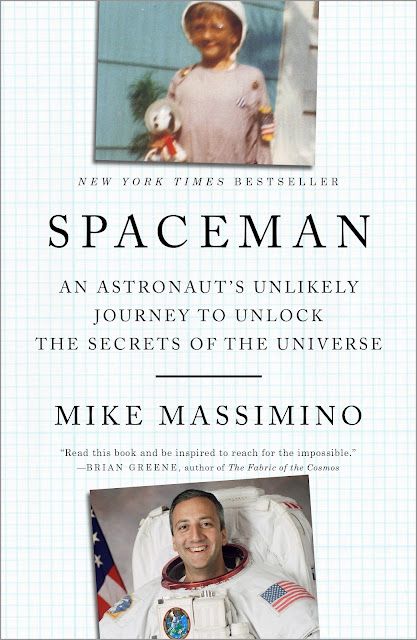
"Spaceman" by Mike Massimino--Nonfiction Review

So I’ve been pretty clear on this blog before about how much I love space, which is why today we’re talking about Mike Massimino’s “Spaceman.”

Mike Massiminio


What I love about this book:

Clearly, the space stuff is my top love for this book. Massimino was part of the tail end of the generation of astronauts who flew in the space shuttle, which I’m not too proud to admit I don’t know as much about as the earlier programs. So it was nice to get to know the names and missions that happened during his time at NASA.

Most of this book is about his journey to become an astronaut. I hadn’t realized this before he pointed it out, but, unlike most career paths, there are no well-known tracts to take to become an astronaut. So it’s nice that he put it down how he did it, for all the advice he provides.

Massimino is a charmingly warm and often funny guy. I went in for the audiobook version—per usual—and it’s read by him. I know I belabor this point a lot, but especially in this, hearing the tone of his voice as he relates some of his personal disappointments and some of the tragedies to befall NASA immeasurably adds to the experience.

Getting his first-hand account of what it was like to work on the Hubble telescope was endlessly fascinating to me. It cannot be adequately expressed how much that orbiting telescope has given us, so it’s incredibly important. Working on it in space sounded equally amazing as it was terrifying.


What I don’t love about this book:

There isn’t much I didn’t love about this memoir. It’s firmly in my wheelhouse, after all. If I had to say something, maybe an argument could be made that it dithers a little bit too much before getting into the meat of the NASA stuff. That isn’t too serious of a criticism, though, because I enjoyed Massimino’s journey becoming an astronaut almost as much as I enjoyed him as an astronaut.

The Space Shuttle Columbia disaster was hard to read about and thus relive. When the Challenger exploded during the launch, that disaster happened before I was born, but I was in middle/high school when Columbia happened. So the tragedy of that event when it happened still sticks in my mind, and the old feelings of disappointment that NASA, an organization I idolized, didn’t do enough to keep that crew safe resurfaced. That they dropped the ball on the dangers of free-falling foam debris from launch and how it could damage the orbiting vehicle.


This preview is an Amazon Affiliate link; 
as an Amazon Associate, I earn from qualifying purchases.

Author’s Website: https://www.mikemassimino.com/


Parting thoughts:

Space exploration is inherently dangerous and expensive. There are many solid arguments for why we shouldn’t bother with this exercise. How to justify the cost monetarily and, more importantly, in lives lost is tricky. Why spend billions of dollars on space exploration to send a handful of people to space while millions of people are starving right here on Earth.

What Space exploration is ultimately about is investing in the next step for our species, for the next generation’s future. It’s about the billions and billions of people yet to be born who could one day lead a better existence beyond the confines of the Earth. 

The Earth, as wonderful and beautiful as it is, is a closed system. We keep adding more and more humans to that closed system without increasing the fixed amounts of resources and livable area. The idea that we’re somehow going to collectively agree to stop creating too many people globally and then create rigidly sustainable utopias out of our various bickering and competing cultures in the near future demonstrates a lack of awareness of human history in my mind.

At this point in our societal and social evolution, we should do what we have always done collectively when faced with shortages of livable space, opportunity, and resources. We should move on and spread out.

Crossing the oceans at one point seemed like an impossible technical feat to our ancestors, yet, they eventually managed it. It wasn’t safe, and it wasn’t cheap. Many people died for the dream of seeing over that next horizon. But in the end, it was necessary.

Let’s be clear about this point: our shameful legacy of appalling poverty, sickness, famine, and war wasn’t caused by NASA’s budget. Our poorest citizens, again globally, are so poor because we’re still collectively beholden to a wealthy and privileged ruling caste. We might not call our billionaires princes, princesses, dukes, or duchesses anymore in the United States, but that doesn’t mean they don’t exist. 

Most of the world’s wealth belongs to a few individuals—a lot of it is inherited wealth that wasn’t earned in any meaningful way by the so-called elites of our various human societies but is merely passed down. That is the real insidious reason most of us toil from the cradle to the grave.

I wish that we were collectively wise enough to conserve the Earth and do so in a way that we could all live reasonably equitably on it and happily. But wishing reality was different doesn’t make it so, and realistically what I believe our next step is—is to chase that next frontier, the last and final one above us all. 

Friday, November 12, 2021

"Hidden Figures" by Margot Lee Shetterly--Nonfiction Review

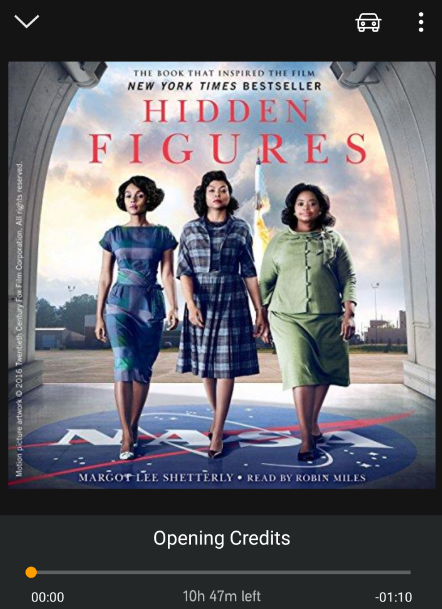
We're doing another space book, Obscurists. Well, sort of, it is more a history of NASA and some of the most talented women to ever work there whose contributions were sadly mostly forgotten until recently. Today's book is "Hidden Figures" by Margot Lee Shetterly.


Margot Lee Shetterly


What I love about this book:

So I'm a big lover of all things space—I'm not so crazy that it's become the playground of billionaires—but still, I love the history of the space race and the ambition and talent that drove NASA forward. I love this book because it shines a light on the contributions of black women who participated, immensely, it turns out, to our success in space.

"Hidden Figures" isn't just a history of NASA's earliest days during the Mercury missions but primarily a biography of Katherine Johnson, Mary Jackson, and Dorothy Vaughan. It shows how all three black women—and more like them—contributed mathematical prowess in the computing departments and engineering expertise in Jackson's case. All of this was at a time when women, in general, were typically discriminated against in the workplace.

Racial prejudice is focused on in far greater intensity in the movie based on this book than the book itself. I'm in no way trying to suggest that it didn't exist back then or that it didn't exist at NASA, and I'm sure these women were faced with that ugly truth. After all, black people don't get to stop being black ever, not for one moment. We should live in a world where color doesn't matter, but that goal has yet to be achieved. 

What I mean is this book reaffirms NASA's core value of excellent research above all else. Any skilled person can describe a good idea or the truth about nature, regardless of uterus status or skin color. That is and always was, most important at NASA. While admitting there were still segregation laws in force at NASA, Katherine Johnson even said that she personally didn't feel it during her time there because the mission was most important at work. I'm paraphrasing from this quote: "... didn't feel the segregation at NASA, because everybody there was doing research. You had a mission and you worked on it, and it was important to you to do your job ... and play bridge at lunch." She added: "I didn't feel any segregation. I knew it was there, but I didn't feel it."

  1.  "Katherine Johnson Interview: NASA's Human Computer" HistoryvsHollywood.com. CTF Media. 2016. Archived from the original on March 3, 2017. Retrieved March 2, 2017.


What I don't love about this book:

The movie focuses on the racial element of the story pretty hard because it's a reliable story beat to gain audience support—at least a certain non-racist audience—but in doing so, it miss characterizes this book, in my opinion. Sure, generally, the past in the late '50s and the early '60s overall had a more in-your-face sort of race problem. However, telling the story of these women as a way of saying they succeeded despite the old racists at NASA is kind of disingenuous and lazy. NASA was a pretty progressive place back then, maybe not to our standards today, but still, the Mercury missions took place on the tail end of the Jim Crow era. The idea that black people and women, too to boot, were trusted with genuine, hard, and necessary—life or death work was radical for the day. 

So the actual shameful thing—the real no-joke insidious racism—that this book points out is how we just forgot these women, who they were, and what they did. It's insidious because of its banality. Women like Johnson, Jackson, and Vaughan were always there up to the modern era. They just weren't given any sort of visibility to the public, in either the media or in popular movies—movies I like which saddens me to no end.

The Hollywood movie is the way that it is, in my opinion, because we like to see the past being somehow less enlightened on this front—across the board—and that we, the wise non-racists, have grown and transcended this problem. Except that's bullshit, and we haven't. We're just much more sensitive to being called out for when we're doing some racist shit. Ignoring the contributions of some, belittling them, denying them representation or just plain apathy toward an ethnic group is, in fact, racist.

Where I am going with this point is that this book's quality that makes it feel like a revelation isn't a good thing as the movie version supposes. It isn't a breath of fresh air, some grand rediscovery—it's a goddamn American tragedy. The idea that we as a society tacitly allowed the perception that NASA employed nothing but exclusively white dudes with pocket protectors from the flight director all the way down to the janitor and no one else—is as tragic as it is wrong.


This preview is an Amazon Affiliate link; 
as an Amazon Associate, I earn from qualifying purchases.


Parting thoughts:

So for my parting thoughts, I'd like to shift gears here. Recently, it has become fashionable, we'll say, for some groups of Americans to vocally and stupidly claim that we never landed on the moon—and also that the Earth is flat. I don't know, probably.

This is one of those things like Mr. McConaughey's character in "Interstellar" that instantly gets under my skin and annoys me. On the face of it, not only is it wrong, with nearly every country verifying that our radio signals from the Apollo missions came from the moon. Countries including Russia, who was famously competing with us at the time to do just that. Not only is it a denial of the single greatest technological feat we as Americans have ever accomplished, including the atomic bomb, and that there are literal mirrors on the moon that we still use in experiments today left by the Apollo astronauts. It is a slap in the face of every brilliant American astronaut, scientist, engineer, mathematician, and physicist who sacrificed so much, sometimes their very lives, to accomplish that dream.

This insult typically comes from the same group of people who can't even spell algebra, let alone pass it in high school. So why do they insist on their factually wrong position and that we take their non-expertise as valid? I've meditated on this point for a long time, and I believe the answer is actually quite simple.

They are Americans who hate America.

That is a loaded and admittedly inflammatory statement that requires qualification—which I will provide. More precisely, they hate America as it is, and as it always has been, which is a broad land of immigrants from all corners of the Earth, with different skins, beliefs, religions, and languages cohering together as one society. They do, however, love their imaginary America that they've constructed in their mind. An America that was somehow uniformly white, Christian (whichever brand they subscribed to), and the reason that there are literally any problems whatsoever is that we've gotten away from that.

There is this sick love for conspiracy where there is no conspiracy. Instead of admitting that maybe their lives are mediocre because they are, in fact, mediocre. They've never taken the time or effort to change that about themselves. Instead, they invent cabals of satan worshiping pedophiles that somehow hold back their natural all-white awesome American-ness.

The denial of the moon landing stems from the same poisoned fruit that we couldn't possibly have succeeded at such a challenge because the people who did it weren't pure as defined by some wackjob. The people who did the work, the math, the planning, and took the risks to make it possible were diverse in ethnicity, gender, and religion.

And that has no place in their imaginary America. So it didn't happen.


Monday, September 20, 2021

Micro Mention "Hidden Figures"

Margot Lee Shetterly


I recall many an idiotic conversation where it was positioned to me that black men and women just don’t contribute as much. An immediate refutation to that is Margot Lee Shetterly’s “Hidden Figures,” the book that inspired the excellent movie.

These women did their jobs as part of our fledgling space program, not just as good as white men and women but often better. The pressure to be accepted at the table was incredibly immense because not only were they women when women were treated as inferiors but also black when a lot of whites didn't consider them even people.

The truth of the matter is we wouldn't have just been poorer as a nation without the contributions and insight of people like Katherine Johnson, Dorothy Vaughan, and Mary Jackson—but poorer as a species. A fine mind can rest in the skull of any person, of any race, gender, or sexual preference. To pretend otherwise is as childish as it is willfully stupid.


This preview is an Amazon Affiliate link; 
as an Amazon Associate, I earn from qualifying purchases.


Friday, February 7, 2020

"Failure Is Not an Option," by Gene Kranz--Nonfiction Review

Morning my dear, dear internet strangers, this Friday, we’re doing another non-fiction review. We’re establishing a pattern here, like serial killers. Today’s review is of “Failure Is Not an Option” by Gene Kranz.

It’s the book about space, specifically about when we went to the moon. I bring this up because, after just a cursory search, there are like four other books with this exact title. So just remember, we’re not talking about retirement or self-esteem or whatever—we’re going to the moon, Alice, to the moon! I heard that in an episode of Futurama and can’t possibly imagine it could be a reference to anything else—ever.  

Gene Kranz


What I love about this book:

Let’s get the obvious done right away. It’s got space stuff, and like I’ve said before, I love me some space stuff. The author, by the way, Gene Kranz, is one of the ultimate insiders in the early days of NASA. He was the flight director on not just Apollo 11 but also Apollo 13. Also, he was the guy in a white vest played by Ed Harris in the Ron Howard movie, also called Apollo 13—go figure. So he’s the man, as in the man in charge during some of the most significant moments in early space flight.

I love that this book takes you sequentially through the early days of the Mercury, Gemini, and, finally, the Apollo programs. Kranz breaks down the three early space programs, from the technology they used to their specific objectives. In Mercury, the first, we here in the United States were playing catch up in just getting an American astronaut into space, orbit the earth and getting him back down again. This goal was compounded by the problem that we were still getting over our “everything just blew up in a fiery ball of hellfire” phase of rocketry. Gemini was different in that all of its objectives, as a program, were to be a proof of concept that would prove the Apollo program was possible. Finally, Apollo, the program everyone knows, is where we actually landed on the Moon.

In addition to all that—the author also tells the very human stories behind the men and women who fought for, sacrificed for, and tragically in some cases—died for the dream of setting foot on another world separate from the Earth. It’s great to remember how Neil Armstrong stepped foot—for the first time ever—on land that was not from our world. However, it’s far less pleasurable to remember how “Gus” Grissom, Ed White, and Roger Chaffee died on the launch pad during a plugs-out test of Apollo 1. Their sacrifice is just as necessary to remember, in my opinion.

It isn’t all heroic pioneering stories or tragedy laced accidents, you learn interesting things about the people who lived and worked at NASA. For instance, Gene Kranz himself is a judo aficionado, something he got into because of a coworker and as a way to blow off steam. There are plenty of interesting little details about the people who actually lived through these events, and it isn’t all sterile facts about rockets and capsules.         


What I don’t love about this book:

Kranz is a wealth of information, and that’s a good thing—but he does tend to get bogged down in minutia. He doesn’t just know exactly what part or piece of machinery was used during a particular mission, but what he wrote on forms and memos to his superiors. This level of detail isn’t all that fascinating. It is a little amusing that either his memory is just that good or his level of personal notes that he kept was that complete, but the actual details themselves can get tedious. For me, it’s a blurry line of when he crosses over from being thorough to too much, a choice much like how many Reeses peanut butter cups are too many Reeses, never all the Reeses, eat all the Reeses!

He also has a tendency to talk around events, restating certain pieces of information multiple times before diving in directly with what actually happened. Overall, the whole book feels a bit overly long, and each story he tells could be tightened up and edited down.


Parting thoughts:

I believe that landing on the moon was the single greatest moment in human history—up to this point. It was one of those few moments in human history where we did a thing not for basic biological needs, or purely out of cynical socioeconomics. True, it is impossible to say that we weren’t motivated to beat the Russians there, because yes, that competition is what pushed us, in the United States, over the top. However, I don’t believe we did it purely just to say we did it before the Russians, we did not spend billions of dollars, people did not dedicate their lives and in some cases die, just for bragging rights. We did it because it had never been done before. We went somewhere no one had ever been before to go see what was out there. It was that adventure that thirst for exploration that drove us to go to the moon.

Like everything, though—as a society, we’ve become complacent with the idea that we’ve been to the moon. Everything loses mystique eventually, and I find most people just take it for granted, like sure they personally haven’t been there but they know someone has, a lot like they probably rationalize they haven’t been to Madagascar but someone clearly has been there. My point is this complacency saps enthusiasm, motivation, and those are the very qualities that got us there when our best computers couldn’t even be considered a useful calculator today. Like the man said, it was a hard choice to go to the moon. Every time we slash NASA’s budget to go fight another endless war over hydrocarbons, it becomes easier to not make that choice going forward. Why is this important? What has space exploration ever given us for how much it costs? The thing you are reading this blog on can trace its genesis back to the technologies NASA first pioneered and helped to develop directly and indirectly. The GPS you use to find your Aunt Sally’s house in Maine likewise comes from the same family of technology.

There is another class of people who go a different way than just run of the mill indifference. They outright deny that we ever made it to the moon. First off, even the Russians admitted it at the height of the cold war—we were not friends at the time, and they would have literally zero reasons to lie about this. That aside, this is one of those few conspiracy theories I narrow my eyes at immediately. Usually, I’m indulgent in listening to dumb conspiracy theories, bring on the ancient Aliens, but on this point—denying possibly one of the greatest achievements our species will ever attain—I become suspicious. I’m under no illusion that mostly this is a visceral emotional reaction on my part and therefore not totally rational. But when someone tells me that the moon landing was faked, I wouldn’t be all that surprised if, in their next breath, they tell me about their pet theory of how the holocaust was a hoax.